
Canadian SMEs Reshore Production as Trade War Drags On, But Experts Warn Transition Won't Be Easy
MONTREAL — With no end in sight to the escalating Canada-U.S. trade war, a growing number of small and medium-sized businesses are making the difficult decision to bring production back to Canadian soil, even if it means swallowing higher costs in the short term. The move comes as the fede
Canadian SMEs Reshore Production as Trade War Drags On, But Experts Warn Transition Won't Be Easy
MONTREAL — With no end in sight to the escalating Canada-U.S. trade war, a growing number of small and medium-sized businesses are making the difficult decision to bring production back to Canadian soil, even if it means swallowing higher costs in the short term.
The move comes as the federal government in Ottawa prepares to roll out a $7.5 billion support package for affected workers and businesses, and as retaliatory tariffs on hundreds of U.S. imports are coming into force. For many entrepreneurs, the calculus has shifted from simple cost-efficiency to long-term survival and sovereignty.
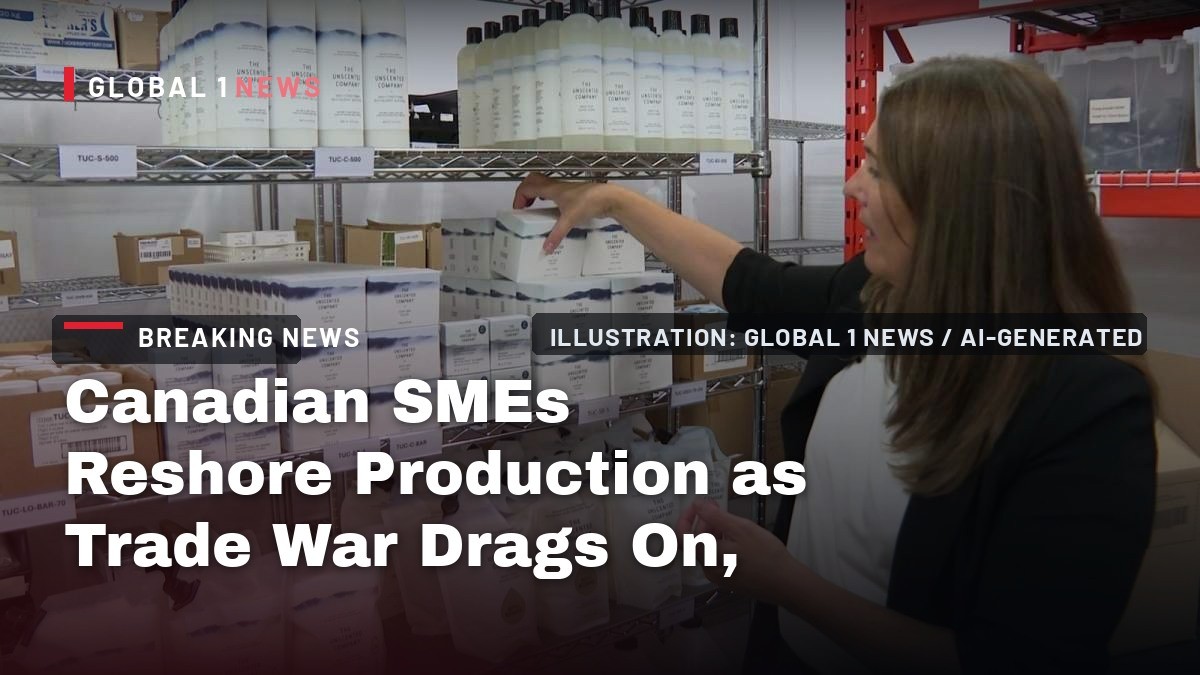
Anie Rouleau, founder and CEO of The Unscented Company, a Montreal-based home and body care business, said the decision to stop contracting soap production to a Vermont manufacturer was not made lightly. The company had a strong relationship with the American firm, but the financial reality of the current trade dispute made it untenable.
“I love my manufacturer in Vermont. He was perfect, but we could not afford having an American flag on one of my products,” Rouleau told Global News.
Rouleau said she recently crunched the numbers and found the current round of tariffs would cost her company $150,000 by the end of 2026. That figure, she said, was significant enough to force a strategic pivot.
“It is significant enough to have a plan. So now we actually are executing our plan,” she said.
A Shift Toward Local Sourcing
The Unscented Company already produces 80 per cent of its stock in Canada, but some of its ingredients are sourced from around the world, including from the United States. Rouleau said she is now committing to more local sourcing, a move that will initially strain her bottom line.
“When you make that decision to produce here in Canada, you’re obviously making it more expensive for a while until you build your volume,” she said. “But I’m willing to postpone profitability to make sure we produce here and to create a solid and sustainable economy.”
Her sentiment is being echoed across the country. On Wednesday, Chapman’s Ice Cream, a family-owned company based in Markdale, Ontario, announced it was on track to convert more than 70 per cent of its ingredients from U.S. sources back to Canada or other countries.
Last year, the company said it would absorb “all immediate increases in our costs” as U.S. President Donald Trump handed down the first round of tariffs on Canadian goods. This week, Ashley Chapman, the company’s chief operating officer, said on social media that customers will not face a price increase on Chapman’s ice cream until March 2028.
“Not only have we managed to keep our component costs the same, but we have also partnered with other Canadian companies to reshore production of some items that have never been produced in Canada before,” she said.
The Complexity of Reshoring
While the enthusiasm for domestic production is understandable, supply chain experts caution that the transition is far more complicated than simply moving a factory across the border. Saibal Ray, the chair of supply chain management at McGill University in Montreal, said there is no harm in trying to move more of a company’s supply chain back to its home country, but the process is more convoluted than many may think.
“Because of NAFTA and CUSMA, supply chains were so integrated across the three countries, we have not developed competency in certain things because that was not needed,” Ray told Global News. “The competency was somewhere else.”
He said this is particularly true for small and medium-sized businesses that have become specialized in a particular part of the supply chain. Unlike large multinationals, SMEs rarely have the capacity to vertically integrate their entire production process.
“For SMEs to do everything themselves at a scale, is absolutely impossible. It is impossible even for big companies, but for SMEs, it’s absolutely impossible,” Ray said.
He credits Canadian businesses for proactively searching to domesticate their supply chains, but said the transition won’t happen overnight. The infrastructure, skilled labour, and raw material inputs needed for many products simply do not exist yet in sufficient quantity in Canada.
“We have to be a little bit more strategic, where we can bring in onshoring things,” he said. “It is much more difficult and much more expensive than people think it is.”
Federal Support and Retaliatory Measures
The federal government has acknowledged the strain on businesses. On Aug 25, 2026, Ottawa announced 50 per cent retaliatory tariffs on hundreds of U.S. imports, with the Department of Finance saying Canada will go dollar-for-dollar against American measures. This follows the collapse of trade talks on Aug 21, which triggered 50 per cent U.S. tariffs on roughly $20 billion of Canadian goods.
To cushion the blow, the federal government introduced a $7.5 billion package of new and enhanced measures to protect Canadian workers and businesses, building on nearly $25 billion in supports over the past 18 months. The funding is intended to help firms like The Unscented Company and Chapman’s Ice Cream manage the transition, though details on how quickly funds will flow to SMEs remain unclear.
Provinces are also taking action. Saskatchewan Premier Scott Moe said the province would impose a 50 per cent tariff on U.S. alcohol starting next month, a move designed to pressure American producers while signalling solidarity with Canadian manufacturers.
What It Means for Consumers
For Canadians watching their grocery bills, the reshoring push offers some reassurance, at least for now. Chapman's Ice Cream, one of the country's best-known family brands, has said customers will not face a price increase on its products until March 2028, even as the company absorbs higher component costs and works to convert more than 70 per cent of its U.S.-sourced ingredients.
Other businesses may not have the same flexibility. Rouleau acknowledged that producing in Canada will be more expensive "for a while" as her company builds volume, and supply chain experts caution that the full cost of bringing production home will take years to work through the system. For consumers, that could mean higher prices on some goods as companies weigh whether to absorb costs or pass them along.
A Long-Term Strategic Imperative
Despite the difficulties, Ray said the current crisis presents an opportunity for Canada to build resilience. With animosity between the leaders of Canada and the U.S. showing no signs of abating, he said only good can come from developing more internal capabilities.
“We have to develop capability over the years,” he said. “Otherwise, again, we will face this problem down the road.”
For Rouleau, the decision to reshore is as much about values as it is about economics. She has said she is willing to postpone profitability while the company builds volume, describing the shift as an investment in a solid and sustainable Canadian economy.
As the trade war grinds on, the question for many Canadian SMEs is no longer whether to reshore, but how quickly they can do so without breaking their businesses in the process. The answer, according to experts, will require patience, strategic planning, and continued government support.
Tags: Canada-U.S. trade war, reshoring, supply chain, SMEs, The Unscented Company, Chapman's Ice Cream, tariffs, manufacturing, Montreal, Markdale, Ontario, McGill University, Department of Finance, Saskatchewan, Scott Moe
By Alex Thompson, Staff Writer
This article was produced with AI-assisted research and editorial support. Sources: Global News Canada, The Guardian, BNN Bloomberg, CP24, Department of Finance Canada.
What's Your Reaction?
 Like
0
Like
0
 Dislike
0
Dislike
0
 Love
0
Love
0
 Funny
0
Funny
0
 Wow
0
Wow
0
 Sad
0
Sad
0
 Angry
0
Angry
0

Canada Correspondent at Global1.News. Based in Toronto, covering Canadian politics, energy, trade, and US-Canada relations. Provides the Canadian perspective on North American and global affairs.














Comments (0)