
Ben-Gvir Temple Mount Visit Tests Jerusalem Status Quo
Ben-Gvir Leads Thousands to Temple Mount for Tisha B'Av Thousands of Israelis gathered at one of Jerusalem's most sensitive holy sites this week, marking a Jewish holiday in a manner that has once again placed the city's fragile arrangements under intense scrutiny.
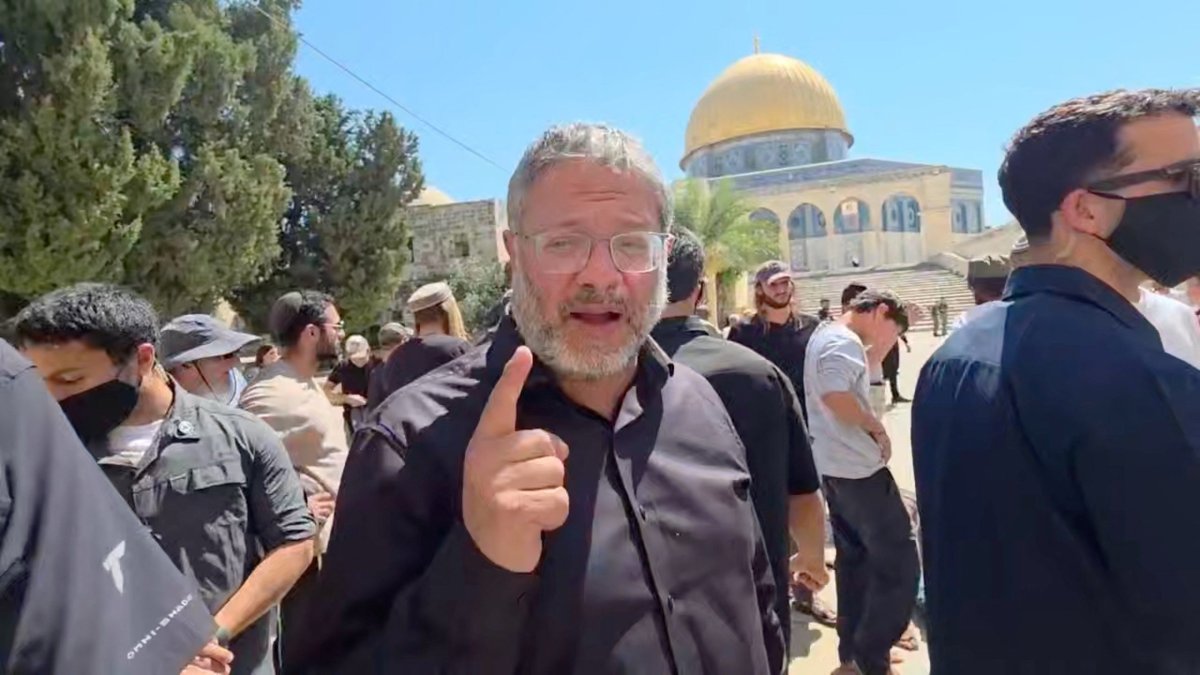
Thousands of Israelis gathered at one of Jerusalem's most sensitive holy sites this week, marking a Jewish holiday in a manner that has once again placed the city's fragile arrangements under intense scrutiny.
Ben-Gvir's Temple Mount Visit Sparks Fresh Debate Over Jerusalem Access
Jerusalem – July 23, 2026 — Israeli National Security Minister Itamar Ben-Gvir led more than 3,200 Israelis into the Al-Aqsa Mosque compound on Thursday to mark Tisha B'Av, according to Daily Sabah reports and statements from the Jerusalem Governorate. The visit, which included collective prayers and the raising of an Israeli flag, has drawn sharp reactions from Palestinian officials and raised questions about the durability of long-standing arrangements at the site.
The Scale of the Tisha B'Av Gathering
Participants entered the compound in groups of up to 150, with entries beginning in the morning and continuing after noon prayers, the Islamic Waqf Department noted. Videos circulated showing visitors praying opposite the Dome of the Rock and singing Israel's national anthem under police presence. Likud lawmaker Amit Halevi joined the group. Israeli authorities framed the day as a religious observance tied to Jewish historical memory of the ancient temples that once stood on the site, which Jews refer to as the Temple Mount.
Restrictions on Palestinian Worshippers
Israeli forces limited Palestinian access, allowing only a small number of worshippers to reach the mosque for dawn prayers, according to the Jerusalem Governorate. Several were reportedly turned away or faced confrontations. The Governorate described the overall events as a dangerous escalation and a clear departure from established practices that have governed the compound since 1967.
The 1967 Status Quo and Its Evolution
Following the 1967 war, Israel and Jordan reached an understanding that preserved Muslim religious authority at the site while permitting limited non-Muslim visitation. This framework, later referenced in the Oslo accords, prohibited organized prayer by non-Muslims and maintained the Waqf's administrative role. Over the years, incremental changes in visitor numbers and security protocols have tested these rules, with critics arguing that larger organized entries risk altering the balance.
Domestic and Regional Reactions
Peace Now called the events a dangerous provocation and a blatant violation of the fragile status quo, pointing to support from ministers including Bezalel Smotrich and Orit Strock. Palestinian officials condemned the flag-raising and collective prayers as direct challenges to existing understandings. Jordan, which serves as custodian of the holy sites under its 1994 peace treaty with Israel, expressed concern that such actions undermine the longstanding arrangements and could complicate bilateral ties.
Strategic Implications for Stability and Normalization
The episode arrives at a delicate moment for regional diplomacy. Countries that have joined the Abraham Accords have emphasized economic and security cooperation while avoiding direct entanglement in Jerusalem's religious disputes. Large-scale visits accompanied by visible national symbols risk energizing hardline voices on multiple sides and narrowing the space for quiet diplomatic management. Analysts note that sustained escalation could slow further normalization talks and place additional pressure on Jordan's role as mediator.
Outlook for Diplomatic Management
Both Israeli and Palestinian officials have channels to de-escalate through security coordination and back-channel messages. Past incidents have been contained when senior leaders on all sides signaled restraint. Whether this week's events remain an isolated flare-up or signal a broader shift will depend on how authorities handle subsequent holidays and visitor policies in the coming months. Continued adherence to the 1967 framework, even if imperfect, remains the clearest path to preventing wider regional spillover.
Historically, Tisha B'Av marks the destruction of the First and Second Temples, events that Jewish tradition links directly to the very ground now occupied by the Al-Aqsa compound. For many observant Israelis the date carries an almost magnetic pull toward the site, transforming a day of mourning into an assertion of historical continuity. Ben-Gvir himself has long treated such visits as political theater; he was barred from the compound for years after earlier attempts to pray there and has repeatedly declared that Jewish sovereignty must be exercised openly rather than negotiated away. Extremist settler groups had publicly floated a target of five thousand visitors this year, a figure that would have dwarfed previous organized entries and further strained the already thin line separating individual visitation from collective ritual.
These ambitions reflect a calculated strategy on Ben-Gvir’s part to normalize large-scale Jewish presence while testing the tolerance of both Israeli security forces and international observers. His past statements frame the Temple Mount not merely as a place of worship but as the ultimate symbol of national redemption, a stance that resonates with his political base yet alarms those who fear incremental erosion of the status quo. The gap between the announced target and the actual turnout of roughly thirty-two hundred therefore reveals both the limits of current mobilization and the persistent appetite for escalation among hardline factions.
Security analysts note that such numbers, even when falling short of the most ambitious projections, still represent a qualitative shift. When hundreds enter in coordinated waves, accompanied by visible national symbols and collective chanting, the distinction between private devotion and public demonstration collapses. This blurring carries immediate consequences for the delicate choreography that has kept the site from becoming a permanent flashpoint.
The Jerusalem Governorate’s official statement went further than generic condemnation, cataloguing specific Talmudic rituals observed during the visit—tefillin wrapped around arms and foreheads, repeated prostrations facing the Dome of the Rock, and synchronized chanting that echoed across the compound. These acts, the statement argued, constitute a deliberate attempt to import synagogue practices into a space whose Islamic character has been preserved for centuries. Waqf officials, who manage daily operations from dawn until closing, maintain strict protocols: non-Muslim visitors are expected to walk quietly, refrain from prayer, and avoid any physical contact with Islamic structures. The sudden appearance of organized groups performing Jewish rites therefore represents not only a religious affront but an administrative breach that the Waqf is powerless to prevent without risking direct confrontation with Israeli police.
The Governorate warned that continued tolerance of such scenes could ignite wider unrest across the occupied territories and neighboring states, potentially unraveling years of quiet diplomacy. Daily management by the Waqf involves meticulous coordination with Israeli authorities over opening hours, maintenance crews, and crowd control, yet these arrangements rest on an unspoken understanding that religious authority remains exclusively Muslim. When that understanding is publicly violated, the Waqf’s legitimacy among Palestinian worshippers erodes, creating pressure on Jordan to respond more forcefully in its role as custodian.
Regional actors are watching these micro-level changes closely, recognizing that administrative drift at the compound can quickly translate into strategic instability. The Waqf’s inability to enforce its own rules without external backing illustrates the structural imbalance that has defined the site since 1967 and explains why even seemingly minor alterations provoke outsized reactions.
The 2000 visit by Ariel Sharon to the Temple Mount is frequently cited as the spark that ignited the Second Intifada, yet the current episode differs in important ways. Sharon arrived with a large security detail and explicit political messaging; Ben-Gvir’s group operated under the cover of a religious holiday while still advancing the same sovereignty narrative. Both incidents exposed how quickly symbolic acts at the site can cascade into sustained violence. The 2015 metal-detector crisis, triggered by a terror attack at the compound, led to weeks of clashes after Israel installed security equipment that Palestinians viewed as an attempt to alter access arrangements; the equipment was eventually removed following Jordanian and American pressure. Similarly, the 2017 gate crisis, involving the installation of surveillance cameras and electronic gates, produced mass protests and temporary closure of the site before a negotiated rollback restored the previous equilibrium.
Each of these earlier crises was contained through a combination of quiet diplomacy and mutual recognition that neither side benefits from uncontrolled escalation. Israeli leaders eventually accepted that overt changes to security infrastructure risked broader regional fallout, while Palestinian and Jordanian officials refrained from mobilizing in ways that would close off future coordination channels. The pattern suggests that de-escalation remains possible when all parties calculate that preserving the fragile framework outweighs short-term political gains.
Nevertheless, the cumulative effect of repeated challenges has narrowed the margin for error. What once required only back-channel assurances now demands more explicit commitments, and the political cost of restraint has risen on every side.
Egypt’s Al-Azhar institution issued a pointed statement condemning the organized prayers and flag-raising as direct assaults on Islamic holy places, language that resonates with its domestic audience and signals Cairo’s unwillingness to remain silent. Saudi Arabia and the United Arab Emirates have adopted a more restrained posture, monitoring developments through diplomatic channels while avoiding public statements that could complicate their own normalization trajectories. Turkey, by contrast, has amplified Palestinian narratives through state media, positioning itself as a defender of Islamic sites even as its regional influence remains constrained by economic pressures.
The Abraham Accords context adds another layer of complexity. Gulf states that established ties with Israel have consistently framed economic and security cooperation as separate from the Palestinian issue, yet large-scale incursions at Al-Aqsa test that separation. Quiet monitoring allows these capitals to preserve their strategic partnerships while retaining the option to recalibrate if domestic or regional sentiment hardens. The balancing act is delicate: too much criticism risks alienating Israel, while insufficient response invites accusations of abandoning Jerusalem.
Analysts therefore view the current episode as a stress test for the accords’ underlying premise that religious disputes can be ring-fenced from broader diplomatic progress. The outcome will depend less on immediate reactions than on whether future holidays produce similar scenes or whether Israeli authorities reassert tighter control.
Israeli security assessments suggest that sustained large-scale visits could trigger rocket fire from Gaza or coordinated protests across the West Bank, particularly if Palestinian factions interpret the events as evidence that the status quo has already shifted. Hamas and Palestinian Islamic Jihad have already issued statements framing the compound incursions as justification for renewed resistance, though their operational capacity remains limited by ongoing Israeli operations and internal divisions. Hezbollah’s posture on the northern front adds another variable; while the group has so far avoided direct involvement in Jerusalem-related flare-ups, any perception that Israel is altering the holy sites could provide pretext for low-level escalation along the Lebanon border.
The United States administration has so far confined itself to calls for calm and respect for existing arrangements, consistent with its broader approach of managing rather than resolving core disputes. Washington’s leverage is constrained by domestic political considerations and by the knowledge that public pressure on Israel often produces the opposite effect inside Israeli coalition politics. Still, quiet messages conveyed through security channels remain the primary instrument for preventing localized incidents from metastasizing.
The interplay between these actors illustrates how a single day’s events at one contested site can reverberate across multiple fronts, linking religious symbolism to calculations of military deterrence and diplomatic signaling.
By Malik Hassan, Staff WriterThis article was produced with AI-assisted research and editorial support. Reporting is based on sources cited in the article.
What's Your Reaction?
 Like
0
Like
0
 Dislike
0
Dislike
0
 Love
0
Love
0
 Funny
0
Funny
0
 Wow
0
Wow
0
 Sad
0
Sad
0
 Angry
0
Angry
0
Middle East Correspondent at Global1.News. Based in Beirut, covering politics, conflict, energy, and society across the Middle East. Brings context and depth to a region often reduced to headlines.











Comments (0)