
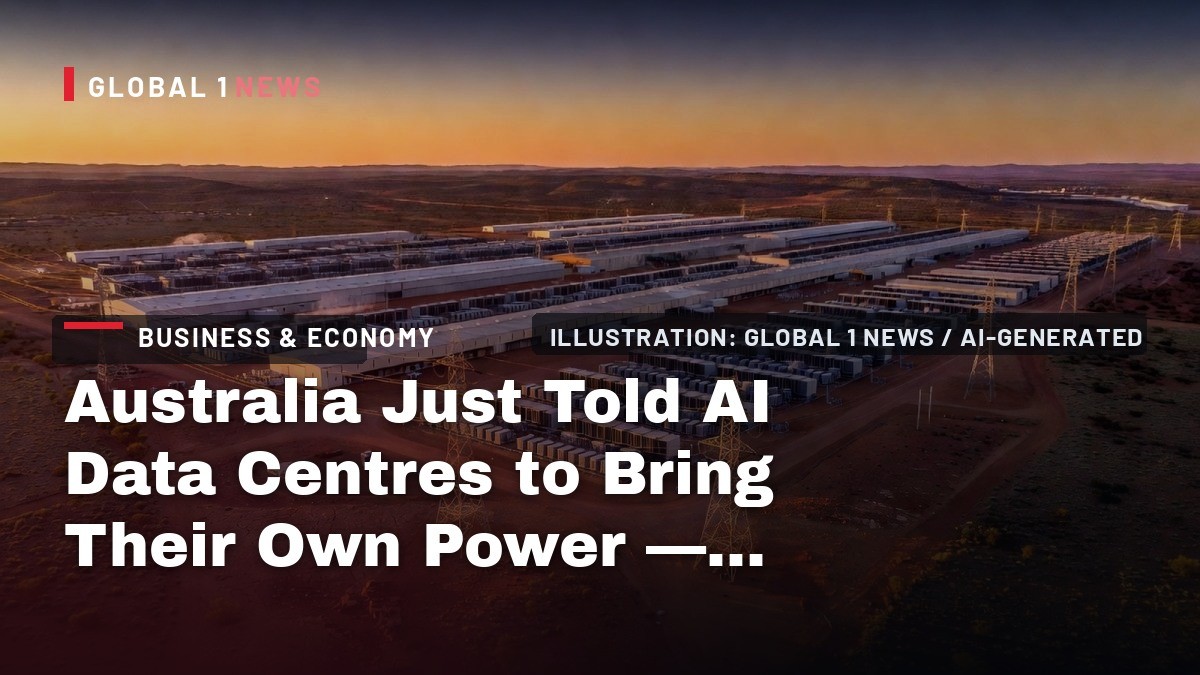
Australia Just Told AI Data Centres to Bring Their Own Power — and Then Backed Down Before the Meeting Ended
Australia's data centres are set to consume as much power by 2036 as every home in New South Wales and Victoria today. A hosting founder on the national rulebook, the renewables backdown, and what 'bring your own power' means for the industry.
Australia Just Told AI Data Centres to Bring Their Own Power — and Then Backed Down Before the Meeting Ended
Let me tell you something that's been sitting wrong with me all week. I've been running hosting infrastructure for over a decade, and I've watched governments around the world try to figure out what to do about the AI data centre boom. Most of them are still in the denial phase — they want the investment, they just don't want to admit what it costs. Then Australia went and did something different. It looked at the numbers, wrote a rulebook that said "you want gigawatts, you bring the gigawatts," and then — in a single National Cabinet meeting — backed away from the one part of it that would have made the whole thing real. That's not a policy story. That's a business story, because Australia just showed every other market how this ends.
The Forecast That Should Scare Every Grid Planner on Earth
Start with the numbers, because the numbers are the whole ballgame. The Australian Energy Market Operator — AEMO — published its 2026 electricity forecast on August 25, and it revised its data centre demand projections up by a massive margin in a single year. Under its central "Step Change" scenario, data centres will draw about 34 terawatt-hours from the national grid by 2035-36 — roughly seven times the 5 TWh they consumed last year, and almost as much as every household in New South Wales and Victoria combined uses today.
Here's the part that keeps me awake at night. AEMO counted 225 known data centre projects that want to hook into the national electricity market. A year ago, that number was 97. The pipeline more than doubled in twelve months. There are already 165 data centres operating across the National Electricity Market, consuming about 3 per cent of the power on the grid. In ten years, AEMO expects that to hit 13 per cent, even allowing for cancellations.
The Rulebook — What Albanese Actually Proposed
To his credit, Prime Minister Anthony Albanese didn't try to pretend this was nobody's problem. In mid-July, his government unveiled a national AI framework with something genuinely new: mandatory standards for large-scale AI data centres, with legal obligations on energy, water, and grid connections. The four headline obligations were the kind of thing I've been telling clients to prepare for for years. Pay the full share of your grid connection costs. Underwrite new power supply — not offsets, not certificates, actual new generation. Be a net-positive energy generator, contributing at least as much to the grid as you consume. And maximise water and energy efficiency. The government also announced a new AI Office and took a hard line on copyright — "not everything produced in Australia is up for grabs," Albanese told OpenAI and Anthropic.
Read those four obligations again, because they're the single most consequential regulatory shift I've seen in this industry. The core idea: a hyperscaler landing a 500-megawatt campus shouldn't get to treat the grid as a free public utility. If you want the power, you help build the power. The government even promised data centres won't drive up power prices for ordinary Australians — the public's single biggest fear. One climate expert put it bluntly: "We've got one shot to get the rules right."
The Backdown — Nine Governments, One Rulebook, and a Very Quiet Retreat
Then came National Cabinet on August 26. Nine governments — the Commonwealth plus every state and territory — met in Sydney and formally endorsed a nationally consistent rulebook for large data centres. Real progress: Australia moved from "every state does whatever it wants" to a nine-government commitment on energy, water, and land-use standards. But here's what didn't make it into the final communique: the requirement that new data centres be powered by renewables.
Queensland Premier David Crisafulli and the Northern Territory Chief Minister went into that meeting insisting their states should be free to power data centres with coal and gas. They came out claiming a win, and they're right to claim it. Albanese acknowledged it — "not all states are exactly the same," he said, and the "renewables only" demand was quietly dropped. Queensland, which has both cheap fossil fuel and a government that wants the data centre jobs, gets to keep burning coal and gas for AI. The rules aren't even finalised — there's another leaders' meeting later this year, and federal laws won't land until 2027.
Now, I get the political calculation. Both major parties want this boom to happen. The numbers are too big to walk away from: Microsoft has committed A$25 billion to Australian cloud and AI infrastructure by the end of 2029 — the largest single corporate technology investment in the country's history — and AWS is betting roughly A$20 billion. The Commonwealth Bank estimates the pipeline at around six gigawatts of potential capacity, about four times what was operational at the end of 2025, with a build-out worth around A$150 billion by 2030.
The Nuclear Brawl — When Energy Politics Eats the Policy
And that's exactly why the politics went sideways. Energy Minister Chris Bowen spent the week before the meeting laying down the law — all electricity used to power the plants would have to be more than offset by funding new renewable projects. His own colleagues nicknamed it "BYO renewable energy," and the conservative media hammered it as a farce. Then, when Queensland pushed back, the renewables mandate evaporated, and the Coalition's nuclear push — Peter Dutton's long-running plan to build seven reactors — suddenly looked less like a fantasy and more like the only politically viable alternative on the table. Bowen calls nuclear "a pipe dream" for data centres. The Coalition says renewables can't deliver the 24/7 power AI needs. Both sides are half right, and neither is building anything fast enough to matter. Here's the thing nobody in the brawl wants to say out loud: the fight over fuel source is a distraction from the real constraint, and it's the same constraint I keep writing about in every market from Texas to Ireland. It's not coal versus solar versus nuclear. It's the queue.
The Secondary Bottleneck Nobody's Talking About — the Queue and the Energy Vacuum
This is the part of the story the headlines miss. AEMO has disclosed eleven data centre projects representing 5.4 gigawatts moving through the transmission connection queue — about 60 per cent in New South Wales, 40 per cent in Victoria. The operator talks about a two-year connection target — in practice, those projects see firm power no earlier than 2028. Every day, more projects join the line. When the renewables mandate got dropped at National Cabinet, the government handed the energy-source question to the market — but the market can't fix a transmission queue by buying a different fuel. The poles and wires take a decade to build no matter what's at the end of them.
That's the real second-order risk for anyone who builds or operates in this industry. You can legislate "underwrite your own power" into existence, and you can even carve out exemptions for states that want to burn coal. But you cannot legislate a gigawatt into a transformer that doesn't exist yet. Australia will spend the next two years with a booming project pipeline and a grid that physically cannot connect most of it — and that mismatch, not the politics, is what decides which projects get built and which get cancelled. For every project that makes it, the interconnection costs get passed somewhere — and everyone who runs a smaller, existing facility pays more for the same electrons as the market tightens.
What This Means for Independent Hosting Providers
First — treat the Australian rulebook as the template for your market. Nine governments just agreed that large data centres should pay their fair share of grid connections and underwrite new generation. That idea isn't staying in Australia. The UK is already experimenting with demand-side charges, Ireland has a de facto moratorium, and Texas is fighting over who pays for transmission. If you're an independent provider, start modelling what a "bring your own power" obligation looks like for your cost base before a regulator does it for you.
Second — power contracts are the strategic asset now, not the afterthought. The single most valuable thing in any market right now is a signed, firm power agreement with a real interconnection date. Lock your rates and capacity now, because when hyperscalers start underwriting generation and paying for grid connections, those costs pass through to everyone who shares the network.
Third — site selection is regulatory arbitrage, and you should play it. Queensland just became the cheap-energy haven for AI because it can burn coal and gas without a federal mandate. The carve-out won't last forever, but while it does it will pull projects and customers toward it. Watch for the same dynamic in your region: the jurisdictions with settled energy rules and available transmission win the build-out.
Fourth — position as the capital-light alternative. When a 500MW hyperscaler campus has to underwrite billions in new generation on top of its construction costs, its pricing power goes up, not down. That's your opening. Independent providers who already have power, space, and a human on the phone become dramatically more attractive when the alternative is a decade of queue-jumping.
Fifth — apply announced-vs-realized discipline to everything you read. 225 projects in the pipeline, 5.4GW in the queue, A$150 billion of planned build-out — none of that is power in the ground. Don't build your capacity plan around the press release; build it around the interconnection date.
The Bottom Line
Australia just did something genuinely useful. It looked at its grid, counted the projects, and told the industry the truth: you want the boom, you pay for the power. Then it flinched on the one part that would have made the promise real, because Queensland wanted cheap coal and the politics got loud. That's not a failure of Australian governance — that's a preview of every market's AI reckoning, delivered a year early so the rest of us can watch.
The lesson isn't about renewables or nuclear. It's about the queue. You can fight about fuel forever, but the transformer is the bottleneck, and nobody's legislating a transformer into existence before 2028. If you're in this business, your job for the next two years is simple: secure the power, respect the timeline, and don't believe the gigawatts until you can touch them.
— Allan Ali, Founder
This article was produced with AI-assisted research and editorial support. Sources: ABC News (Aug 25-27, 2026), AEMO 2026 Electricity Statement of Opportunities, Bloomberg (Aug 26, 2026), Australian Financial Review (Aug 25, 2026), The Guardian (Aug 25-28, 2026), Reuters.
What's Your Reaction?
 Like
0
Like
0
 Dislike
0
Dislike
0
 Love
0
Love
0
 Funny
0
Funny
0
 Wow
0
Wow
0
 Sad
0
Sad
0
 Angry
0
Angry
0

Publisher of Global1.News. Automation architect, systems builder, and the guy making sure the truth gets published.











Comments (0)