
Abundant Mines plans landfill-powered Bitcoin mine near Mexico City
Abundant Mines is about to light up a new kind of power plant near Mexico City – a landfill‑gas‑fueled Bitcoin mine. Why a landfill? That distinction matters: if the gas is already being captured and burned, the marginal benefit of adding a generator drops dramatically.
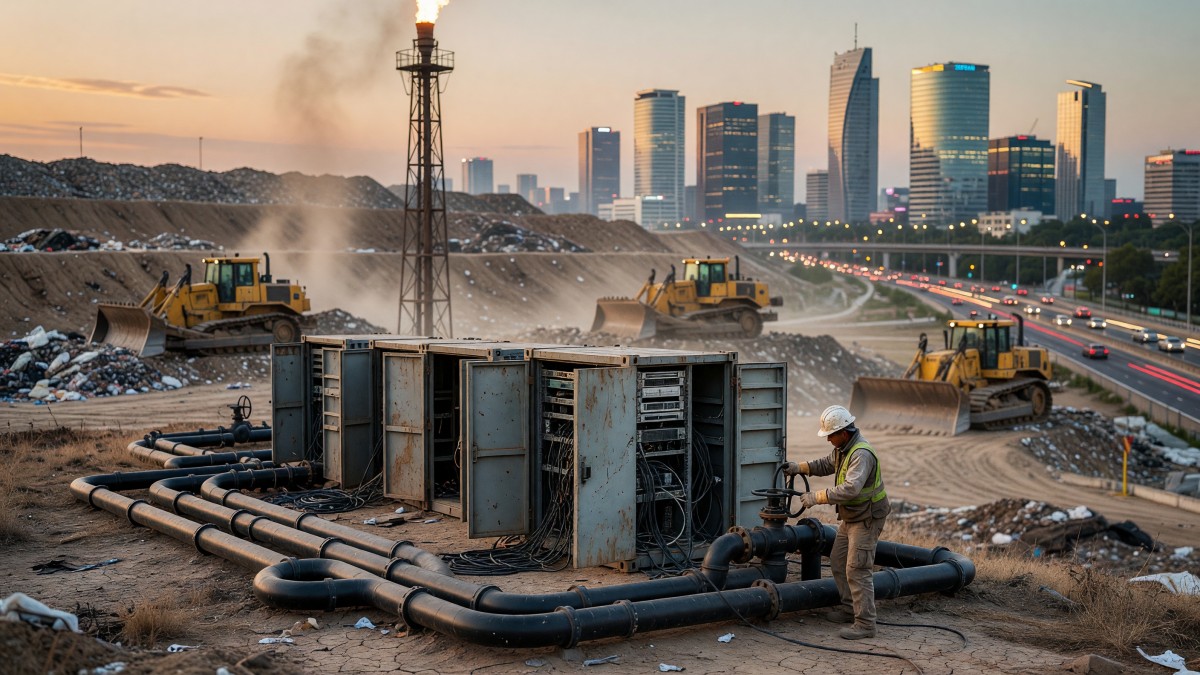
Abundant Mines is about to light up a new kind of power plant near Mexico City – a landfill‑gas‑fueled Bitcoin mine. The venture is being driven by methane‑mitigation specialists CH4 Capital and a local partner, Kardashev BTC, and it sits on the Relleno Sanitario Chicoloapan landfill, operated by Grupo Contadero. The whole thing is a textbook example of how “green” hype can mask a very pragmatic, and sometimes risky, business model for founders trying to squeeze every watt out of a marginal energy source.
Why a landfill? The economics of methane capture
Turner, co‑founder and CEO of Abundant Mines, says the site was chosen because methane is currently escaping into the atmosphere, not because it’s already being flared or piped to the grid. That distinction matters: if the gas is already being captured and burned, the marginal benefit of adding a generator drops dramatically. By targeting an uncontrolled emission source, CH4 Capital can claim carbon‑credit revenue while the miner gets cheap power.
The financing model is simple on paper. CH4 Capital funds the capture equipment, generators and mining rigs via loans to the operator. It then earns interest on those loans and pockets carbon‑credit income from methane destruction. The miner keeps the Bitcoin. In practice, the cash flow hinges on two variables – the consistency of gas flow and the price of carbon credits – both of which can swing wildly in emerging markets.
Capacity claims and the reality of scaling
The public numbers are a little fuzzy. In a LinkedIn post dated November 25, Turner floated an initial 2 MW plant with room to grow to 8 MW. CH4 Capital’s own project page lists a 4 MW first phase and says the landfill could ultimately support 8‑10 MW. The discrepancy is typical of early‑stage projects where the gas capture infrastructure is still being tuned. As Turner himself admits, “developing landfill‑powered sites requires substantial infrastructure and time to optimise gas collection.”
From a founder’s perspective, that means you’re betting on a ramp‑up period that can stretch months, even years, before you hit the advertised megawatt levels. During that window you’re still paying loan interest, maintaining generators and hoping the gas flow doesn’t dip below the threshold needed to keep the rigs humming.
Backup flares and the hidden cost of reliability
CH4 Capital’s operating model includes a backup flare to burn captured gas when the generators are offline. That’s a safety net, but it also underscores the fragility of a power source that depends on a biological process. Landfill gas generation can fluctuate with temperature, waste composition and even seasonal rainfall. When the gas supply dips, the flare kicks in, burning methane that could have powered the rigs and generating carbon credits, but it also means the Bitcoin miners go idle.
Idle rigs translate directly into lost hashpower and, for Abundant Mines, a hit to the Hashrate Redirect program that promises to shift spare capacity to customers experiencing downtime. If the fallback flare is used frequently, the whole value proposition erodes – you’re paying for a backup that doesn’t produce Bitcoin.
Carbon credits: a volatile revenue stream
CH4 Capital’s upside hinges on carbon‑credit income. The firm claims it earns revenue from “methane destruction” credits, a market that has been expanding but remains subject to regulatory shifts. In Latin America, credit pricing can be volatile, and the eligibility criteria differ from country to country. A sudden policy change could slash the credit value, leaving the loan‑financed infrastructure under‑funded.
For independent hosting providers watching this model, the lesson is clear: don’t rely on a single ancillary revenue stream to underwrite core capital costs. Diversify your income sources, or you’ll find yourself scrambling when the credit market hiccups.
Infrastructure overhead: the hidden capital burn
The landfill project isn’t just a generator and a few rigs. It requires a full gas collection system – wells, pipelines, compressors, gas‑cleaning units and continuous monitoring of flow and methane content. Turner notes that all equipment for the initial phase will be owned and operated by Abundant Mines, with “no client‑owned miners” on site. That ownership model pushes all cap‑ex onto the miner, increasing the balance‑sheet load.
From a risk‑management lens, that’s a double‑edged sword. Owning the hardware gives you control, but it also means you shoulder depreciation, maintenance and eventual replacement costs. For a startup, that capital intensity can be a choke point, especially if you’re also servicing loan repayments to CH4 Capital.
Comparative perspective: landfill power in data centers
The idea of powering compute workloads with landfill gas isn’t brand‑new. Earlier this year, DCD reported on UK data‑center developer Era4 planning a similar scheme in Kent. Those projects share the same promise – cheap, green electricity – but they also share the same operational headaches: gas variability, regulatory compliance and the need for on‑site generation assets.
The takeaway for us Caribbean‑based founders is that the hype around “green” landfill power often masks the gritty reality of building and running a power plant from scratch. If you’re looking to replicate the model, expect a steep learning curve and a long lead time before you see any meaningful return on investment.
Actionable takeaways for independent operators
First, treat landfill‑gas projects as long‑haul bets, not quick wins. Align your financing with a realistic ramp‑up schedule and build in buffers for gas‑flow volatility. Second, diversify revenue – don’t count on carbon credits alone. Pair the power source with other services, like edge hosting or hybrid cloud, to smooth cash flow.
Third, keep ownership decisions clear. If you take on the hardware, you also take on the risk of depreciation and maintenance. Consider joint‑venture structures where the capital burden is shared, especially when you’re still proving the gas supply model.
Finally, keep an eye on regulatory shifts in the carbon‑credit market. A policy change can swing your ancillary income dramatically, and you’ll want to have contingency plans ready.
Landfill‑gas Bitcoin mining is a clever way to monetize methane that would otherwise vent to the atmosphere, but it’s not a silver bullet for cheap power. As a founder, you have to weigh the operational complexity against the potential cost savings, and plan for the inevitable hiccups that come with turning waste into watts.
— Allan Ali, Founder
This article was produced with AI-assisted research and editorial support. Reporting is based on the source material cited below. Sources: Data Center Dynamics; datacenterdynamics.com; Global1.News (29 November 2026).
By Allan Ali, Global1.News
What's Your Reaction?
 Like
0
 Dislike
0
 Love
0
 Funny
0
 Wow
0
 Sad
0
 Angry
0

Publisher of Global1.News. Automation architect, systems builder, and the guy making sure the truth gets published.













Comments (0)