
8 countries condemn Israel's rejection of roadmap to end Gaza war
Eight countries on Sunday issued a joint condemnation of Israel's rejection of a roadmap designed to complete the implementation of US President Donald Trump's plan to end the Gaza conflict, warning that the move jeopardizes collective efforts to achieve lasting peace.
Eight countries on Sunday issued a joint condemnation of Israel's rejection of a roadmap designed to complete the implementation of US President Donald Trump's plan to end the Gaza conflict, warning that the move jeopardizes collective efforts to achieve lasting peace. The foreign ministers of Turkiye, Egypt, Indonesia, Jordan, Pakistan, Qatar, Saudi Arabia and the United Arab Emirates said Israel's position amounts to "a direct repudiation" of the Comprehensive Plan to End the Gaza Conflict, which was endorsed by UN Security Council Resolution 2803.
The joint statement, reported by Anadolu Agency, marks a significant escalation in diplomatic pressure on Israel from key regional and international actors. The ministers asserted that Israel's rejection "fundamentally undermines the collective efforts undertaken to achieve a just and lasting peace" and confirmed that Israel "now bears responsibility for obstructing the efforts to bring peace in Gaza and the rest of the Occupied Palestinian Territory."
Israel's Rejection and the Roadmap's Core Components
The roadmap in question, which has been accepted by Palestinian factions, was the result of extensive mediation efforts involving Egypt, Qatar, Turkiye and the US, alongside the High Representative of Gaza and the Board of Peace. According to the ministers' statement, the plan outlines a phased approach to stabilizing the enclave, including the decommissioning of weapons, the withdrawal of Israeli forces, the deployment of an International Stabilization Force, the transfer of administrative authority to the National Committee for the Administration of Gaza, and the reconstruction of the war-torn territory.
Israel's declared rejection of this framework, first reported by Channel 14, includes reservations over the role of the international force. The ministers warned that this refusal amounts to an explicit refusal to proceed with the implementation of Trump's plan and threatens to derail US efforts to end the war and establish conditions for lasting peace. The statement stressed the importance of "sustained and active US engagement" to ensure Israel's full compliance with the commitments and arrangements set out under the plan and roadmap.
Diplomatic Pressure and the Demand for US Engagement
The joint statement places significant responsibility on Washington to hold Israel to its commitments. The ministers urged the Board of Peace, with active US support and engagement, to take "immediate and concrete measures" within its mandate to preserve the integrity of the plan and prevent any party from obstructing its implementation. This language signals that the eight countries view the US as the primary guarantor of the plan's success, and that continued Israeli obstruction could strain its relationship with key Arab and Muslim-majority allies.
The statement also said Israel bears "direct and full responsibility" for consequences resulting from continued rejection, obstruction, delay or non-compliance, including any deterioration on the ground or disruption of efforts to end the war in Gaza. This is a pointed warning that the diplomatic track cannot be sustained indefinitely if Israel remains intransigent.
Two-State Solution and Palestinian Statehood
The ministers reaffirmed their support for Palestinian self-determination and statehood, categorically rejecting any attempt to deny or prevent the establishment of a Palestinian state, including through unilateral actions. The statement explicitly endorsed the two-state solution, calling for "an independent and sovereign Palestinian State based on the 1967 lines, with East Jerusalem as its capital."
This language is consistent with longstanding international consensus but carries particular weight given the current context. Israel's rejection of Palestinian statehood, as cited in the joint statement, represents a direct challenge to the foundational premise of the peace process. The ministers' categorical rejection of such attempts underscores the diplomatic isolation Israel faces on this issue, even among nations that have normalized or been considering normalizing relations with it.
Human Impact: Ceasefire Violations Continue
While the diplomatic statements were being issued, the reality on the ground in Gaza remained grim. On the same day, Israeli attacks killed at least one Palestinian and wounded several others across the Gaza Strip, marking further violations of the ceasefire agreement in effect since Oct. 10, 2025, medical sources told Anadolu Agency.
A Palestinian was killed and six others were injured when an Israeli drone struck a tent sheltering displaced people near Al-Aqsa University in the Al-Mawasi area west of Khan Younis. In central Gaza, several Palestinians were injured when an Israeli strike targeted the roof of a house in the Nuseirat refugee camp. A child was also shot and injured by an Israeli quadcopter drone east of the Bureij refugee camp.
These incidents highlight the fragility of the ceasefire and the continued dangers facing civilians, particularly those in makeshift shelters and refugee camps. The attacks came as mediators continued efforts to complete the implementation of the ceasefire agreement, underscoring the disconnect between diplomatic progress and the situation on the ground.
The Toll of War and the Stakes of Implementation
The human cost of the conflict remains staggering. The Israeli army launched an offensive in the Gaza Strip in October 2023 that has killed more than 73,000 Palestinians and wounded over 174,000 others, according to figures cited by Anadolu Agency. Despite the ceasefire, the Israeli army has continued attacks in the Palestinian enclave, killing at least 1,262 Palestinians and injuring more than 4,100 others since Oct. 10, 2025, according to Gaza's Health Ministry.
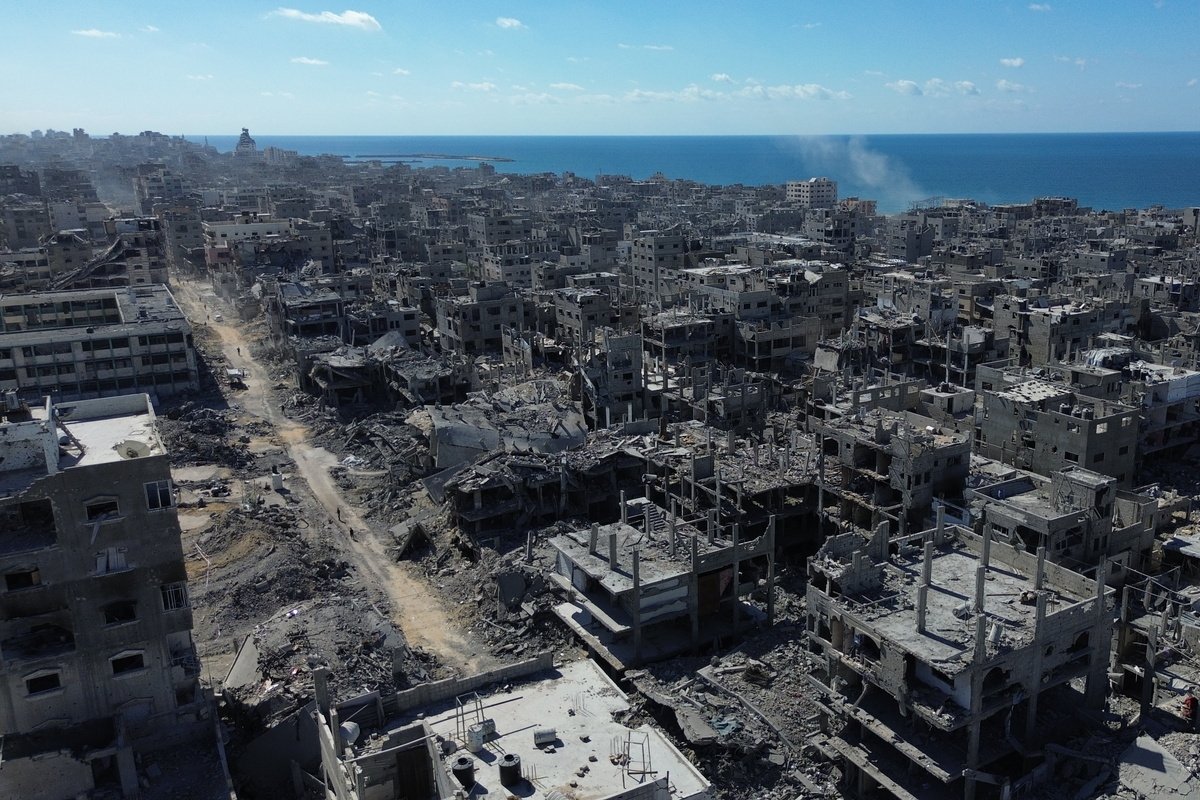
These figures, while stark, only partially capture the scale of the catastrophe. The destruction of civilian infrastructure, the displacement of hundreds of thousands of people, and the psychological trauma endured by survivors, particularly children, will have long-term consequences for Palestinian society. The roadmap's provisions for reconstruction and the transfer of administrative authority are therefore not merely political arrangements but essential steps toward enabling any semblance of normal life to resume.
Analysis: What the Diplomatic Pressure Means
The joint statement from eight countries represents a coordinated effort to hold Israel accountable within the framework of the US-led plan. By explicitly calling for sustained US engagement, the ministers are signaling that the success of the plan depends on Washington's willingness to exert pressure on Israel. This is a delicate balance: the US is both the architect of the plan and Israel's closest ally, and its ability to compel compliance remains untested.
The Board of Peace, a body established under the plan, now faces a critical test. Its mandate to implement the roadmap and advance the second phase of Trump's plan requires cooperation from all parties, including Israel. If Israel continues to obstruct, the board's credibility and the viability of the entire plan will be called into question.
For ordinary Palestinians, the stakes are existential. The roadmap offers a pathway to reconstruction, security and a political horizon. Its failure would mean continued occupation, violence and displacement. The ministers' warning that Israel bears "direct and full responsibility" for any deterioration on the ground is a clear acknowledgment that the window for a negotiated settlement is narrowing, and that the consequences of failure will be borne by those who have already suffered so much.
The coming weeks will be critical. The demand for "immediate and concrete measures" from the Board of Peace, coupled with the call for active US engagement, suggests that the diplomatic track is entering a decisive phase. Whether Israel will comply, and whether the US will enforce the plan's provisions, remains to be seen. What is certain is that the people of Gaza cannot afford further delay.
This article was produced with AI-assisted research and editorial support. Sources: Anadolu Agency, Middle East Monitor, joint ministerial statement by the foreign ministers of Turkiye, Egypt, Indonesia, Jordan, Pakistan, Qatar, Saudi Arabia and the UAE.
By Fatima Al-Rashid, Staff Writer
What's Your Reaction?
 Like
0
Like
0
 Dislike
0
Dislike
0
 Love
0
Love
0
 Funny
0
Funny
0
 Wow
0
Wow
0
 Sad
0
Sad
0
 Angry
0
Angry
0

Gulf/MENA Correspondent at Global1.News. Based in Doha, covering Gulf politics, energy markets, diplomacy, and development across the Middle East and North Africa. Tracks the economic transformation of the Gulf states.















Comments (0)