
3 Palestinians Killed in Israeli Drone Strike in West Bank
The occupied West Bank has long been a flashpoint, but the Israeli military's escalating tactics there are now drawing renewed international scrutiny.
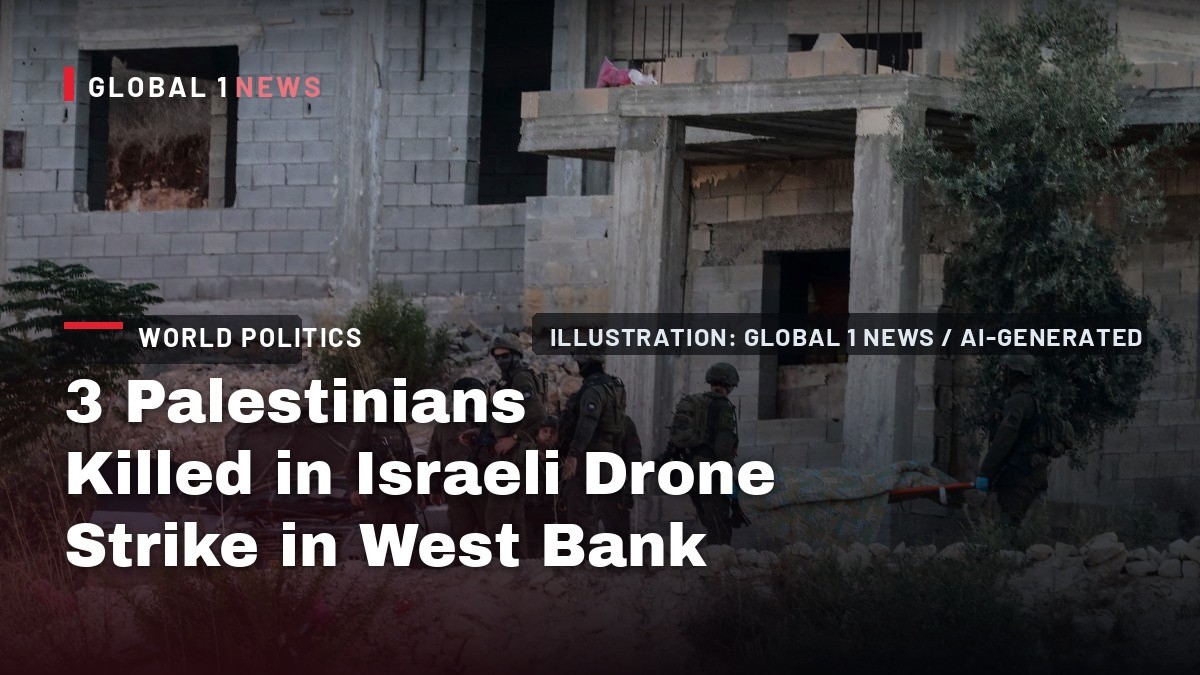
The occupied West Bank has long been a flashpoint, but the Israeli military's escalating tactics there are now drawing renewed international scrutiny. Friday's drone strike in Jenin, which killed three Palestinians, marks a significant escalation in a territory already gripped by violence and political tension. The incident, occurring just 60 days before Israel's Knesset election, underscores how the dynamics of the Gaza war have bled into the West Bank, reshaping the strategic calculus for all parties involved.
3 Palestinians killed in Israeli drone strike in occupied West Bank
Jenin, Occupied West Bank - August 29, 2026 - An Israeli drone strike killed three Palestinian men in the city of Jenin on Friday evening, marking the first aerial attack on the city in nearly ten months. The Palestinian Health Ministry confirmed the deaths, identifying the victims as Qais Bitawi, 22; Basel Turkman, 26; and Moamen Jaradat, 22. The ministry stated that Israeli forces have taken custody of the bodies, a move that has drawn sharp criticism from Palestinian officials and humanitarian groups.
A Rare Airstrike in a Volatile City
The strike targeted a partially built home in the Harsh al-Saada area of western Jenin, according to Palestinian sources. Initial reports from Israeli media suggested a vehicle was hit, but Palestinian Red Crescent sources and local witnesses confirmed the target was a half-constructed building. The choice of a drone rather than a ground raid is notable, as Israeli forces have primarily relied on armored vehicles and infantry for operations in the Jenin refugee camp since January 2025.
The Palestinian Red Crescent reported that Israeli military vehicles deployed to the area immediately after the strike, converging on the scene as ambulances arrived. In a statement, the organization said, "The Israeli army is holding our ambulance crew after it arrived at the targeted house." The crew was later released but ordered to leave the area without transporting the dead or wounded, effectively preventing medical evacuation and the recovery of the victims' remains.
Israeli Military Claims and Palestinian Response
The Israeli army issued a statement saying its warplanes "precisely struck" several people in the city, without initially specifying who or how many. A subsequent statement claimed the military "eliminated" three people, including Bitawi, whom it described as a Hamas member. The army did not name the other two victims. Local reports from IMEMC and other Palestinian outlets described the three men as young residents of the Jenin camp, with one identified as a local Hamas leader and two of his aides.
The Palestinian Health Ministry, which serves as the official record-keeper for casualties in the occupied territories, confirmed the deaths and the detention of the bodies. The ministry's statement, relayed through the Public Authority for Civil Affairs, the official Palestinian liaison with Israel, did not provide further details on the circumstances of the strike. The withholding of bodies is a recurring point of contention, as Palestinian families are often denied information about burial locations or the timing of funerals.
The West Bank's Escalating Toll Since October 2023
The occupied West Bank has seen a dramatic surge in Israeli military activity since the outbreak of the Gaza war in October 2023. What began as a response to Hamas's cross-border attack has evolved into a broader campaign that has touched nearly every Palestinian community in the territory. The Jenin refugee camp, a long-standing hub of armed resistance, has been a primary focus of Israeli operations, with continuous raids and incursions since January 2025.
The human cost has been severe. Thousands of Palestinians have been displaced from the Jenin camp, and widespread damage to homes and infrastructure has been reported. The UN and humanitarian organizations have documented the destruction of residential blocks, water networks, and roads, describing the situation as a humanitarian crisis. Friday's drone strike adds a new dimension to this campaign, signaling that Israel is willing to use aerial force in a territory where it has historically relied on ground operations.
Political Timing: 60 Days Before Israel's Election
The strike comes at a politically sensitive moment for Israeli Prime Minister Benjamin Netanyahu. With the Knesset election scheduled for October 27, 2026, Netanyahu is under growing pressure from right-wing and far-right factions within his coalition. These groups have consistently demanded a more aggressive posture in the West Bank, and Netanyahu has increasingly highlighted military operations in the Palestinian territories as a key part of his campaign platform.
The timing of the Jenin strike is unlikely to be coincidental. By demonstrating a willingness to use advanced military assets like drones, Netanyahu can project strength to his base while also signaling to the broader Israeli public that his government is taking a hard line on security. However, this approach carries risks. Escalating violence in the West Bank could alienate centrist voters and draw international condemnation, potentially complicating Israel's diplomatic position at a time when regional normalization talks with Saudi Arabia remain stalled.
Regional and International Reactions
The strike has drawn predictable reactions from Palestinian factions and Arab governments. Hamas, which controls Gaza, has not yet issued an official statement, but its allies in the West Bank have condemned the attack as an assassination. The Palestinian Authority, which exercises limited self-rule in parts of the West Bank, has called for international intervention to halt what it describes as Israeli aggression.
Internationally, the strike is likely to reignite debates about the use of drones in law enforcement and military operations. Human rights groups have long argued that drone strikes in densely populated areas violate international humanitarian law, particularly when they result in civilian casualties or when bodies are withheld. The ICC has an ongoing investigation into alleged war crimes in the Palestinian territories, and Friday's incident could become part of that broader inquiry.
Strategic Calculus and Second-Order Effects
For Israel, the strike serves multiple purposes. It disrupts militant networks in Jenin, sends a message of deterrence to other armed groups, and reinforces the government's security credentials ahead of the election. But it also risks inflaming the very tensions it seeks to suppress. The withholding of bodies, in particular, is a tactic that has historically fueled Palestinian anger and prolonged cycles of violence.
For the Palestinians, the strike is a reminder of their vulnerability. The Jenin camp, which has been under near-constant military pressure for over a year, has become a symbol of resistance and suffering. The deaths of three young men, all in their twenties, will likely galvanize further protests and potentially armed responses. The Palestinian Red Crescent's treatment at the scene—detained and then released without being allowed to do its job—adds a humanitarian dimension that could resonate beyond the region.
The broader regional context is equally fraught. The Gaza war has already reshaped alliances and strained relationships across the Middle East. Arab states, including Egypt, Qatar, and Saudi Arabia, have publicly condemned Israeli actions in Gaza but have been more muted in their responses to West Bank operations. Friday's strike, however, could test those positions, particularly if it leads to a wider escalation or a new wave of Palestinian protests.
What Comes Next
The immediate aftermath of the strike is likely to be marked by funerals and protests in Jenin, with the Israeli military maintaining a heavy presence in the area. The withholding of the bodies will be a central grievance, and Palestinian factions may use it to rally support. For Netanyahu, the political calculus is clear: maintaining a hard line in the West Bank is essential to securing his coalition's survival. But the long-term consequences of such tactics are uncertain, both for Israel's international standing and for the stability of the region.
The last Israeli airstrike in Jenin province was reported on October 28, 2025, when a helicopter targeted a cave and a vehicle near Kafr Qud, killing three Palestinians. Friday's strike, coming nearly ten months later, suggests that Israel is willing to resume aerial operations in the West Bank when it deems them necessary. Whether this marks the beginning of a new phase in the conflict or a one-off tactical decision remains to be seen, but the implications for the occupied territories are profound.
By Malik Hassan, Staff Writer
This article was produced with AI-assisted research and editorial support. Sources: Daily Sabah (Anadolu Agency), Al Jazeera, WAFA, IMEMC.
What's Your Reaction?
 Like
0
Like
0
 Dislike
0
Dislike
0
 Love
0
Love
0
 Funny
0
Funny
0
 Wow
0
Wow
0
 Sad
0
Sad
0
 Angry
0
Angry
0

Middle East Correspondent at Global1.News. Based in Beirut, covering politics, conflict, energy, and society across the Middle East. Brings context and depth to a region often reduced to headlines.















Comments (0)