
US-Iran War Escalates: 2 Troops Killed in Jordan as Retaliatory Strikes Rock Southern Iran
Two American service members were killed and one is missing after Iran struck a US base in Jordan with ballistic missiles on Friday. President Trump ordered retaliatory strikes that killed at least 50 Iranians and wounded 517 more. The escalation marks the eighth consecutive night of US-Iran hostilities and brings total US combat deaths to 16 since the war began on February 28, 2026.
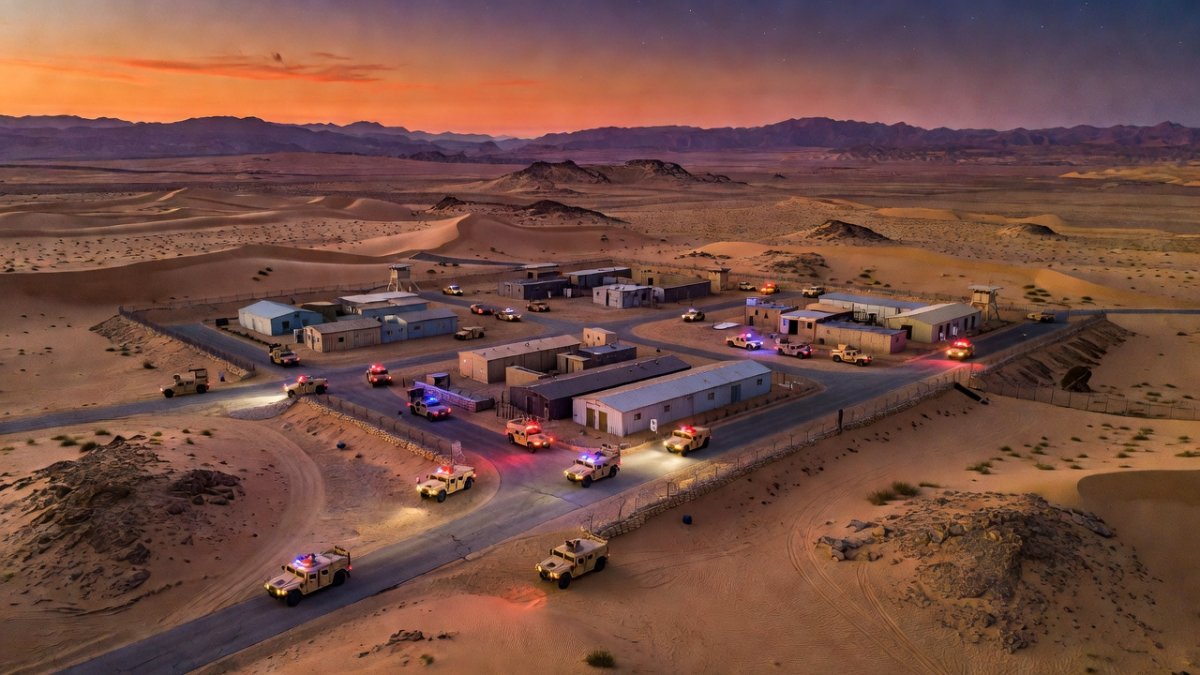
Two American service members are dead, one is missing, and the Middle East is barreling toward a full-blown regional war after Iran struck a US military base in Jordan with ballistic missiles and drones on Friday — and President Donald Trump answered with a wave of retaliatory strikes that killed at least 50 people inside Iranian territory.
US-Iran War Escalates: 2 Troops Killed in Jordan as Retaliatory Strikes Rock Southern Iran
Washington, D.C. — The eighth consecutive night of US-Iranian hostilities erupted Saturday into Sunday as the two countries traded their heaviest blows yet, pushing the five-month-old conflict past a threshold many analysts had dreaded: American combat deaths on the ground and a retaliatory campaign that now threatens Iran's nuclear infrastructure.
Iran's Islamic Revolutionary Guard Corps (IRGC) launched a coordinated barrage of ballistic missiles and one-way attack drones at a US logistics hub in eastern Jordan late Friday local time. US Central Command confirmed Saturday that two US service members were killed in the attack and a third remains missing. Their names have been withheld pending next-of-kin notification.
"We mourn the loss of two American heroes," President Trump said in a statement from the White House. "The United States will not tolerate attacks on our personnel. I have ordered the Department of Defense to deliver a decisive response."
The president did not wait long. Within 12 hours, US warplanes and naval assets launched extensive strikes across Iran's southern Hormozgan Province, targeting IRGC command centers, missile storage facilities, and coastal defense positions near the strategic Strait of Hormuz. Iranian state media reported at least 50 people killed and 517 wounded in the American counter-strikes, with explosions reported in Bandar Abbas — Iran's primary naval hub — and on Qeshm Island, which sits at the mouth of the Strait of Hormuz.
Sixteen Americans Killed Since War Began
The deaths in Jordan bring the total number of US service members killed in action since the war with Iran began on February 28, 2026, to 16. Another 430 have been wounded, according to Pentagon figures cited by multiple outlets. The first American combat death was reported in early March, but the pace of casualties has accelerated sharply as the conflict has expanded beyond the initial air campaign into ground-force engagements and now — for the first time — a direct strike on a US base in Jordan.
Jordan, a key US ally that hosts American forces under a long-standing bilateral security agreement, has found itself increasingly drawn into the crossfire. The kingdom's air defenses activated multiple times during the Iranian barrage, and Jordanian officials confirmed that fragments from intercepted missiles landed in residential areas, though no Jordanian casualties were reported.
Strait of Hormuz: The Economic Battlefield
At the center of the escalating conflict lies the Strait of Hormuz, the narrow waterway between Iran and the Arabian Peninsula through which roughly 20% of the world's oil passes. Both sides have waged an increasingly aggressive campaign for control of the strait over the past two weeks, with each accusing the other of targeting commercial shipping.
Iran declared the strait effectively shut earlier this week, claiming the right to control passage in what it calls its territorial waters. The US responded by imposing a full naval blockade on all ship traffic to and from Iranian ports — a move that Tehran has labeled an act of war under international maritime law.
On Friday, the IRGC claimed that two oil tankers had exploded after hitting mines planted by "deceptive American intelligence agencies." The Pentagon flatly denied the accusation, calling it "a transparent attempt to justify Iranian attacks on civilian shipping." Independent shipping data from the region shows maritime traffic through the strait has fallen by more than 60% since early July, and Brent crude oil prices have surged.
Iran Threatens Full-Scale Offensive
The Iranian government has escalated its rhetoric dramatically in response to the US strikes. In a statement carried by state-run Press TV, Iran's Supreme National Security Council warned that if the United States continues its military campaign for another two to three days, Iran "will have no choice but to launch a full-scale offensive that will make the previous phases of this war look like skirmishes."
Iran also accused the United States of striking the Darkhovin nuclear facility in Khuzestan Province, an allegation the Pentagon has not directly addressed. The Atomic Energy Organization of Iran said that while the facility was not directly hit, nearby explosions caused "concern about the integrity of containment structures" and that international inspectors had been summoned.
Tehran also claimed to have targeted US bases in Kuwait with drones — a claim that Kuwaiti officials neither confirmed nor denied as of publication time. US Central Command said its air defenses in the Gulf region intercepted "multiple inbound threats" overnight, with no damage or casualties reported at US facilities in Kuwait or Bahrain.
Israel in the Crosshairs
Israel, which has been fighting alongside the United States since the war's first hours on February 28, has also come under renewed pressure. Iranian missiles triggered air-raid sirens in southern Israel on Saturday, with interceptions observed over the port city of Eilat and the neighboring Jordanian city of Aqaba. The Israel Defense Forces reported no casualties but confirmed that several projectiles had been intercepted by the Iron Dome and David's Sling systems.
Israel's missile defense chief acknowledged this week that the country needs more interceptors than previously anticipated, as the intensity and frequency of Iranian salvos have exceeded pre-war planning. "We didn't see a huge difference on paper, but real combat revealed that things needed to be improved from fight to fight," the official told Business Insider.
Israeli Prime Minister Benjamin Netanyahu convened an emergency security cabinet meeting Saturday night. His office released a statement saying Israel "stands shoulder to shoulder with the United States" and that any Iranian attack on Israeli territory "will be met with a response of a magnitude Tehran cannot imagine."
The $113 Billion War
Five months into what is now the most sustained US combat operation since the Iraq War, the financial toll is staggering. A war cost tracker maintained by independent analysts estimates that the conflict has cost American taxpayers approximately $113.3 billion through mid-June. That figure has certainly climbed since the renewal of hostilities in early July.
The cost includes munitions expenditure — the US Navy alone has fired hundreds of Tomahawk cruise missiles and Standard Missile interceptors — plus deployment costs for the additional 30,000 troops sent to the region since February, and the ongoing air campaign that has averaged more than 50 strike sorties per day during peak periods.
Congress has not held a formal vote on war authorization under the 1973 War Powers Resolution, though the administration asserts that the February 28 strikes were conducted under Article II of the Constitution as a response to an imminent threat. Several members of Congress, including both Democrats and skeptical Republicans, have called for a formal debate, but no vote has been scheduled.
What Comes Next
The trajectory of the war now depends on whether this weekend's exchange represents a temporary spike or a permanent escalation. The killing of US troops on the ground fundamentally changes the political calculus in Washington — previous phases of the conflict could be framed as precision strikes on Iranian military assets, but the American public is now confronted with body bags returning home.
Diplomatic channels remain open but largely frozen. The EU and Gulf states have called for an immediate reopening of the Strait of Hormuz without conditions or fees, according to Saudi state media. Oman and Qatar have offered to mediate, but neither Washington nor Tehran has shown willingness to de-escalate while the other is actively striking its territory.
For the 16 American families who have lost loved ones — and the two more added this weekend — the diplomatic abstractions offer little comfort. The United States is now in its fifth month of open-ended combat operations against Iran, with no ceasefire in sight, no war authorization from Congress, and a president who has promised to "punish" Iran until it capitulates.
At the current rate of escalation, the question may no longer be whether this becomes a full-scale war — but rather, what kind of war it will be when it gets there.
By Jessica Ali, Staff Writer
===SUMMARY===
Two American service members were killed and one is missing after Iran struck a US base in Jordan with ballistic missiles on Friday. President Trump ordered retaliatory strikes that killed at least 50 Iranians and wounded 517 more. The escalation marks the eighth consecutive night of US-Iran hostilities and brings total US combat deaths to 16 since the war began on February 28, 2026. The strategic Strait of Hormuz remains contested, with Iran threatening a full-scale offensive if the US continues its campaign. Israel also faces renewed missile threats as the conflict shows no signs of de-escalation.
This article was produced with AI-assisted research and editorial support. Reporting is based on sources cited in the article.
What's Your Reaction?
 Like
0
Like
0
 Dislike
0
Dislike
0
 Love
0
Love
0
 Funny
0
Funny
0
 Wow
0
Wow
0
 Sad
0
Sad
0
 Angry
0
Angry
0

Editor-in-Chief at Global1.News. Atlanta-based journalist who cuts through the BS and tells it like it is. Lead anchor, host, and the voice you hear when the spin stops and the truth starts.














Comments (0)