
Unitree's US$9B IPO Tests China's Embodied-AI Appetite
Unitree Robotics prices its Shanghai Star Market IPO at 150.8 yuan per share, valuing the Hangzhou-based humanoid-robot maker at US billion. The 6.1 billion yuan raise, backed by DeepSeek and Tencent, sets a valuation benchmark for China's embodied-intelligence sector as rival start-ups race towa...
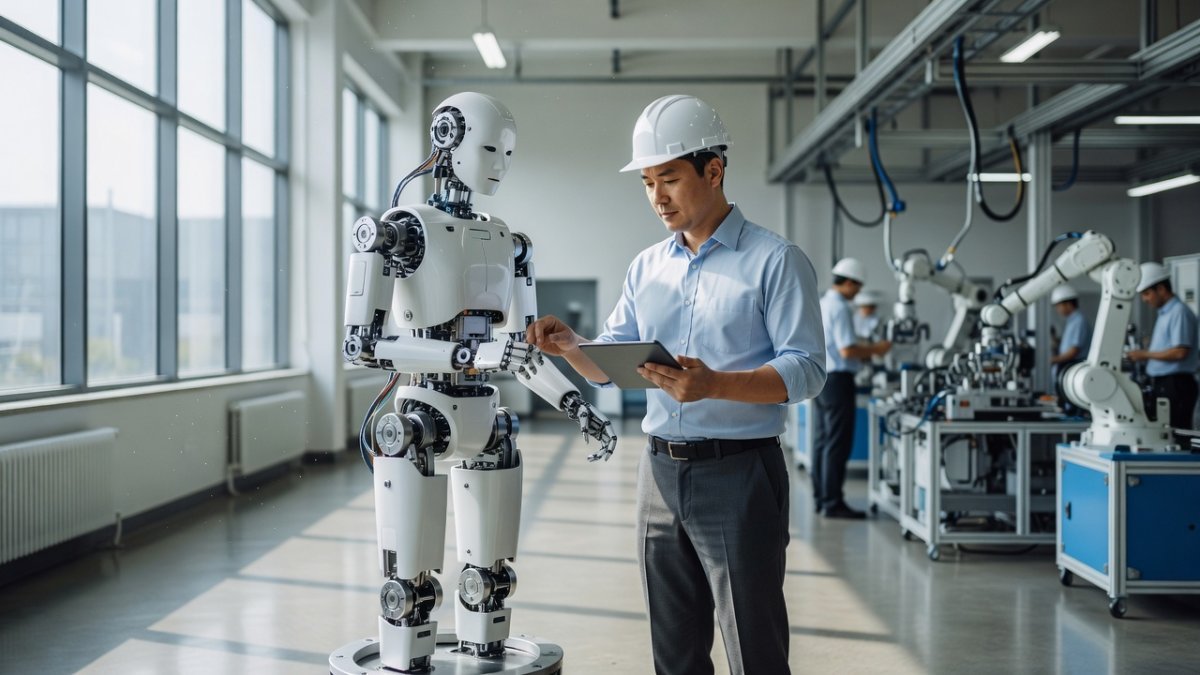
Unitree's US$9B IPO Tests China's Embodied-AI Appetite
Unitree Robotics has priced its long-awaited initial public offering on Shanghai's Star Market at 150.8 yuan per share, valuing the Hangzhou-based humanoid-robot maker at 60.99 billion yuan (US$9 billion) and setting what analysts describe as a valuation benchmark for China's booming embodied-intelligence sector. The company will sell 40.45 million new shares to raise 6.1 billion yuan, above its initial 4.2 billion yuan target, with AI unicorn DeepSeek and tech giant Tencent Holdings among the strategic investors. Widely billed as "mainland China's first humanoid stock," the deal tests whether retail and institutional investors will back a sector that has drawn heavy venture capital but produced few profitable players.
Tags: Unitree Robotics, Unitree IPO, humanoid robots, embodied AI, Shanghai Star Market, DeepSeek, Tencent, robotics stocks, China tech stocks, UBTech, AI robotics boom, China IPO
A First-Humanoid-Stock Debut With Strong Strategic Demand
Unitree's filing, released Thursday evening, confirms that the company secured a deep bench of state-backed and private strategic investors for the placement. Beyond DeepSeek and Tencent, the roster includes China National Petroleum Corp, China Southern Power Grid, China Telecom, Citic Securities and the National Council for Social Security Fund. The breadth of participation signals that Beijing views the humanoid-robot champion as a strategic asset in its push to lead embodied artificial intelligence, a field that combines robotics hardware with large language models and perception systems.
The pricing arrives as a wave of Chinese robotics start-ups races toward public markets. Deep Robotics, Leju Robotics, AgiBot, X Square Robot and LimX Dynamics are all pursuing listings, and venture capital firms have already pushed valuations for top-tier start-ups beyond 20 billion yuan. Unitree's debut is therefore being watched not merely as a single company event, but as a signal of how much public capital the entire physical-AI sector can absorb.
DeepSeek's 141 Million Yuan Bet and Co-Development Pact
DeepSeek's participation carries strategic weight beyond the cheque. The AI unicorn invested 141 million yuan in the placement, bound by a three-year lock-up period, and agreed to co-develop AI models and embodied-intelligence technology with Unitree. According to the company, the two firms will also give each other priority access in areas such as robot procurement and AI model services.
The partnership links China's leading low-cost AI model developer with its flagship humanoid-robot maker, reflecting a broader industrial logic: the same reasoning models that power chatbots are increasingly being adapted to control physical machines. For Japan's robotics industry, which has traditionally dominated industrial automation through companies such as FANUC, Yaskawa and Kawasaki Heavy Industries, the DeepSeek-Unitree axis illustrates how China is attempting to compress the software-to-hardware cycle in ways that legacy automation vendors have been slower to embrace.
A Valuation Ceiling for the Embodied-Intelligence Sector
Market participants expect the listing to anchor — and potentially cap — valuations across the embodied-intelligence space. Zheng Hualiang, founder of Hangzhou-based venture capital firm Leap VC and an early Unitree backer, said the IPO would serve as a valuation anchor and "effectively the ceiling" for other companies in the sector. His firm first invested in Unitree in 2022 when its pre-money valuation stood at about 1 billion yuan, attracted by the company's terrain-traversal and motion-control capabilities relative to wheeled-robot rivals.
The valuation math is demanding. At 150.8 yuan per share, Unitree's IPO implies a price-to-earnings ratio of 219.23 times and a price-to-sales multiple of 35.89 times. Hong Kong-listed peers UBTech Robotics and Dobot trade at price-to-sales multiples of 19.37 times and 20.12 times respectively, and both remain unprofitable. The gap underscores how much of Unitree's premium rests on expectations for the humanoid market's growth rather than on current earnings.
A Profitable Outlier in a Loss-Making Sector
Unitree stands apart from most of its Chinese rivals in one respect: it is profitable. The company recorded 1.7 billion yuan in revenue and 591 million yuan in adjusted net profit last year, according to its prospectus, with net profit up roughly 674 per cent year on year on the adjusted basis cited by analysts. Its profitability reflects a business model that sells robot dogs, humanoid units and core components such as actuators to commercial and research customers, rather than relying solely on future software revenues.
The distinction matters for investors comparing the robotics boom with earlier AI infrastructure cycles. Companies such as UBTech and Dobot have burned cash while scaling, and the sector has yet to demonstrate large-scale commercial deployment of humanoid robots in factories, warehouses or homes. Unitree's positive cash generation gives it more room to weather a valuation correction if the broader AI trade wobbles again.
Unitree's revenue base also points to a different commercial strategy from the software-first approach of many AI start-ups. The company sells physical products — quadruped robot dogs, humanoid units and core components such as actuators and sensors — to research labs, industrial customers and government buyers. That hardware-led model produces recurring demand tied to China's factory-automation push, which the Ministry of Industry and Information Technology has targeted through policies encouraging domestic robotics adoption. It also gives Unitree a revenue stream that is less exposed to the corporate cloud-spending cycle that has driven recent volatility in AI infrastructure stocks.
Retail Enthusiasm Against a Volatile Market Backdrop
Despite the stretched multiples, investor interest remains robust. An employee at a rival Chinese robotics start-up, who asked to be identified only by his surname Zhang, said he planned to subscribe to the Unitree IPO on Monday despite low expectations of receiving an allotment, noting that a misstep by Unitree "could make fundraising harder for the companies behind it." Kathy Shi, a Shanghai-based retail investor, said she applied for shares as a bet on the listing premium rather than near-term industry fundamentals, citing policy backing and Star Market excitement as her main drivers.
The enthusiasm is colliding with a volatile backdrop. Fears of overcrowded trades triggered sharp sell-offs in AI computing, semiconductor and optical-module stocks last month, and Shanghai's tech-focused Star 50 Index closed July down nearly 26 per cent after a more than 60 per cent surge earlier this year. Zheng cautioned that any broader rally across the robotics supply chain could prove short-lived unless shipment volumes scale rapidly: "The secondary market may trade on the theme in the short term. Over the longer run, it still comes down to whether that enthusiasm translates into actual business."
What to Watch For
The subscription window opens Monday, and the first trading session will provide the clearest read on whether China's public markets can sustain a US$9 billion humanoid-robot valuation. Investors should watch three signals: the extent of the listing-day premium or discount, whether the Star 50 Index can hold its weekly rebound, and how quickly Unitree's rivals follow with their own filings. For Asia-Pacific investors, the listing also sharpens the competitive picture: Japanese automation giants and component suppliers are watching whether China's embodied-AI leaders can convert policy support and cheap capital into manufacturing scale that reaches global markets.
Tokyo's robotics ecosystem, long anchored by industrial incumbents and precision-component makers, now faces a capital-markets counterpart to the technological challenge China has already posed in manufacturing. Should Unitree's listing price hold or appreciate, the fundraising math for Japanese start-ups in adjacent fields — from SoftBank-backed humanoid efforts to sensor and motor specialists supplying both countries' supply chains — will be measured against a Chinese benchmark that did not exist six months ago. Regulators and investors in the region will also be parsing the deal for signs of how much of the premium is policy-driven state capital versus durable commercial demand.
Unitree's debut will not by itself resolve the debate over whether humanoid robotics is a bubble or a build-out. But as the first public-market test of China's embodied-intelligence ambitions, it will shape the fundraising calculus for every start-up in the sector — and for the investors betting that robots, not chatbots, are the next big export of Chinese AI.
By Kenji Tanaka, Staff Writer
This article was produced with AI-assisted research and editorial support. Reporting is based on sources cited in the article.
What's Your Reaction?
 Like
0
Like
0
 Dislike
0
Dislike
0
 Love
0
Love
0
 Funny
0
Funny
0
 Wow
0
Wow
0
 Sad
0
Sad
0
 Angry
0
Angry
0

Japan Correspondent at Global1.News. Tokyo-based voice covering Japanese politics, technology, economy, and culture. Tracks the intersection of tradition and innovation in one of the world's most dynamic societies.











Comments (0)