
Ukrainian F 16 Downs Russian Su 35 First Kill
Ukrainian F-16 downs Russian Su-35 in first confirmed air-to-air kill, confirmed by Gen. Dan Caine on July 22, 2026. AIM-120 AMRAAM and Erieye radar were key. Russia has lost 9 Su-35s; Ukraine 4 F-16s and 1 Mirage 2000.
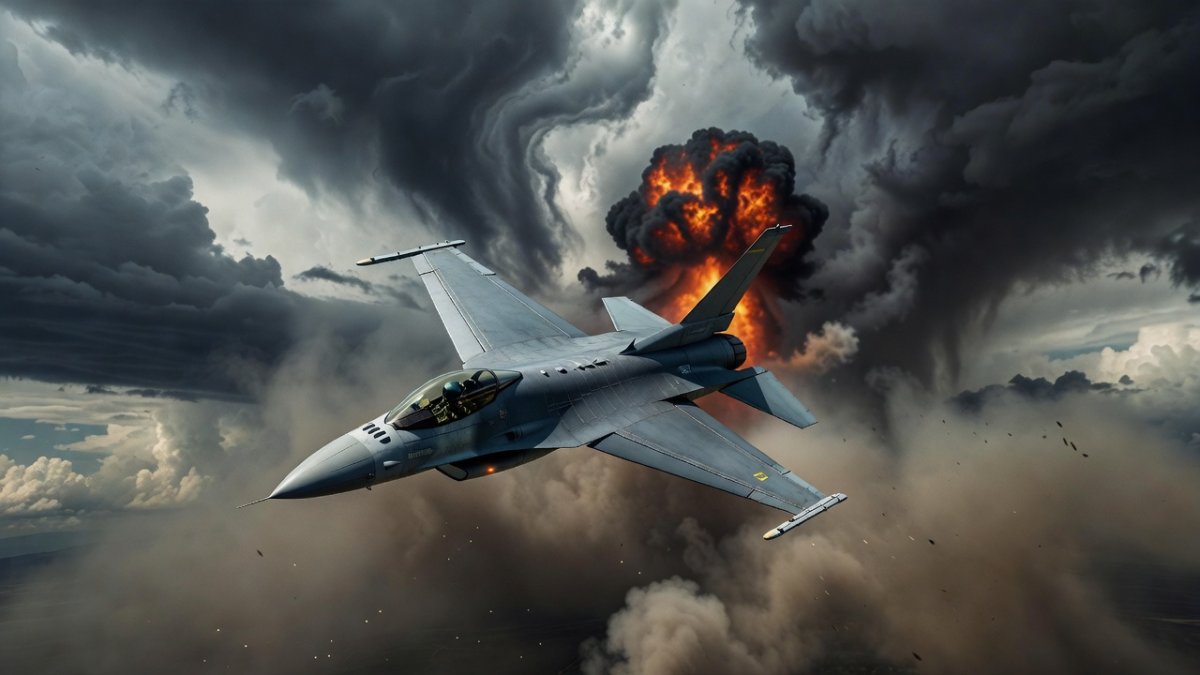
Folks, let me tell you something the Kremlin really doesn't want you to hear. A Ukrainian F-16 just took a Russian Su-35 out of the sky — not on paper, not in a propaganda video, but in real air-to-air combat. And the confirmation didn't come from Kyiv. It came straight from the top U.S. military officer, under oath, before the Senate.
Ukrainian F-16 Downs Russian Su-35 in Historic First Air Kill
Washington, D.C. — The Chairman of the Joint Chiefs of Staff, General Dan Caine, confirmed to the Senate Appropriations Committee on Tuesday, July 22, 2026, that a Ukrainian F-16 fighter jet achieved its first confirmed air-to-air victory — shooting down a Russian Su-35 interceptor in what analysts are calling a watershed moment in the air war over Ukraine.
The Confirmation: General Caine Under Oath
General Dan Caine, the highest-ranking U.S. military officer, appeared before the Senate Appropriations Committee on July 22 and dropped what could be the most significant air warfare update of 2026. He stated plainly that a Ukrainian F-16 had shot down a Russian Su-35 fighter jet in air-to-air combat. The engagement occurred "recently," according to Caine, in a piece of testimony delivered without the usual layers of Pentagon hedging. Senators pressed Caine on everything from budget allocations for long-range munitions to the pace of F-16 sustainment funding, yet it was this single air-to-air confirmation that cut through the procedural noise and landed like a hammer. Caine's delivery was clinical, almost matter-of-fact, which only amplified its weight: no spin, no caveats, just the raw fact of a Ukrainian pilot scoring a kill against one of Russia's most advanced fighters.
This is the first confirmed aerial victory by a Ukrainian F-16 since the aircraft arrived in Ukrainian service in mid-2024 — a milestone that validates two years of pilot training, billions in Western military aid, and a strategic bet that these fourth-generation fighters could make a difference against a larger, more established Russian air force. The Ukrainian Air Force has maintained a measured silence publicly, but the Pentagon has backed up the claim through official channels. That silence from Kyiv is deliberate; they know the value of letting American testimony do the talking while Russian state media scrambles to downplay the loss.
The Senate hearing covered a wide range of national security topics, but Caine's statement on the F-16 kill dominated the headlines. It represented the kind of unambiguous battlefield success that the Pentagon rarely publicizes — precisely because it proves Western training and equipment are translating directly into kills against Russian hardware. Committee members from both sides of the aisle leaned in when Caine spoke; the moment underscored how rare it is for a four-star to deliver such a clean, attributable victory narrative in open session.
Su-35 vs. F-16: What the Matchup Really Means
Let's talk hardware without the hype. The Su-35S is a fourth-generation-plus fighter that Russia markets as one of its most capable combat aircraft. It carries two AL-41F1S engines with thrust-vectoring nozzles, an Irbis-E passive electronically scanned array radar with detection ranges exceeding 400 kilometers, and a weapons loadout that includes the R-77 and R-73 air-to-air missiles. Each unit costs Moscow roughly $85 million. Russian propaganda loves to tout the Su-35 as an unbeatable air-superiority machine, yet the jet's real-world performance has repeatedly fallen short of the sales brochures.
On the other side of the engagement, the F-16 Fighting Falcon — a design that first flew in the 1970s but has been upgraded continuously — fields the AN/APG-83 AESA radar on newer variants, Link-16 datalink connectivity that doesn't exist on Russian platforms, and the AIM-120D AMRAAM beyond-visual-range missile. The cost? Around $32 million for a new-build Block 70, or roughly $48 million for the upgraded ex-Danish and ex-Norwegian airframes that Ukraine operates. The F-16's decades of incremental refinement have produced a platform that punches far above its generational weight when paired with modern Western sensors and missiles.
On paper, the Su-35 looks like the superior platform. But this kill proves what military aviators have known for decades: the pilot and the system integration matter more than the raw specs. The F-16's lower radar cross-section, its NATO-standard data links, and its compatibility with Western airborne early warning systems gave the Ukrainian pilot a decisive edge. This wasn't a fair fight — it was a smart fight. Russian pilots may boast about thrust-vectoring supermaneuverability in airshow videos, but those parlor tricks mean nothing when the first missile arrives from a direction the Su-35's crew never anticipated.
How It Happened: The Tactical Picture
While General Caine did not provide minute-by-minute details of the engagement, analysts have assembled a likely picture based on known Ukrainian capabilities and Russian operating patterns. The kill almost certainly involved an AIM-120 AMRAAM missile fired from beyond visual range — a "BVR" shot that exploits the F-16's superior sensors and networking instead of trying to out-turn a thrust-vectoring Su-35 in a dogfight. Russian fighters have shown a consistent habit of flying predictable racetrack patterns at medium altitude, often with radars sweeping in narrow sectors while electronic warfare pods remain in standby to conserve power.
Crucially, the Ukrainian F-16 likely operated under guidance from a Saab 340 Erieye airborne early warning and control aircraft — a Swedish-made radar platform that provides long-range surveillance and target tracking. The Erieye can detect fighter-sized targets at distances exceeding 300 kilometers and feed that data directly to the F-16 via Link-16, allowing the Ukrainian pilot to launch from a position where the Russian Su-35 never even knew it was being targeted. That's how you beat a more expensive, more agile aircraft: you never let it see you coming. The Erieye's low-band radar is particularly effective against low-observable threats and can maintain track even when the target attempts terrain masking.
The AIM-120D has a no-escape zone extending to approximately 80 kilometers and an active radar seeker that activates in the terminal phase, making it extremely difficult for the target to defeat even with countermeasures. Against a Su-35 that may not have had its electronic warfare systems active or its radar pointed in the right direction, the AMRAAM would have been devastating. Ukrainian pilots have trained extensively on these exact profiles at Luke Air Force Base, drilling the timing of Link-16 handoffs and the precise moment to commit the missile so the Russian pilot has minimal reaction window.
Numbers That Tell the Real Story
Russia has now lost nine Su-35S fighters over the course of this war — a staggering number for what is supposed to be Moscow's premier air superiority platform. Of those nine, at least five have been confirmed by geolocated wreckage imagery, according to open-source intelligence trackers like Oryx. The other four are listed as probable based on pilot claims and radar data. Compare that to Ukraine's losses: four F-16s and one Mirage 2000 have been lost across the entire conflict, mostly to Russian surface-to-air missiles and ground fire rather than air-to-air combat.
Those numbers matter because they expose a fundamental reality: Russia is losing advanced aircraft at a rate it cannot sustain, while Ukraine is preserving its Western-supplied fleet through superior tactics and integrated air defense. The Sukhoi losses also represent a significant financial blow — at $85 million per aircraft, nine Su-35s equals $765 million in destroyed hardware. The Kremlin can spin all it wants, but the math doesn't lie. Each lost Su-35 also removes a highly trained pilot from the roster, and Russia’s replacement pipeline for both airframes and aviators is visibly strained.
What This Does to the Air War
This kill changes the calculus in the sky over Ukraine. For months, the air war has been a stalemate of stand-off missile exchanges, drone operations, and surface-to-air duels. Russian fighter jets have largely operated from stand-off ranges, avoiding deep penetration of Ukrainian-controlled airspace because of the threat from Western-supplied air defense systems. But this is different — this is a confirmed air-to-air kill that demonstrates Ukraine can actively hunt Russian fighters, not just dodge them. The psychological impact is just as important as the tactical one. Every Russian pilot now knows that a Ukrainian F-16, guided by NATO-standard AWACS coverage, can reach out and touch them beyond visual range. That uncertainty forces Russian air operations to become more cautious, more predictable, and ultimately less effective. It creates a deterrent effect that no amount of Russian propaganda can undo.
From a NATO perspective, this success validates the entire F-16 transfer program — the training pipeline at Luke Air Force Base in Arizona, the maintenance support infrastructure in Eastern Europe, and the strategic decision to supply these aircraft despite Russia's threats of escalation. Allied defense ministries in Denmark, Norway, and the Netherlands, which donated the F-16s, now have concrete evidence that their contributions are making a battlefield difference. Additional deliveries already pledged will only compound that advantage.
Russia's Dilemma and What Comes Next
Moscow faces an uncomfortable choice. It could escalate by deploying its most advanced fighter — the Su-57 Felon — to front-line roles, but that risks exposing the Kremlin's crown jewel to Ukrainian air defenses and potential loss. Russian commanders have already shown extreme caution with the Su-57, keeping it operating over Russian territory and the Black Sea rather than Ukrainian airspace. Losing a fifth-generation fighter would be an unmitigated public relations disaster. Alternatively, Russia could pull its fighter assets further back, conceding more airspace to Ukrainian operations. That would give Ukraine greater freedom to conduct close air support for ground troops, reconnaissance missions, and strikes against Russian logistics nodes. Either outcome advantages Kyiv.
General Caine's Senate testimony also signals to Congress that continued military aid — including more F-16s, more AIM-120s, and more training slots — is producing tangible results. The argument for sustaining and expanding the aid package just got a lot stronger. Norway and Denmark have already pledged additional F-16 deliveries, and the pilot training pipeline is expanding to include more Ukrainian aviators. The Kremlin’s usual bluster about “red lines” rings hollow when its own premier fighters keep falling to Western-supplied jets.
The Bigger Picture
This isn't just about one jet shooting down another. It's about what happens when Western technology, Ukrainian courage, and American leadership come together against an unprovoked invasion. The F-16 kill is a symbol of something larger — that air power alone cannot protect an aggressor, that pilot skill and system integration can overcome raw hardware specs, and that sustained allied support can shift the balance in a shooting war. General Dan Caine didn't just announce a victory. He sent a message to Moscow, to Kyiv, to NATO allies, and to the American people: this fight is winnable, and every dollar invested in Ukraine's defense is producing real battlefield dividends. The Su-35 wreckage — scattered somewhere on Ukrainian soil — is proof.
The skies over Ukraine just got a little more dangerous for Russian pilots. And that's exactly how it should be.
By Jessica Ali, Staff Writer
SUMMARY: Ukrainian F-16 downs Russian Su-35 in first confirmed air-to-air kill, confirmed by Gen. Dan Caine on July 22, 2026. AIM-120 AMRAAM and Erieye radar were key. Russia has lost 9 Su-35s; Ukraine 4 F-16s and 1 Mirage 2000.This article was produced with AI-assisted research and editorial support. Reporting is based on sources cited in the article.
What's Your Reaction?
 Like
0
Like
0
 Dislike
0
Dislike
0
 Love
0
Love
0
 Funny
0
Funny
0
 Wow
0
Wow
0
 Sad
0
Sad
0
 Angry
0
Angry
0

Editor-in-Chief at Global1.News. Atlanta-based journalist who cuts through the BS and tells it like it is. Lead anchor, host, and the voice you hear when the spin stops and the truth starts.













Comments (0)