
Ukrainian Drone Strike Forces Major Russian Refinery to Shut Down for Six Months, Triggering Fuel Rationing in Orenburg Region
Ukrainian drone strike forces the Orsknefteorgsintez refinery in Russia's Orenburg region to shut down for up to six months, triggering fuel rationing and odd-even license plate rules at gas stations as sanctions block repairs to key infrastructure.

The Orsknefteorgsintez oil refinery in Russia's Orenburg region has completely shut down following a Ukrainian drone strike this week, with repairs expected to take up to six months due to Western sanctions blocking access to imported equipment. Governor Yevgeny Solntsev announced the full shutdown on Thursday, warning that the region now faces a worst-case fuel supply scenario. The attack marks the latest escalation in Ukraine's deep-strike campaign against Russian energy infrastructure, which has already triggered fuel rationing, export bans, and price hikes across multiple Russian regions.
Ukrainian Drone Strike Forces Major Russian Refinery to Shut Down for Six Months, Triggering Fuel Rationing in Orenburg Region
Orsk, Russia — The Orsknefteorgsintez refinery, a key fuel producer located roughly 1,500 kilometers from Ukraine's border near Kazakhstan, has halted all operations after a drone attack on Tuesday, according to regional authorities. The shutdown has prompted emergency fuel rationing measures, including an odd-even license plate system at gas stations, as the region scrambles to secure alternative supplies.
Complete Shutdown Confirmed by Regional Governor
Orenburg region Governor Yevgeny Solntsev confirmed the plant's total closure on Thursday, stating that shrapnel from the drone strike damaged "key infrastructure" that cannot be repaired promptly. "The plant has completely shut down," Solntsev wrote on Telegram, adding that repairs could take up to six months because the damaged equipment is imported and therefore inaccessible due to Western sanctions.
The governor's statement marked a significant escalation in the official assessment of the damage. On Wednesday, Solntsev had already introduced fuel rationing and an odd-even license plate system at gas stations across the region, a measure typically reserved for severe supply disruptions. By Thursday, he described the situation at local filling stations as "not simple everywhere, but manageable."
Ukraine's Military Claims Responsibility for Strike
Ukraine's General Staff said on Tuesday that its forces had struck the Orsknefteorgsintez refinery, located over 1,300 kilometers from Ukrainian territory in Russia's Orenburg Oblast. The refinery has an annual crude-processing capacity of approximately 6.6 million metric tons, according to The Moscow Times, though other estimates place its nominal capacity at around 5.76 million tonnes per year. In 2024, the facility processed 4.2 million tonnes of crude.
The attack is part of a broader and intensifying Ukrainian campaign against Russian oil infrastructure. According to The Kyiv Independent, Ukraine has been waging an increasingly successful deep strike campaign, hitting oil depots, disrupting production at major facilities, and in some cases halting operations indefinitely. The strikes have mounted pressure on the Kremlin by aggravating a domestic fuel supply crisis that has already caused export bans, price hikes, and sales restrictions across Russia.
Fuel Rationing and Regional Emergency Measures
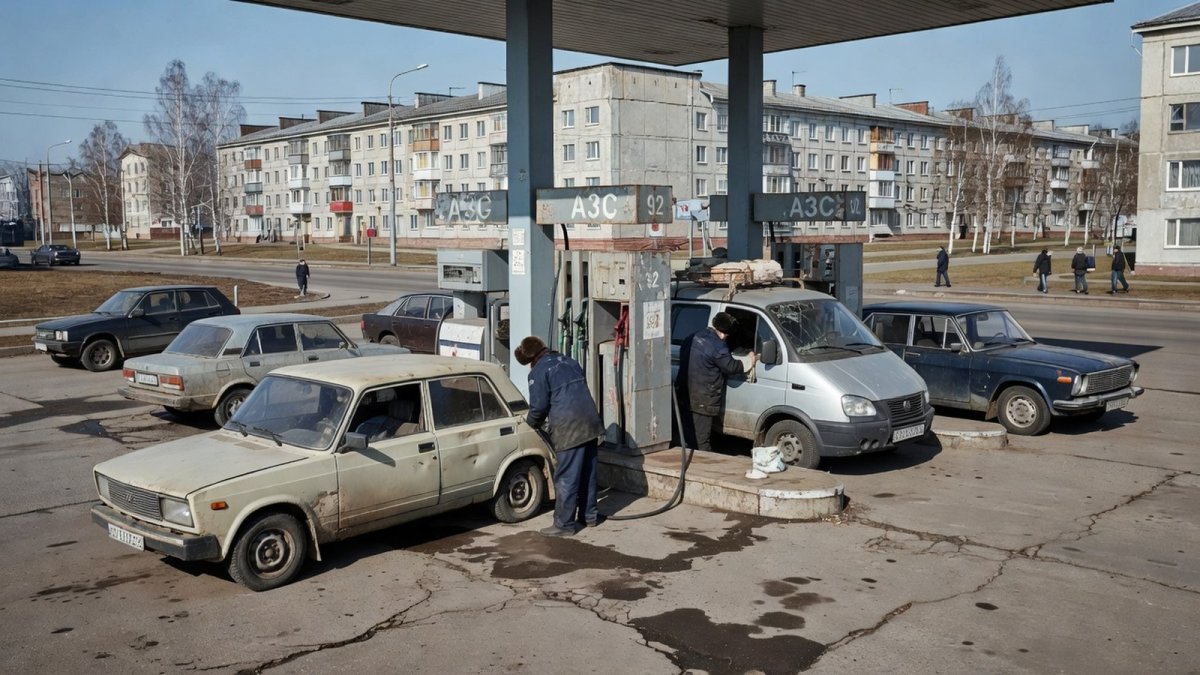
Governor Solntsev reported that 80% of the region's 287 filling stations were currently operational, with priority being given to "emergency and specialized vehicles." The remaining 20% of stations are either closed or facing supply interruptions, according to the governor's Telegram updates.
"We're preparing for a worst-case scenario and will have to rely on fuel supplies brought in from outside the region," Solntsev wrote, acknowledging that logistics are already being reconfigured to import fuel from neighboring territories. The governor's comments suggest that local fuel production has effectively ceased, leaving the region dependent on external supply chains that may be strained by the sudden demand.
Orenburg Becomes 16th Region Hit by Fuel Disruptions
Orenburg is the 16th reported region to face renewed fuel disruptions following a brief period of stabilization in late July, according to The Moscow Times. That stabilization was disrupted by fresh Ukrainian attacks on energy infrastructure, which have resumed with greater frequency and intensity in recent weeks.
The peak of Russia's fuel crisis fell in June and early July 2026, according to Meduza. During that period, Russian regions introduced various restrictions on gasoline sales, and citizens were forced to stand in hours-long lines at gas stations. While authorities claimed most initial problems had been resolved by late July, the new wave of strikes has reignited concerns about fuel availability across the country.
Fresh Strikes on Bashkortostan's Salavat Refinery
The Ukrainian campaign showed no signs of abating overnight on Wednesday, when Kyiv's forces struck the Gazprom Neftekhim Salavat oil refinery complex in Russia's Republic of Bashkortostan, according to The Kyiv Independent and The Guardian. The Salavat facility is one of Russia's largest refineries, located approximately 1,300 kilometers from Ukraine's border. The attack also started a fire at a nearby Wildberries logistics facility, though the extent of damage at both sites has not been independently verified.
The Salavat strike demonstrates that Ukraine's long-range drone capabilities extend deep into Russian territory, targeting facilities that were previously considered beyond reach. Analysts suggest this signals a deliberate strategy to spread Russia's air defense resources thin while systematically degrading its refining capacity.
Sanctions Compound Damage from Drone Strikes
A critical factor in the extended shutdown timeline is the interaction between physical damage and Western sanctions. Governor Solntsev explicitly noted that the damaged equipment at Orsknefteorgsintez is imported and cannot be replaced or repaired due to sanctions restrictions. This combination of drone strikes and sanctions creates a compounding effect, where even repairable damage becomes effectively permanent in the short term.
The Kremlin has not publicly commented on the Orsk shutdown or the broader fuel supply situation. However, Russian President Vladimir Putin acknowledged fuel shortages in late June, stating that plans would be "adjusted" to address the crisis, according to the New Indian Express. More than a dozen major Russian refineries have been hit since the campaign intensified, contributing to domestic fuel shortages that have become a politically sensitive issue.
Impact on Ordinary Russians and Regional Economy
For residents of the Orenburg region, the refinery shutdown translates directly into daily inconvenience and economic uncertainty. The odd-even license plate system means drivers can only purchase fuel on alternating days based on their plate numbers, a measure that recalls Soviet-era shortages. Emergency vehicles and specialized services receive priority, but ordinary citizens face potential delays and limited access to gasoline.
The region's economy, which relies heavily on the refinery as a major employer and industrial anchor, now faces an uncertain period. The six-month repair timeline, if accurate, would extend well into the winter months, when fuel demand for heating and transportation typically rises. Local authorities have not indicated whether temporary fuel imports will be sufficient to meet demand over that extended period.
Broader Context of Ukraine's Energy War
Ukraine has repeatedly targeted Russian refineries, ports, and energy infrastructure to raise the economic cost of Moscow's war effort, according to Al Jazeera. The strategy has evolved significantly over 2026, with strikes becoming more frequent and reaching deeper into Russian territory. The Orsk refinery, located near the Kazakhstan border, represents one of the farthest targets successfully struck to date.
The campaign has created a persistent dilemma for Russian authorities: defending vast energy infrastructure across a country spanning 11 time zones is logistically challenging, yet allowing strikes to continue unchecked risks undermining both military fuel supplies and civilian morale. The fact that Orenburg is the 16th region to face fuel disruptions suggests the problem is widespread rather than isolated.
Uncertain Path Forward
The full extent of damage at Orsknefteorgsintez cannot be independently verified, as Russian authorities have restricted access to the site and independent media face severe constraints. The six-month repair estimate provided by Governor Solntsev may prove optimistic or pessimistic depending on the actual condition of the damaged equipment and the availability of alternative supply chains.
What remains clear is that Ukraine's deep strike campaign has achieved a strategic effect beyond mere physical damage. By forcing Russian regions to implement rationing and import fuel from outside, the strikes are imposing economic costs and logistical burdens that compound over time. For the residents of Orenburg and other affected regions, the immediate reality is one of uncertainty at the gas pump, with no clear end in sight.
By Irina Volkov, Staff Writer
This article was produced with AI-assisted research and editorial support. Sources: The Moscow Times, The Kyiv Independent, The Guardian, Meduza.
What's Your Reaction?
 Like
0
Like
0
 Dislike
0
Dislike
0
 Love
0
Love
0
 Funny
0
Funny
0
 Wow
0
Wow
0
 Sad
0
Sad
0
 Angry
0
Angry
0

Russia/Eastern Europe Correspondent at Global1.News. Covering Russian politics, energy, security, and the shifting dynamics of the post-Soviet space. Provides clear-eyed analysis on one of the world's most opaque regions.












Comments (0)