
UK house prices dip for first time in nearly three years
The UK housing market has recorded its first annual fall in prices since November 2023, according to fresh data from Lloyds Banking Group, signalling a decisive cooling after a prolonged period of upward pressure.
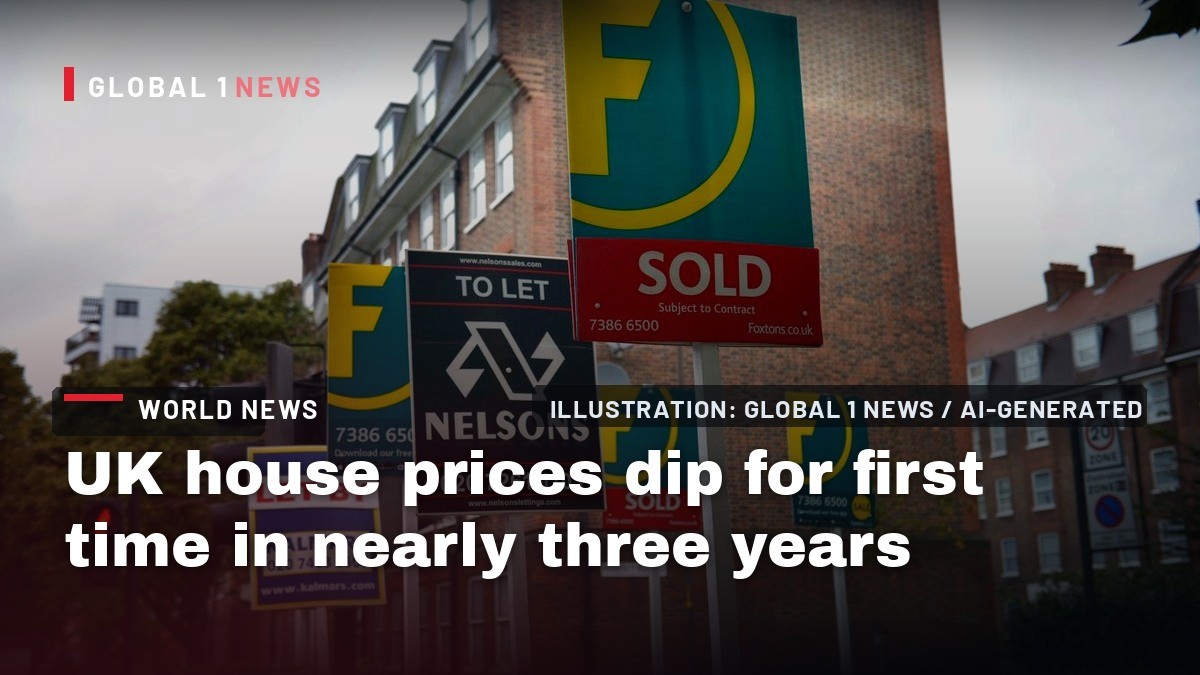
The UK housing market has recorded its first annual fall in prices since November 2023, according to fresh data from Lloyds Banking Group, signalling a decisive cooling after a prolonged period of upward pressure.
The average property now costs £298,468, marking a 0.4 per cent drop compared with the same month last year. On a monthly basis, prices fell 0.2 per cent in August, following a 0.1 per cent decline in July, underscoring a softening trend that has gathered pace through the summer months.
Andrew Asaam, mortgages director at Lloyds, said: "The average property now costs £298,468, marking the first annual fall in house prices since November 2023." He added: "Despite that, prices are still marginally up (a 0.2 per cent increase) since the start of the year."
Economic uncertainty weighs on the market
The reversal comes against a backdrop of heightened economic volatility, with global events feeding through to inflation and borrowing costs. Asaam noted: "The housing market has faced a more difficult backdrop in recent months, with the impact of global events on inflation and borrowing costs creating greater economic uncertainty."
That uncertainty is now visibly shaping behaviour on both sides of the transaction. Sellers, it appears, are increasingly reluctant to accept lower offers, while prospective buyers are adopting a wait-and-see approach. "What we're not seeing is a rush of homeowners cutting prices," Asaam observed. "But more are choosing to sit tight, with sellers reluctant to accept offers they feel are too low, while some buyers are waiting to see how conditions develop."
Jonathan Hopper, chief executive of Garrington Property Finders, painted a similar picture of a market in recalibration. He said struggling sellers are cutting prices pre-emptively to attract interest, with those putting their home on the market now often facing an uncomfortable reality check on their price expectations.
A market still well above pre-pandemic levels
Despite the recent softening, the data serves as a reminder of just how far prices have travelled in a relatively short period. The average home remains around 25 per cent more expensive than it was at the end of 2019, a striking legacy of the pandemic-era boom that followed.
"Average house prices remain around 25 per cent higher than they were at the end of 2019, despite the substantial increase to interest rates seen over recent years," Asaam said.
That persistent elevation continues to stretch affordability, particularly for those attempting to step onto the ladder for the first time. Sarah Coles, head of personal finance at AJ Bell, was blunt about the scale of the challenge. She said horribly high prices have made it incredibly difficult to get onto the property ladder, and if they come down off recent highs, it could bring properties within reach – especially if sellers are prepared to negotiate.
However, she cautioned that any relief would be conditional. "The fly in the ointment is that mortgage costs are still a huge stretch, so the size of your deposit will make all the difference," she said, adding that it is worth considering any help available, from topping up a Lifetime Isa to secure a bigger Government bonus, to asking family for assistance.
Regional divergence: North outperforms the South
The national figures, however, mask considerable regional variation. Northern Ireland recorded the strongest annual growth at 6.9 per cent, with the average property there reaching a record £231,245. Scotland saw prices rise 3.5 per cent, while Wales posted a more modest 0.6 per cent increase.
Within England, growth was strongest in the northern regions, while price growth came under pressure across much of southern England. That divergence, analysts suggest, reflects the greater affordability challenge caused by higher average prices in the south, where the gap between earnings and property values remains most acute.
Nicky Stevenson, managing director of Fine & Country, said the current climate demands a pragmatic approach from vendors. "In a market where buyers have more choice and are increasingly payment-conscious, an ambitious asking price can quickly become a barrier to securing a deal," she said. "Sellers who price realistically from the outset are much more likely to capture the attention of the buyers who are ready to act."
Mortgage pressures persist
For those reliant on financing, the outlook remains fraught. Recent volatility in bond markets has raised the spectre of further increases to mortgage rates, just as many buyers were beginning to adjust to the current level of borrowing costs.
Ian Futcher, financial planner at wealth manager Quilter, explained: "Clearly, stretched affordability and an uncertain economic background has had a negative impact on house prices and, unfortunately, recent volatility in bond markets has the potential to put further pressure on mortgage rates."
He added: "Swap rates have risen sharply in recent days and some lenders have already begun adjusting pricing in response."
The timing could hardly be worse for those on the cusp of a purchase. "For first-time buyers who have spent months building a deposit and carefully calculating what they can afford, sudden shifts in mortgage rates can pull the rug from under their feet just as they are preparing to make a move," Futcher said.
Lenders, for their part, insist they are responding to the challenge. Mark Harris, chief executive of mortgage broker SPF Private Clients, said lenders are working hard to offer solutions to those trying to get on the ladder for the first time.
Autumn outlook: subdued but stable?
Looking ahead, industry figures anticipate a market that remains relatively quiet, though not necessarily one poised for a sharp correction. The combination of ongoing affordability constraints and a degree of political uncertainty is likely to keep activity in check.
Jason Tebb, president of OnTheMarket, noted: "As we head into autumn, and another Budget beckons, political uncertainty and challenging economic conditions continue to form a backdrop to activity."
Iain McKenzie, chief executive of The Guild of Property Professionals, echoed that sentiment, suggesting any recovery would be gradual. "If mortgage rates remain broadly stable and confidence continues to improve, the traditional autumn uplift in activity could provide some momentum," he said. "But affordability remains the defining constraint, so any recovery is likely to be measured rather than dramatic."
Lloyds' Asaam struck a similarly cautious tone, forecasting a period of limited movement. "We expect the market to remain fairly subdued in the months ahead, but this will likely only have a limited impact on house prices," he said. "While affordability remains a challenge, wages continue to grow and employment has held up better than many anticipated. This will help to support demand from those who need or want to move."
For now, the picture is one of a market pausing for breath – still historically expensive, yet showing the first tangible signs of give. Whether that develops into a more meaningful correction or merely a plateau will depend, in large part, on the trajectory of mortgage rates and the broader economic mood as the autumn unfolds.
By Erica Thornton, Staff Writer
This article was produced with AI-assisted research and editorial support. Sources: The Independent, Lloyds Banking Group.
What's Your Reaction?
 Like
0
Like
0
 Dislike
0
Dislike
0
 Love
0
Love
0
 Funny
0
Funny
0
 Wow
0
Wow
0
 Sad
0
Sad
0
 Angry
0
Angry
0

US Politics and Policy Correspondent at Global1.News. Based in Washington DC, covering American politics, policy, elections, and the courts. Knows how the system works and tells you what it actually means.















Comments (0)