
Trump Revives Birthright Citizenship Fight With New Executive Orders
In a recent BBC News report, President Donald Trump signed two executive orders seeking to scale back birthright citizenship in the United States — a direct response to the Supreme Court's rejection of his earlier attempt to end the 150-year-old policy.
In a recent BBC News report, President Donald Trump signed two executive orders seeking to scale back birthright citizenship in the United States — a direct response to the Supreme Court's rejection of his earlier attempt to end the 150-year-old policy.
Trump Revives Birthright Citizenship Fight With Narrower Executive Orders
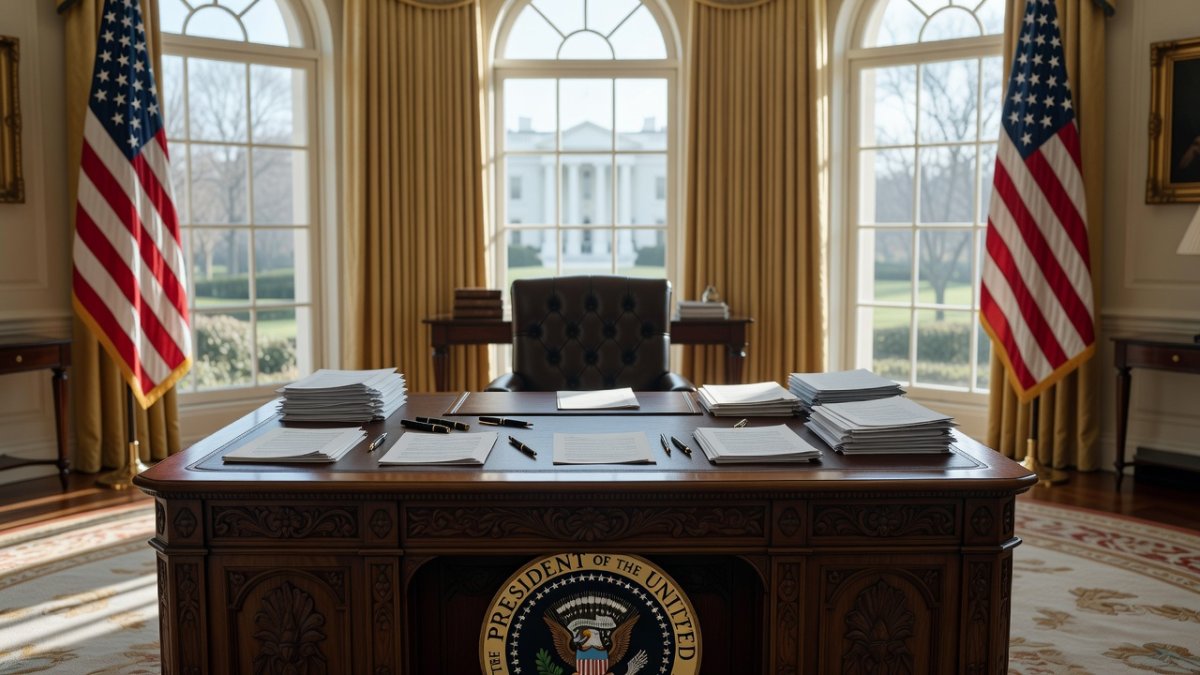
Washington, DC — 7 August 2026 — President Donald Trump signed two executive orders on Thursday at the Resolute Desk in the Oval Office that seek to narrow the scope of automatic citizenship for children born in the United States. The first order expands existing exceptions to birthright citizenship, while the second targets the practice of birth tourism. Legal challenges are expected from advocacy groups and constitutional scholars who argue the measures exceed presidential authority under the 14th Amendment.
The New Executive Orders: A Narrower Second Attempt
The first executive order expands the narrow exception to birthright citizenship that currently applies only to children of foreign diplomats and invading forces. Under the new directive, babies born in the United States to two non-citizen parents become ineligible for automatic citizenship when one parent falls into one of four categories: a member of a foreign terrorist group, a foreign government employee, an individual who has attempted to gain citizenship through fraudulent means, or a person living in a U.S. territory where citizenship is not conferred by federal statute. The order explicitly states that Puerto Rico citizenship remains codified by federal statute and is therefore unaffected. The text of the order reads: "My Administration has guarded against the risks posed by malign foreign actors who attempt to swindle American citizens by taking advantage of the generosity of our Nation." This language frames the policy change as a protective measure against exploitation rather than a broad overhaul of the Citizenship Clause.
The second executive order directs the secretary of state and the secretary of homeland security to halt birth tourism, the practice of pregnant mothers entering the United States specifically to give birth so their children receive automatic citizenship. President Trump stated from the Oval Office on Thursday that "This should have happened years ago, but we're taking care of it now." He further claimed that "hundreds of thousands" of babies have been born through birth tourism. Nonpartisan estimates from the Migration Policy Institute place the annual figure between 22,000 and 26,000, while government data recorded 9,600 births to mothers listing foreign addresses in 2024. These figures provide a narrower empirical baseline than the president's assertion and underscore the administration's focus on a practice that remains statistically limited relative to total U.S. births.
Stephen Miller's Case: The Push Behind the Orders
Stephen Miller, serving as homeland security advisor and White House deputy chief of staff for policy, stood beside President Trump during the signing ceremony and provided the administration's primary public justification. Miller described the targeted practice as one in which individuals "come here pretending to be a tourist, pretending to be a visitor... But the real reason they're here is to have a child, to make that child an automatic citizen, (to) leave our country and then have a U.S. citizen child." He cited a section of the Immigration and Nationality Act that grants the president authority to set exceptions and limitations on entry as the legal foundation for the orders. The administration has also accused Russian and Chinese adversaries of exploiting birthright citizenship, framing the policy as a national security vulnerability rather than solely an immigration issue.
Miller argued that children born under these circumstances later gain access to welfare benefits, the voting booth, and "all the other rights and privileges that belong solely to Americans." This framing positions the executive orders as a defense of resources reserved for citizens. The approach reflects the administration's consistent emphasis on enforcement mechanisms that operate through existing statutory authority rather than requiring new legislation from Congress. Critics, including immigration advocates, contend that such measures risk creating unequal categories of citizenship based on parental status, while administration officials maintain that the orders simply close loopholes that have persisted for decades.
The Supreme Court Showdown: What the June Ruling Said
On his first day back in office for the second term, President Trump signed an executive order that sought to reinterpret the 14th Amendment's Citizenship Clause. The order argued that children of undocumented immigrants and temporary visa holders were not "subject to the jurisdiction" of the United States and therefore ineligible for automatic citizenship. In June of this year, the Supreme Court struck down that order in a 6-3 decision. Six justices voted against the administration despite the Court's conservative supermajority, leaving birthright citizenship intact as established policy since the amendment's ratification in 1868.
Chief Justice John Roberts, writing for the majority, stated there was "scant evidence for this dramatically revisionist view" and affirmed that "The Framers of the Fourteenth Amendment extended that promise to 'every free-born person in this land.' We keep that promise today." The majority opinion further noted: "If Congress intended to limit American citizenship to the children of those domiciled in the United States, nothing in the succinct language of the Citizenship Clause conveyed that design." The ruling represented one of the most significant legal setbacks for the administration's immigration agenda in the second term and reinforced the judiciary's role in interpreting the scope of the Citizenship Clause.
Legal Scholars Doubt the New Orders Survive
Gabriel Chin, a professor at UC Davis School of Law, told BBC that portions of the new orders might withstand scrutiny while other aspects "raise some serious constitutional questions." Chin acknowledged that the president possesses authority to restrict individuals from entering the United States specifically to have a child, yet he concluded that "once a child is born in the United States, I don't think the president has any power to decide that that child is not a citizen." He characterized birth tourism as "a drop in the bucket" compared with millions of annual U.S. births and described it as an unusual phenomenon rather than a systemic crisis.
Kimberly Wehle, a constitutional law expert who spoke to Al Jazeera, assessed that the orders are likely to be deemed unconstitutional. She suggested the measures may represent an effort to appeal to the president's far-right base at a time when poll numbers are slumping. Wehle stated that "It looks like what Donald Trump is setting up is a clash between himself and the authority of the United States Supreme Court" and added that "Lots of things aren't looking up for Donald Trump, so he's trying to make political hay out of something that, frankly, is resolved." Legal challenges are anticipated from advocacy organizations that view the orders as an attempt to circumvent the June ruling through narrower but still constitutionally questionable means.
Political Calculation: A Fight With the Court, Not Just Over Citizenship
President Trump's hardline stance on immigration has remained a defining element of his political career across both terms. The June Supreme Court defeat occurred despite a conservative supermajority, highlighting limits on executive reinterpretation of constitutional text. Wehle's observation that the president is "trying to make political hay" aligns with the narrower scope of the current orders, which Trump described to Al Jazeera as "making adjustments" after earlier efforts were rejected. The administration has framed the measures as necessary corrections to a policy that "They've taken birthright citizenship and they've made a joke out of it."
Immigration advocates argue that the orders risk fragmenting citizenship status along lines of parental nationality and could invite prolonged litigation that burdens federal courts. Administration officials counter that the directives address genuine vulnerabilities exploited by foreign actors and protect the integrity of citizenship. The political stakes extend beyond the immediate policy dispute, as the orders test the boundaries of executive power when Congress has not acted and the judiciary has already ruled on a related question. Immediate legal challenges are expected to determine whether the narrower approach survives where the broader 2025 order did not.
Analysis and Implications: A Constitutional Test With Global Echoes
This sequence of events represents more than a dispute over citizenship rules; it constitutes a direct test of executive authority against established judicial precedent. Analysts suggest the administration is probing the extent to which successive executive orders can achieve policy goals when legislative action is absent and prior judicial rulings have rejected similar efforts. The approach raises questions about separation of powers and the durability of Supreme Court interpretations of the 14th Amendment when presidents pursue incremental adjustments rather than wholesale reversal.
Internationally, the debate resonates in countries that maintain forms of jus soli citizenship alongside those that rely exclusively on jus sanguinis principles. Nations with substantial immigrant populations monitor the U.S. litigation closely, as outcomes could influence domestic policy discussions on automatic citizenship and birth tourism. Court challenges are likely to produce temporary stays and appeals that extend into the 2026 midterm cycle, potentially shaping electoral debates over immigration enforcement and constitutional limits on presidential power. The prolonged contest underscores the enduring tension between executive initiative and judicial oversight in defining the boundaries of American citizenship.
By Irina Volkov, Staff Writer
This article was produced with AI-assisted research and editorial support. Reporting is based on sources cited in the article.
What's Your Reaction?
 Like
0
Like
0
 Dislike
0
Dislike
0
 Love
0
Love
0
 Funny
0
Funny
0
 Wow
0
Wow
0
 Sad
0
Sad
0
 Angry
0
Angry
0

Russia/Eastern Europe Correspondent at Global1.News. Covering Russian politics, energy, security, and the shifting dynamics of the post-Soviet space. Provides clear-eyed analysis on one of the world's most opaque regions.













Comments (0)