
Trump meets US-backed Venezuelan president for first time since Maduro seized
In a scene that feels more like a political theater than a diplomatic encounter, U.S. President Donald Trump sat down with Venezuela’s interim president, Delcy Rodríguez, at the United Nations General Assembly this week.
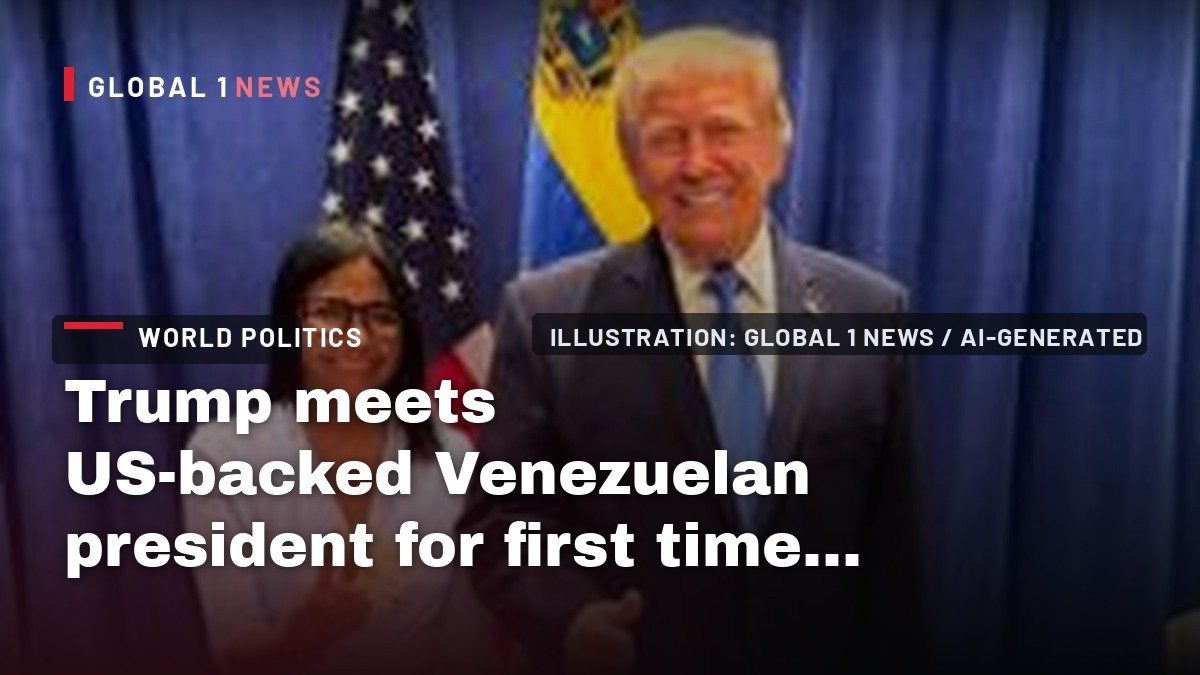
In a scene that feels more like a political theater than a diplomatic encounter, U.S. President Donald Trump sat down with Venezuela’s interim president, Delcy Rodríguez, at the United Nations General Assembly this week. The meeting, the first face‑to‑face dialogue between the two leaders since the United States backed Rodríguez to replace Nicolás Maduro, underscores a dramatic shift in the power dynamics of a country long isolated by sanctions and internal turmoil. It also raises unsettling questions about the future of Venezuela’s oil wealth, regional security, and the role of foreign powers in shaping Latin America’s destiny.
The backdrop: a U.S.‑backed power shift
The encounter cannot be understood without recalling the events that brought Rodríguez to the presidential seat. In a bold move that stunned the international community, U.S. forces carried out a raid on Caracas, capturing Maduro and delivering him to a New York jail where he now awaits trial on drug‑trafficking and other charges. Within days of that operation, Rodríguez was sworn in as interim president by Venezuela’s National Assembly, a ceremony described as having the “White House’s blessing.” This rapid transition, facilitated by Washington, marks a stark departure from the usual diplomatic pathways that have historically governed regime changes in the region.
Rodríguez’s ascent is also notable because she had previously served as Maduro’s vice‑president and was placed on a U.S. sanctions list in 2018. Those sanctions were lifted in April of this year, clearing the way for her to assume a more open relationship with Washington. The lifting of sanctions, coupled with her appointment, signals a pragmatic, if controversial, recalibration of U.S. policy toward Venezuela, moving from containment to partnership under a government perceived as more amenable to American interests.
The oil deal that reshapes the market
At the heart of the Trump‑Rodríguez meeting lay a staggering oil agreement that grants the United States control over more than 65 billion barrels of Venezuelan reserves—roughly a fifth of the country’s total oil wealth. The deal, described by the administration as the “biggest oil deal in world history,” awards a U.S.–led consortium a 100‑year concession over 17 oilfields. Such a long‑term lease effectively hands a foreign power a generational stake in one of the world’s most oil‑rich nations.
Trump emphasized the magnitude of the arrangement during his UN address, claiming that the United States and Venezuela together now control “more than 60 %” of the world’s oil. While the exact percentage is a rhetorical flourish, the underlying message is clear: the United States is positioning itself as a dominant player in the global energy market, leveraging Venezuela’s resources to bolster its own strategic and economic leverage.
Security cooperation and the promise of stability
Beyond oil, Rodríguez told Trump that the two leaders discussed advancing cooperation in “strategic areas such as energy, mining, and security.” The inclusion of security in the agenda reflects a broader U.S. concern about the stability of a nation that has long been plagued by crime, corruption, and the influence of illicit drug networks. By aligning with a government that emerged from a U.S. raid, Washington hopes to secure a partner that can help curb transnational criminal activities that spill over into neighboring countries.
Accompanying the presidents were senior U.S. officials—Secretary of State Marco Rubio and White House Chief of Staff Susie Wiles—signaling the high priority the administration places on this partnership. Their presence suggests that the United States intends to embed its security objectives within the broader framework of economic cooperation, a strategy that blends hard and soft power to cement influence in the region.
Regional reactions and the specter of foreign intervention
The rapid realignment of Venezuela’s leadership under U.S. auspices has sparked unease across Latin America. Historically, the region has been wary of external powers dictating internal political outcomes, a sentiment that resurfaces whenever Washington intervenes directly. While some neighboring governments may welcome a more stable, U.S.-aligned Venezuela, others view the episode as a dangerous precedent that could embolden future interventions.
Opposition leader María Corina Machado, who has been barred from re‑entering Venezuela, remains a vocal critic of the new regime. Her exclusion from the political process underscores the limited space for dissent under Rodríguez’s interim government, raising concerns about democratic legitimacy and the extent to which the United States is willing to overlook internal repression in exchange for strategic gains.
The human cost behind the geopolitical chessboard
Amid the high‑level talks and oil contracts, ordinary Venezuelans continue to grapple with the daily hardships that have defined the country for years—hyperinflation, shortages of basic goods, and a fractured health system. The promise of “advancing cooperation” in sectors like mining and energy may eventually translate into jobs or infrastructure, but the immediate impact on the populace remains uncertain.
Moreover, the fact that the meeting took place only a few kilometres from the New York jail where Maduro is held adds a stark visual reminder of the personal toll of this power shift. Families of political prisoners, activists, and ordinary citizens watch as their nation’s resources are negotiated in distant boardrooms, while many still struggle to secure a meal each day.
Looking ahead: what the oil concession means for Venezuela’s future
The 100‑year concession over 17 oilfields effectively locks Venezuela into a century‑long partnership with a foreign consortium. While the influx of capital and technology could revitalize production, it also risks cementing a dependency that may limit the country’s sovereignty over its own natural wealth. The agreement’s scale—controlling a fifth of the nation’s reserves—means that any future government will inherit a legacy of external control that could shape policy choices for generations.
Given the volatile nature of global oil markets, the long‑term profitability of such a deal remains uncertain. Yet the United States’ willingness to secure a foothold in Venezuela’s oil sector signals a strategic calculation: control over energy resources is a lever for geopolitical influence, especially as other powers, such as China and Russia, also vie for a presence in Latin America.
Conclusion: a fragile partnership under scrutiny
The Trump‑Rodríguez meeting at the UN marks a pivotal moment in the ongoing saga of Venezuela’s political and economic transformation. It reflects a bold U.S. strategy that blends military intervention, economic partnership, and diplomatic engagement to reshape a nation’s trajectory. However, the partnership rests on a fragile foundation—one built on a contested legitimacy, a sweeping oil concession, and a region wary of foreign meddling.
As the United States and Venezuela move forward with their “cooperation agenda,” the eyes of Latin America will remain fixed on how this alliance impacts everyday lives, regional stability, and the broader balance of power. The story is still unfolding, and the consequences—both for the Venezuelan people and for the future of the continent—will be judged not only by oil barrels and security agreements, but by the lived realities of those who have endured years of hardship and now stand at the crossroads of a new, uncertain era.
This article was produced with AI-assisted research and editorial support. Reporting is based on the source material cited below. Sources: BBC News Latin America; bbc.co.uk; Global1.News (23 September 2026).
By Elena Vasquez, Staff Writer
What's Your Reaction?
 Like
0
Like
0
 Dislike
0
Dislike
0
 Love
0
Love
0
 Funny
0
Funny
0
 Wow
0
Wow
0
 Sad
0
Sad
0
 Angry
0
Angry
0

Latin America Correspondent at Global1.News. Based in Mexico City, covering politics, economics, energy, and culture across the region. Brings an on-the-ground perspective to stories spanning from the Rio Grande to Patagonia.









Comments (0)