
Trump admin again denies Abbas, Palestinian officials visas to attend UN General Assembly
The United States’ decision to deny visas to the Palestinian Authority (PA) delegation for this year’s United Nations General Assembly marks the second consecutive year of such a refusal, a move that underscores the deepening diplomatic rift between Washington and Ramallah.
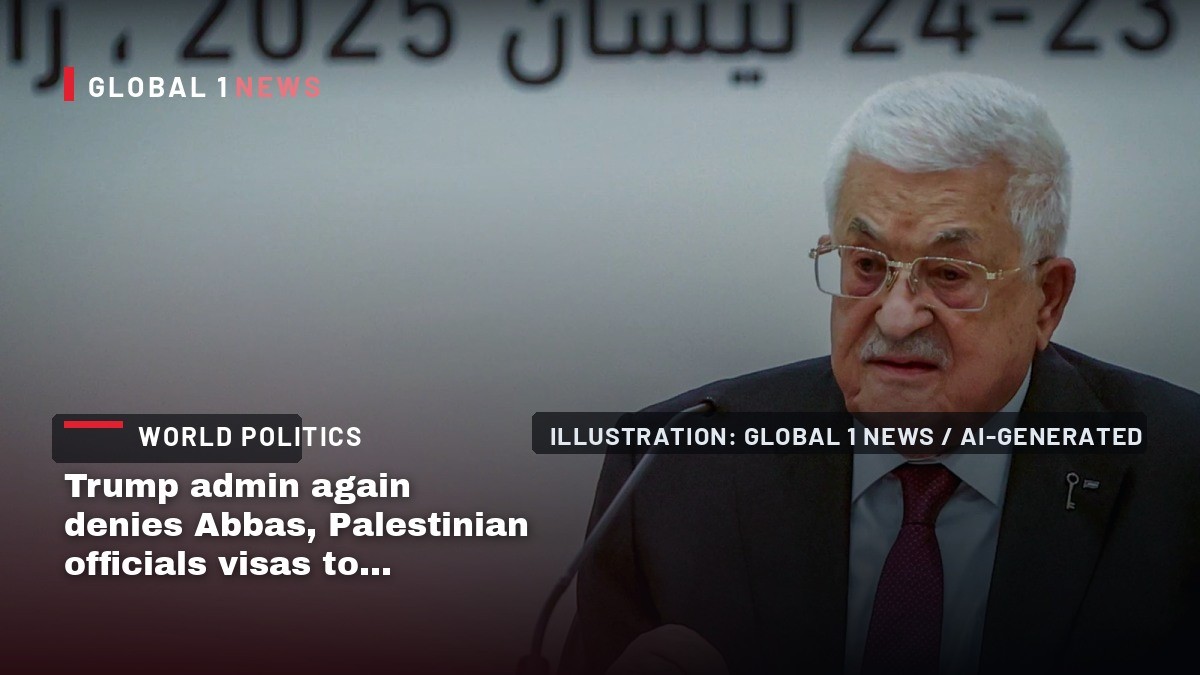
The United States’ decision to deny visas to the Palestinian Authority (PA) delegation for this year’s United Nations General Assembly marks the second consecutive year of such a refusal, a move that underscores the deepening diplomatic rift between Washington and Ramallah. The State Department’s justification, issued on Wednesday, links the denial to what it describes as the PA’s continued reliance on “international lawfare” against Israel and a pattern of actions that, in its view, sidestep direct negotiations in favor of unilateral diplomatic initiatives.
State Department’s Rationale
The official statement from the State Department frames the visa denial as a response to what it calls a failure by the PA and the Palestine Liberation Organization (PLO) to honor previously‑made commitments. According to the department, the two entities have “once again, failed to live up to their commitments” by pursuing legal strategies at international forums rather than engaging in direct talks aimed at a negotiated settlement.
Specifically, the department alleges that the PA and PLO have been “initiating and supporting actions at international organizations that undermine and contradict prior commitments,” and that they are “taking actions to internationalize” the conflict through bodies such as the International Criminal Court and the International Court of Justice. The language suggests that Washington views these legal avenues as a means for the Palestinians to bypass the diplomatic track that the United States has long championed.
Accusations of Terrorist Support
Beyond the legal‑strategic criticism, the State Department adds a more serious charge: the PA is “continuing to pay stipends to terrorists and glorify acts of terrorism and terrorists in public pronouncements and school textbooks.” This allegation aligns with a broader U.S. policy narrative that links financial support to families of militants with the perpetuation of violence, a point that has been a recurring theme in American diplomatic pressure on the PA.
The statement does, however, note that waivers were granted to members of the Palestinian “observer” mission already stationed at the United Nations. This limited concession indicates a nuanced approach—allowing a minimal presence while still restricting the delegation’s ability to engage fully in the high‑level debate week.
Timing and the UN General Assembly Agenda
The denial comes just days before the UN General Assembly’s high‑level debate week, a period when heads of state and senior officials address the global body on pressing international issues. The timing, according to observers, is unlikely to be coincidental. JNS reports that the Assembly will vote on a resolution Thursday that would permit the PA to participate via video or pre‑recorded statements, a compromise that would enable a limited Palestinian voice while still reflecting Washington’s stance on visa restrictions.
Palestinian President Mahmoud Abbas is slated to speak on September 24, the same day Israeli Prime Minister Benjamin Netanyahu is scheduled to address the Assembly. The parallel scheduling underscores the symbolic contest for narrative dominance at the world stage, with each leader poised to present their respective visions for the conflict and its resolution.
U.S. Diplomatic Engagement Patterns
According to the source material, the Trump administration’s direct contact with the PA has been limited in recent months. In contrast, U.S. officials appear to meet more frequently with representatives of Hamas, the militant group that controls Gaza. This shift in engagement patterns signals a possible recalibration of American diplomatic priorities, perhaps reflecting a belief that Hamas, as the de‑facto authority in Gaza, is a more immediate interlocutor on security and humanitarian concerns.
The administration’s lack of clear signals regarding the PA’s role in any future governance structure for Gaza further deepens the uncertainty. While Abbas has publicly called for a role for the PA in post‑war administration, the United States has offered no indication that it will endorse such a position, leaving the Palestinian leadership in a precarious diplomatic limbo.
Implications for Palestinian Representation
The visa denial and the limited waiver for the observer mission together constrain the PA’s ability to fully participate in a key diplomatic forum. By restricting physical presence, the United States effectively limits the PA’s capacity to engage in side‑door negotiations, network with other delegations, and influence the broader discourse beyond a pre‑recorded statement.
For the Palestinian public, the move may be perceived as another setback in the quest for international recognition and legitimacy. The PA’s reliance on multilateral platforms to amplify its narrative has been a cornerstone of its diplomatic strategy; curtailing that avenue could have reverberations in domestic political calculations and in the broader regional perception of Palestinian agency.
Regional Context and Reactions
The decision occurs against a backdrop of heightened regional tension, with the Gaza conflict still fresh in the collective memory of neighboring states. While the source material does not detail reactions from other Arab or Muslim-majority countries, the broader diplomatic environment suggests that any perceived marginalization of Palestinian representation at the UN could provoke criticism from allies of the PA and from nations that champion the Palestinian cause in international forums.
At the same time, Israel’s own diplomatic posture remains assertive. Prime Minister Netanyahu’s scheduled address to the Assembly on the same day as Abbas underscores Israel’s intent to present its narrative directly to the global community, emphasizing security concerns and the legitimacy of its actions in the recent conflict. The parallel speeches set the stage for a direct contest of narratives on the world stage.
Looking Ahead: Prospects for Dialogue
The continuation of visa refusals signals a hardening of the United States’ policy stance toward the PA, at least in the short term. Without a shift in the PA’s approach to international legal mechanisms—or a demonstrable change in its alleged support for terrorism, as alleged by the State Department—the likelihood of a reversal appears slim.
Nevertheless, the upcoming UN vote on allowing video participation offers a narrow window for the PA to maintain a presence, albeit limited, in the high‑level debate. Whether this concession will translate into substantive diplomatic leverage remains uncertain. For Israeli officials, the focus will likely remain on securing international support for their security narrative, while for Palestinian leaders, the challenge will be to keep their cause visible despite the constraints imposed by the United States.
This article was produced with AI-assisted research and editorial support. Reporting is based on the source material cited below. Sources: JNS (Jewish News Syndicate); jns.org; Global1.News (18 September 2026).
By Hannah Berg, Staff Writer
What's Your Reaction?
 Like
0
Like
0
 Dislike
0
Dislike
0
 Love
0
Love
0
 Funny
0
Funny
0
 Wow
0
Wow
0
 Sad
0
Sad
0
 Angry
0
Angry
0
Israel Correspondent at Global1.News. Based in Tel Aviv, covering Israeli politics, security, technology, and society. Provides balanced, deeply-sourced reporting on one of the most closely-watched regions in the world.












Comments (0)