
T&T named partner in new US military command — and Port of Spain stays silent
Trinidad and Tobago's name is on the list. The United States has formally named the Trinidad and Tobago Defence Force as an operating partner in its newest military command for the hemisphere — a task force built to take on drug-trafficking networks that Washington has compared to Al Qaeda and the...
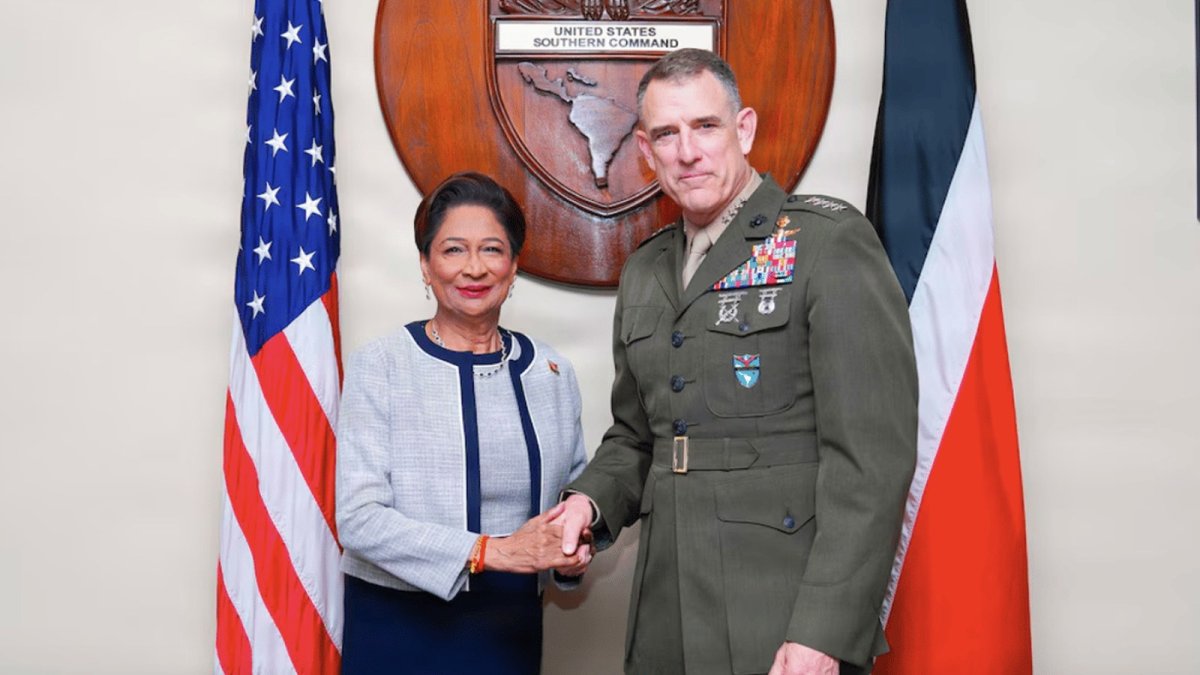
Trinidad and Tobago's name is on the list. The United States has formally named the Trinidad and Tobago Defence Force as an operating partner in its newest military command for the hemisphere — a task force built to take on drug-trafficking networks that Washington has compared to Al Qaeda and the Islamic State. And yet, as of this week, the Government in Port of Spain has said almost nothing about it.
The announcement came on Friday August 7, 2026, from the US Embassy in Port of Spain, carried by the Caribbean Media Corporation. It said the activation of Joint Task Force Western Hemisphere (JTF-WHEM) by US Southern Command had further strengthened bilateral security cooperation with Trinidad and Tobago. The statement was brief. The implications are not.
What we know about the new command
JTF-WHEM is described as a purpose-built task force that will coordinate US military operations with Caribbean and Latin American allies — Trinidad and Tobago included — to counter transnational criminal networks, enhance regional maritime interdiction and respond rapidly to humanitarian crises. It is the operational arm of a broader American push that, according to The New York Times, US officials have compared to past military campaigns against Al Qaeda and the Islamic State.
The US Embassy tied the task force directly to Trinidad and Tobago's ongoing participation in the Americas Counter Cartel Coalition (A3C), an 18-nation grouping. Both, the Embassy said, "reflect a shared commitment to defend sovereignty, strengthen regional security, and confront narco-terrorist networks."
But the fine print matters. This is not a training exercise or a diplomatic talking shop. JTF-WHEM is a military command, and the Defence Force's name appears among its operating partners. For a small Caribbean state, that placement raises questions that go far beyond the language of a press release.
What precisely will the partnership involve? Will Trinidadian vessels and personnel be placed under American operational control in certain circumstances? Will the Defence Force participate in strikes, or only in surveillance and interdiction? None of this has been publicly explained.
The silence from Port of Spain
The most striking feature of this week's announcement is not what Washington said — it is what Port of Spain did not say. Caribbean360 reports that the Government has offered virtually no public comment on the arrangement. At a moment when citizens might expect a statement explaining what it means to have the Defence Force listed as a partner in a US military command with lethal-force authority in the region, word from the capital has been scarce.
That silence is itself a story. When a small nation signs onto a security arrangement with the world's largest military power, citizens are entitled to know the terms. What commitments were made? What obligations flow from the partnership? What happens if a Trinidadian vessel or service member is involved in an operation that goes wrong? None of this has been publicly addressed.
Opposition Leader Pennelope Beckles has offered the only public political comment on the broader arrangement, saying the implications of Trinidad and Tobago signing on to the Doral Charter "remain to be seen." It is a measured response — but it also reflects how little information has been placed before the public.
This is not simply a matter of transparency for its own sake. The security choices made in Washington and Port of Spain will shape the Caribbean's maritime environment for years to come, and citizens deserve a seat at that table.
How Trinidad and Tobago got here
The path to this moment began in March 2026, when Prime Minister Kamla Persad-Bissessar travelled to Miami for the Shield of the Americas Summit at Trump National Doral. Trinidad and Tobago was among roughly 17 nations that signed the so-called "Doral Charter" — a coalition described as committed to the use of "lethal force" against drug cartels. The Prime Minister reportedly received one of President Donald Trump's signing pens.
The symbolism was potent. Several left-leaning governments in the hemisphere, including Brazil, Mexico and Colombia, were not invited to the summit. The absence of countries with deep experience of cartel violence underscored the political character of the coalition Washington was building. This was not a neutral multilateral exercise; it was a public alignment, and Trinidad and Tobago was on one side of it.
For a small developing nation, the decision to sign was never going to be free of controversy. The explicit commitment to lethal force sits uneasily with a country whose crime problems, while serious, are a world away from the cartel wars of Mexico or Colombia. Yet the Government's public explanations at the time were thin — and they have only grown thinner since.
The wider picture: Operation Southern Spear
The new task force did not emerge from a vacuum. It follows Operation Southern Spear, the US military campaign of strikes on suspected drug-trafficking vessels in the Caribbean Sea that began in September 2025. The declared aim was "detecting, disrupting, and degrading transnational criminal and illicit maritime networks." Trinidad and Tobago publicly backed the United States during that campaign's buildup.
But the campaign has become increasingly controversial. On February 17, 2026, according to US military reporting, US forces struck three suspected drug-trafficking boats in international waters, killing 11 people. Then, in July 2026, CNN reported that the boat strikes may not have worked. The mission's official goals are classified, according to a May 20 report from the Pentagon's inspector general, and the Pentagon watchdog is reviewing the maritime strikes amid legal concerns.
For the Caribbean, those developments are deeply unsettling. These waters are not a distant battlefield; they are our fishing grounds, our trade routes, our lifelines. When a US task force is given authority to strike vessels in this region, and when the results of such strikes are both unverified and legally contested, the risks to Caribbean lives and livelihoods become a matter of urgent concern.
What it means for Trinidad and Tobago and the Caribbean
The central tension is now impossible to ignore. Trinidad and Tobago's name appears on the partner list of a new US military command with lethal-force authority in the region, while the Government has offered its citizens almost no explanation of what that means for national sovereignty, for the local security situation, or for the wider Caribbean.
For a small state, sovereignty is not an abstraction. It is the ability to decide who enters your waters, under what rules, and with what authority. Every security partnership involves some surrender of that autonomy. The question is whether the terms are transparent and whether the public has been consulted. On both counts, the current silence is a failure.
There is a regional dimension as well. As a founder of CARICOM, Trinidad and Tobago's security choices ripple across the Caribbean. Other member states will be watching closely — some with interest, others with alarm. A coalition that excludes Brazil, Mexico and Colombia, and that operates with classified goals and contested legal authority, is not the kind of arrangement that builds regional consensus.
The Caribbean's energy trade and transshipment routes — the lifeblood of many regional economies — run through these same waters. A security arrangement that operates without clear public accountability does not just threaten sovereignty in the abstract; it puts livelihoods at risk in practice. Regional institutions have a role to play in demanding answers on behalf of the people of the Caribbean.
None of this is to say that cooperation with the United States on maritime security is wrong. The drug trade is real, and it flows through Caribbean waters. But cooperation must be built on clear rules, public accountability and genuine partnership — not silence.
The Government owes this country an answer. What exactly did Trinidad and Tobago sign? What authority has been granted? And what happens the first time a Trinidadian life is caught in the crossfire of a mission whose goals are classified? Until Port of Spain speaks, those questions will hang over every vessel that sails our waters.
By Sharon Sahatoo, Staff WriterThis article was produced with AI-assisted research and editorial support. Reporting is based on sources cited in the article.
What's Your Reaction?
 Like
0
Like
0
 Dislike
0
Dislike
0
 Love
0
Love
0
 Funny
0
Funny
0
 Wow
0
Wow
0
 Sad
0
Sad
0
 Angry
0
Angry
0
Caribbean Correspondent at Global1.News. Based in Port of Spain, Trinidad, covering Caribbean politics, economy, energy, climate, and culture. Amplifying the voices and stories of the Caribbean region.










Comments (0)