
Toyota orders workers to train humanoid robots but says humans won't be replaced
Toyota is already putting its workforce on the front lines of a robotic revolution, training humanoid machines to mimic the precise hand movements of seasoned assembly‑line workers.
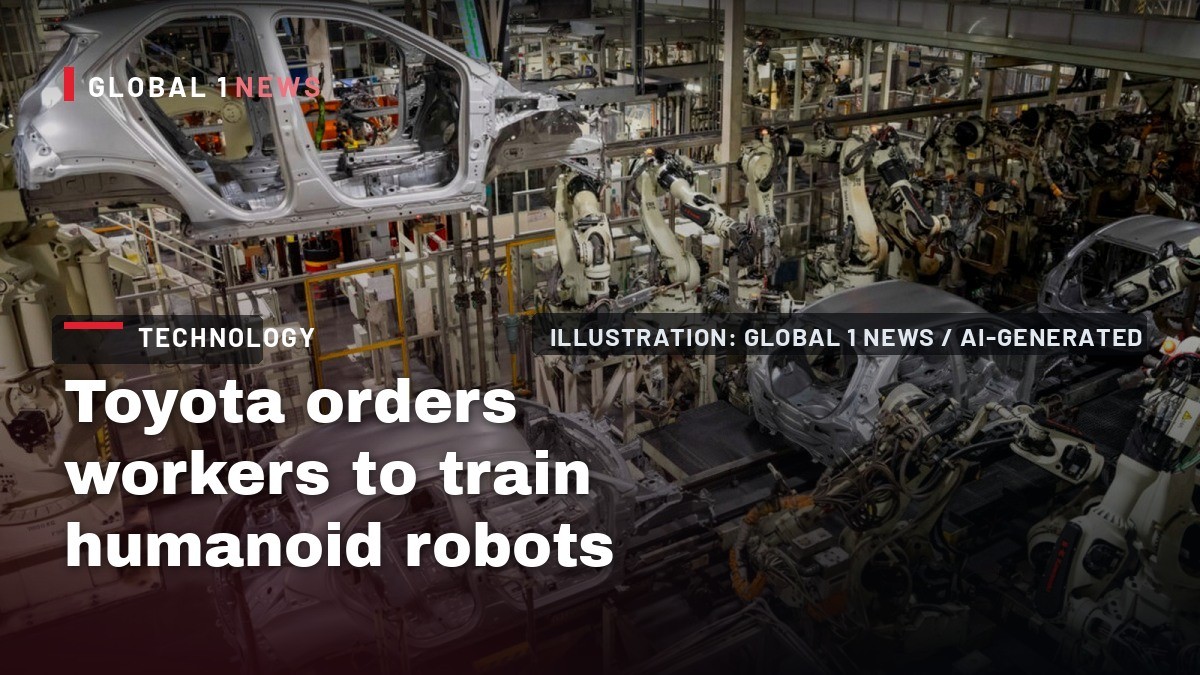
Toyota is already putting its workforce on the front lines of a robotic revolution, training humanoid machines to mimic the precise hand movements of seasoned assembly‑line workers. The automaker’s push to field 400,000 factory robots by the end of the decade has drawn headlines, but a senior executive insists the goal is not to replace people—it’s to build a workplace where robots and humans coexist. As the rollout gathers steam, the implications for Toyota’s 18,000‑strong global labor force, and for the broader auto industry, merit a close look.
The Scale of Toyota’s Robotic Ambition
Starting in 2028, Toyota plans to pour roughly $6.42 billion a year into modernising its plants with a new robotic workforce, according to a report from Nikkei Asia. The company’s target split is 150,000 robots in its own vehicle factories and an additional 250,000 in group‑company facilities that churn out components and raw materials. Those figures translate to a total of 400,000 machines—a scale that would dwarf any single‑industry deployment to date.
The robots in question are not the traditional, stationary arms that have long populated automotive assembly lines. Toyota’s current focus is on its ELEY humanoid platform, a wheeled unit equipped with finger‑like “jigs” that allow it to practice the fine‑motor tasks human workers perform daily. By teaching these machines on the shop floor, Toyota hopes to accelerate the learning curve that has historically hampered the adoption of more flexible, mobile robots.
Human Workers as Trainers, Not Targets
Workers at Toyota’s 60 factories worldwide—including 11 sites in the United States—are already wearing the same jigs that the ELEY robots use, effectively serving as live instructors. Hiroki Nakajima, an executive vice president, told Nikkei Asia that the company envisions “a world where robots coexist with humans, rather than replacing them.” That sentiment frames the training program as a partnership: humans impart skill, robots absorb it, and both continue to operate side by side.
Nonetheless, the presence of 18,000 veteran employees on the line raises legitimate questions about job security. Labor unions have historically pushed back against automation that threatens wages or employment levels, and the rollout of a half‑million robots could intensify that tension. Toyota’s public stance, however, is clear: the robots are meant to augment, not supplant, the human workforce.
Global Context: How Toyota’s Plan Stacks Up
Japan already sits near the top of the global industrial‑robot leaderboard, with 450,500 units deployed in 2024, according to the International Federation of Robotics. China leads with two million robots, while the United States and South Korea reported 34,200 and 30,600 respectively. Toyota’s ambition to add 400,000 new units would push Japan’s total well beyond its current rank, reinforcing the nation’s position as a robotics powerhouse.
What sets Toyota apart is its focus on humanoid platforms. While most industrial robots remain fixed‑position arms or simple mobile carriers, humanoids promise general‑purpose flexibility. If Toyota can successfully train these machines to handle a variety of tasks—from delicate wiring to component sequencing—it could set a new benchmark for what “robotic automation” looks like in a mass‑production environment.
Technical Hurdles and Safety Concerns
Humanoid robots still face a litany of challenges before they can be deployed at scale. Safety around human workers remains a paramount issue; any mishap involving a wheeled robot with articulated fingers could have serious consequences on a crowded assembly floor. Moreover, the hardware and AI required for true autonomy are still in early development stages, and mass‑production capabilities have only just begun to emerge.
Cost‑effectiveness is another unanswered question. While Toyota is committing billions to the transition, the per‑unit expense of a sophisticated humanoid robot remains higher than the wage of a skilled worker in many markets. The company’s willingness to absorb that cost suggests a strategic bet that the long‑term gains—greater flexibility, reduced reliance on a shrinking labor pool, and the ability to pivot production lines quickly—will outweigh the initial outlay.
Industry Momentum: Competitors Join the Race
Toyota is not alone in betting on humanoids. Chinese EV makers Xpeng and Nio have already begun developing their own platforms, and South Korean giant Hyundai announced plans to field Atlas robots from Boston Dynamics starting in 2028. Hyundai’s goal is to install up to 25,000 Atlas units across its and Kia’s plants over the next few years, a figure that, while modest compared with Toyota’s target, signals a broader industry shift toward mobile, human‑like automation.
Boston Dynamics underscored this momentum by opening a robotics training center at Hyundai Motor Group Metaplant America in Georgia on September 21. The center will teach Atlas robots to sequence automotive parts and place them correctly for assembly—a core competency that mirrors the tasks Toyota’s ELEY robots are learning today. The parallel development paths suggest a converging consensus: the future of auto manufacturing will be a hybrid of human craftsmanship and robotic precision.
Labor Market Realities and the Aging Workforce
The push for robots is partially driven by demographic pressures. Toyota’s global workforce includes a sizable cohort of veteran employees, many of whom are approaching retirement age. As the industry grapples with an aging labor pool and a shortage of skilled younger workers, automation offers a way to maintain production capacity without over‑relying on a dwindling talent pipeline.
However, the transition is not without friction. Labor unions have expressed concerns about potential layoffs and the impact on worker compensation. While Toyota’s leadership frames the initiative as a collaborative effort, the reality on the shop floor may evolve as robots prove their reliability and cost advantage. The balance between preserving jobs and embracing efficiency will likely shape the next few years of labor negotiations in the auto sector.
What the Next Five Years Could Look Like
By 2028, Toyota expects to begin its annual $6.42 billion investment, signaling the start of a multi‑year rollout. If the training programs at current plants succeed, we could see a gradual substitution of humanoid units for the most repetitive, precision‑heavy tasks, while human workers focus on supervision, quality control, and complex problem‑solving. This hybrid model could become the new norm not just for Toyota, but for the entire automotive supply chain.
In the meantime, the industry will watch closely how Toyota measures the performance of its ELEY robots against traditional automation. Metrics such as error rates, downtime, and the speed of task acquisition will determine whether the hefty investment pays off. As the data comes in, stakeholders—from investors to labor representatives—will gauge whether the promise of “robots coexisting with humans” is a realistic vision or a marketing tagline.
This article was produced with AI-assisted research and editorial support. Reporting is based on the source material cited below. Sources: Ars Technica; arstechnica.com; Global1.News (22 September 2026).
By Jessica Ali, Staff Writer
What's Your Reaction?
 Like
0
Like
0
 Dislike
0
Dislike
0
 Love
0
Love
0
 Funny
0
Funny
0
 Wow
0
Wow
0
 Sad
0
Sad
0
 Angry
0
Angry
0

Editor-in-Chief at Global1.News. Atlanta-based journalist who cuts through the BS and tells it like it is. Lead anchor, host, and the voice you hear when the spin stops and the truth starts.














Comments (0)