
The Mecca Pact: A New Treaty Organization, Just Like the Old One
In early August 2026, Pakistan, Saudi Arabia and Turkiye signed the Mecca Joint Defense Agreement (MJDA), a collective security pact that has quickly become the focus of regional strategic discourse.
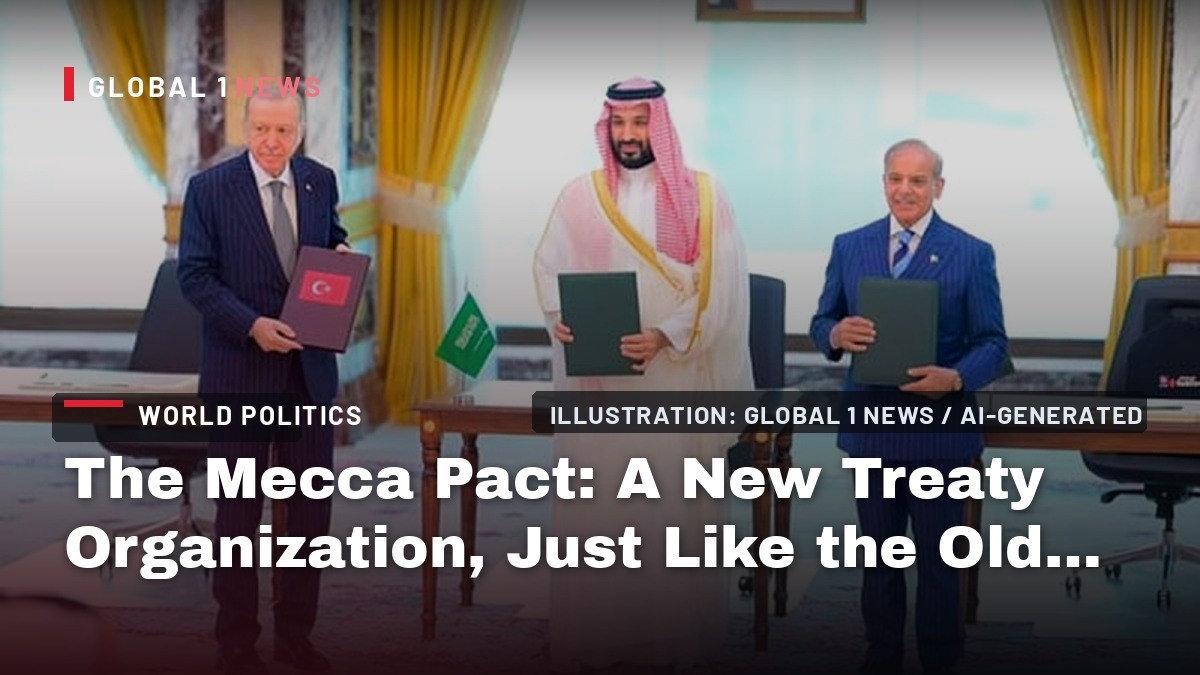
In early August 2026, Pakistan, Saudi Arabia and Turkiye signed the Mecca Joint Defense Agreement (MJDA), a collective security pact that has quickly become the focus of regional strategic discourse. While some commentators have hailed the MJDA as a transformative force that could eclipse the North Atlantic Treaty Organization (NATO), a broader historical perspective suggests a more modest, perhaps even circumscribed, impact. By tracing the origins, structure and outcomes of Cold‑War‑era alliances—most notably the Central Treaty Organization (CENTO)—and by comparing their trajectories with the present circumstances of the three signatories, we can assess the likely efficacy of the MJDA in addressing the security challenges that motivated its creation.
Historical Antecedents: The Baghdad Pact and the Evolution of CENTO
The MJDA’s most immediate historical analogue is the Baghdad Pact of 1955, which later rebranded as the Central Treaty Organization after Iraq’s 1958 withdrawal. The original pact linked Iran, Iraq, Pakistan, Turkiye (then spelled Turkey) and the United Kingdom, with the United States initially participating as an observer. Its formation was a direct response to the post‑World War II realignment of power and the emerging bipolar contest between capitalism and communism. Washington’s strategic calculus, articulated in the “Long Telegram,” sought to extend containment beyond the NATO perimeter by establishing a chain of friendly states stretching from Ankara to Karachi.
Despite its lofty objectives—mutual defense against Soviet aggression, economic cooperation, and the creation of joint infrastructure such as a nuclear research centre in Tehran and communication links funded by Washington—the alliance quickly encountered internal fractures. A 1958 military coup in Iraq precipitated that nation’s exit, and a subsequent Ba’athist revolution extinguished any realistic prospect of Iraqi reintegration. The remaining members continued under the CENTO banner, yet the organization’s relevance waned, as illustrated by the 1963 Karachi summit that devolved into a ceremonial dedication of a cement factory rather than substantive security coordination.
Structural Weaknesses: Limited Commitment and Absence of Enforcement Mechanisms
Both CENTO and the MJDA share a common structural shortcoming: the absence of robust, enforceable obligations. CENTO’s defense articles emphasized “mutual cooperation, non‑interference in internal affairs and respect for pre‑existing obligations,” while leaving open the possibility of accession by additional Arab League members—none of which ever joined. The United States, though willing to provide military or economic assistance, never assumed a binding guarantee to intervene on behalf of the alliance. Consequently, the pact’s defensive promise remained largely symbolic, with real security cooperation confined to bilateral arrangements rather than collective action.
The MJDA mirrors this pattern. Its three signatories confront divergent security environments and possess disparate strategic priorities. Pakistan continues to be preoccupied with a low‑grade conflict with India, Turkiye remains the largest ground force within NATO, and Saudi Arabia pursues a regional adventurism that does not align neatly with the defence postures of its partners. As a result, the MJDA, like CENTO, is “a treaty without teeth,” offering limited practical coordination beyond the diplomatic affirmation of shared interests.
Member States’ Divergent Threat Perceptions
Pakistan’s security calculus is dominated by its longstanding rivalry with India. The article notes that “India remains the primary threat to Pakistan and the reason that the latter has long sought strategic ‘depth’ in Afghanistan.” This enduring concern drives Pakistan’s defence planning and limits its capacity to devote resources to a multilateral framework that does not directly address the Indo‑Pakistani standoff.
Turkiye’s position is equally complex. Although it has gravitated toward strong‑man governance and has demonstrated a fluid approach to defence procurement—illustrated by its purchase and subsequent resale of Russian S‑400 systems—it remains a NATO member with substantial conventional forces. The MJDA offers Riyadh little in terms of conventional capability, and Turkiye’s strategic interests are more closely tied to the stability of the Black Sea region, the Baku‑Tbilisi‑Ceyhan oil pipeline and its own NATO commitments than to the security of the Persian Gulf.
Saudi Arabia’s regional policy, characterised in the source as “adventurism,” is driven by aspirations for influence that extend beyond its immediate neighbourhood. The article suggests that Riyadh’s ambitions are “mistaken” in the context of the MJDA, as neither Pakistan nor Turkiye are likely to endorse Saudi initiatives that could entangle them in costly regional confrontations. This misalignment further undermines the prospect of cohesive collective defence.
Economic and Infrastructure Aspirations: Lessons from CENTO’s Unfulfilled Projects
Beyond pure military considerations, CENTO attempted to foster economic integration through projects such as a joint nuclear research centre in Tehran and communication corridors linking Ankara, Tehran and Karachi. While these initiatives were ambitious, they never achieved the transformative impact envisioned, partly because the underlying political cohesion was insufficient to sustain long‑term investment and cooperation.
The MJDA, by contrast, has not articulated a comparable suite of economic or infrastructural programmes. The source material does not mention any new joint projects, suggesting that the agreement is presently confined to a defensive declaration rather than a broader economic partnership. Without such complementary mechanisms, the MJDA lacks the multidimensional leverage that could otherwise bind its members more tightly and create mutual dependencies that reinforce collective security.
Geopolitical Context: A Transforming Global Order and the Limits of Regional Pacts
The early 2020s have witnessed a fluid international environment in which the traditional “modus vivendi” among the United States, Europe, Russia and China remains unsettled. Proxy conflicts and shifting alliances have challenged the post‑Cold‑War order, prompting some analysts to speculate about the demise of NATO. The source cautions, however, that “reports of NATO’s death are greatly exaggerated,” underscoring the resilience of existing security architectures.
In this context, the MJDA emerges as a regional response to perceived gaps in the global security architecture. Yet, as with CENTO, the pact’s efficacy is constrained by the divergent national interests of its members and by the absence of a credible external guarantor willing to provide the “military or economic assistance necessary to preserve member states’ independence.” The lack of such a guarantor means the MJDA will likely remain a diplomatic statement rather than a decisive security instrument.
Comparative Outlook: MJDA, CENTO and the Commonwealth of Independent States Model
The article draws a parallel between the MJDA and the Commonwealth of Independent States (CIS), describing the latter as “a forum for warm promises and suppressed disgruntlement.” This analogy highlights the tendency of regional arrangements to become platforms for rhetorical solidarity without translating into substantive joint action. CENTO’s experience—marked by limited collective defence, reliance on bilateral deals, and eventual marginalisation—reinforces this pattern.
Given these precedents, the MJDA is likely to follow a similar trajectory. Its members will continue to pursue independent defence and security planning, as they have done under CENTO and in the contemporary era. The pact may serve as a venue for diplomatic coordination and for signalling shared concerns, but it is unlikely to resolve the core security dilemmas that motivated its inception.
Forward‑Looking Assessment: Potential Paths for the MJDA’s Evolution
While the historical record suggests modest expectations, the MJDA could still evolve in ways that enhance its relevance. One avenue would be the development of concrete, joint projects—perhaps in maritime security, counter‑terrorism or infrastructure—areas where the three states possess complementary capabilities. Such initiatives could generate “mutual dependence” and create a foundation for deeper security cooperation.
Another possibility lies in expanding the alliance’s membership to include additional Arab League states, thereby broadening the resource base and strategic reach. However, the CENTO experience demonstrates that external expansion is fraught; none of the invited Arab League members ever acceded, and the prospect of broader inclusion remains uncertain.
Ultimately, the MJDA’s impact will be measured by the willingness of Pakistan, Saudi Arabia and Turkiye to translate diplomatic rhetoric into actionable security collaboration. If the pact remains confined to symbolic statements, it will echo the limited legacy of CENTO. Conversely, if the members can identify shared threat domains—such as safeguarding maritime chokepoints like Bab el‑Mandeb or countering non‑state actors in the Gulf—there exists a modest but meaningful space for the MJDA to contribute to regional stability.
This article was produced with AI-assisted research and editorial support. Reporting is based on the source material cited below. Sources: The Diplomat; thediplomat.com; Global1.News (12 September 2026).
By Prof. David Park, Staff Writer
What's Your Reaction?
 Like
0
Like
0
 Dislike
0
Dislike
0
 Love
0
Love
0
 Funny
0
Funny
0
 Wow
0
Wow
0
 Sad
0
Sad
0
 Angry
0
Angry
0

East Asia/Technology Correspondent at Global1.News. Seoul-based voice covering Korean politics, technology, business, and culture. Analyzes how technology and geopolitics intersect across East Asia.













Comments (0)