
Springboks Lose World No 1 Ranking After Ellis Park Defeat
JOHANNESBURG — The Springboks walked off Ellis Park on Saturday evening with something far heavier than a 16-33 scoreline weighing on their shoulders.
Springboks Lose World No 1 Ranking After Ellis Park Defeat
JOHANNESBURG — The Springboks walked off Ellis Park on Saturday evening with something far heavier than a 16-33 scoreline weighing on their shoulders. For the first time in over a year, South Africa are no longer the world's No 1 ranked rugby team, and the manner of this defeat — a 17-point margin that stands as New Zealand's biggest-ever win over the Boks at the iconic Johannesburg venue — has sent a jolt through the entire South African sporting landscape.
The All Blacks scored five tries to South Africa's one in front of a packed Ellis Park crowd, overturning a 13-12 half-time deficit with a devastating second-half display that left the home side chasing shadows. The defeat drops the Boks to No 2 in the World Rugby rankings, with New Zealand claiming top spot after gaining 1.75 ranking points while South Africa lost the same. With the second Test of this four-match "Rugby's Greatest Rivalry" series set for Cape Town Stadium on Saturday 29 August, the Springboks now face the very real prospect of falling 2-0 behind in a series they desperately need to win.
Tags: Springboks, All Blacks, Ellis Park, Rugby's Greatest Rivalry, Rassie Erasmus, World Rugby rankings, South Africa rugby, New Zealand rugby, Cape Town Stadium, Will Jordan
The Match: A Tale of Two Halves
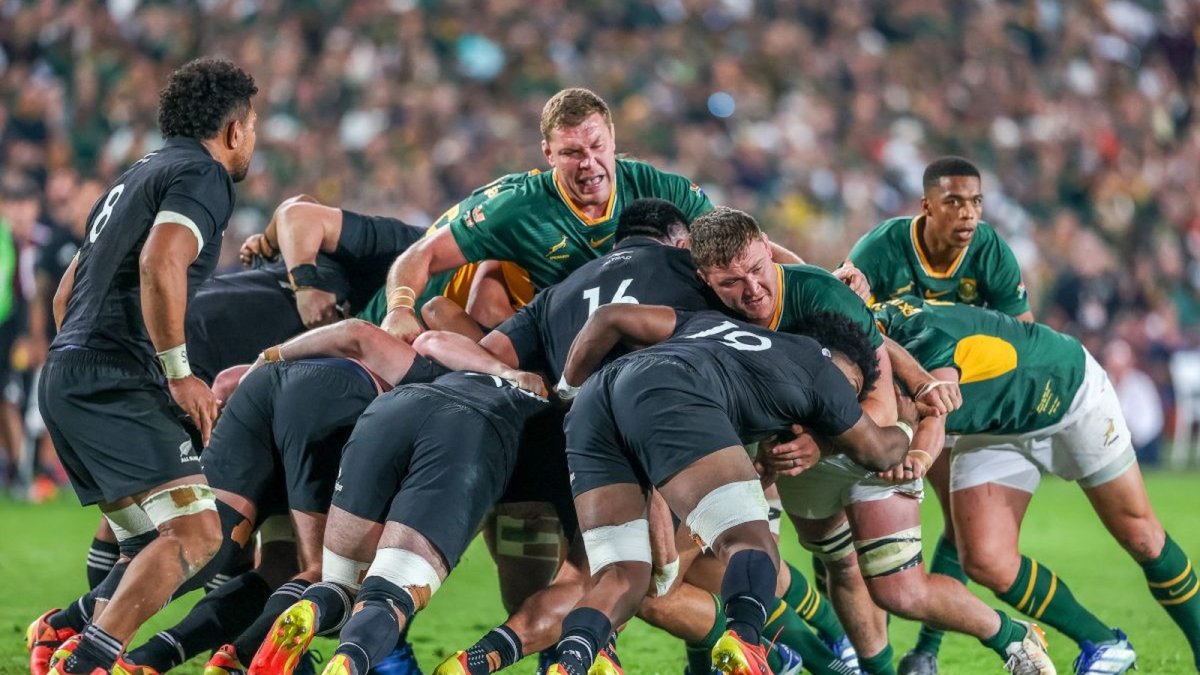
The opening exchanges suggested this would be the tight, forward-dominated arm-wrestle that South African rugby fans have come to expect from this fixture. Cheslin Kolbe slotted a fifth-minute penalty to give the Boks an early 3-0 lead, and when Will Jordan crossed for the All Blacks' first try, the home crowd barely flinched — this was always going to be a game of momentum swings. Andre Esterhuizen, introduced from the replacements bench, powered over for South Africa's only try of the afternoon, with Kolbe adding the conversion and two further penalties to send the Boks into the sheds with a slender 13-12 advantage. The scrum was dominant, the physicality was there, and the packed Ellis Park faithful dared to dream. But whatever Scott Robertson said to his All Blacks at half-time worked. New Zealand emerged a different animal. Will Jordan added his second try, Josh Moorby crossed, Fabian Holland touched down, and Luke Jacobson completed the rout as the All Blacks ran in unanswered scores after the break. Ruben Love converted four of the five tries, and suddenly the 13-12 half-time lead felt like a distant memory. The final indignity came late when the Boks were reduced to 13 men on the field following yellow cards in the closing stages. Rassie Erasmus, however, was quick to dismiss any suggestion that the numerical disadvantage had any bearing on the result. The damage was done long before.Tactical Analysis: Where Did It Go Wrong?
The Guardian's assessment was brutal but accurate: "South Africa had the muscle and the territory but far too little ambition. Their backline barely got a look-in as the game narrowed into box kicks, collisions and set-piece pressure." The Boks dominated the scrums in the first half — Ox Nche was a menace at loosehead, and the All Blacks were visibly struggling to cope with the pressure. Penalties piled up, and New Zealand were fortunate to go into the break trailing by just one point. But the moment Nche was replaced, the scrum parity shifted, and with it, the entire complexion of the match. Erasmus identified the 58th minute as the turning point. The Boks trailed 19-16 and were pressing hard against the All Blacks' scrum when they conceded a penalty on their own feed. It was a moment that encapsulated the afternoon — so much pressure, so little reward. "We were dominant in the scrums, but it doesn't help you if you're dominant in one or two parts of the game," Erasmus admitted afterwards. "The All Blacks were more dominant in most parts of the game." The box-kick game that has become a hallmark of the Springboks' tactical approach under Erasmus failed to yield the territorial dividends it usually produces. New Zealand's back three dealt with the aerial bombardment with composure, and when the Boks did try to spread the ball wide, the execution was lacking. Unforced errors — induced by New Zealand's intensity and sharpness, according to Erasmus — repeatedly killed promising attacking positions.Rankings and History: A Significant Fall
The 17-point margin was not just a defeat — it was New Zealand's biggest-ever win over the Springboks at Ellis Park. In 16 Tests between the two nations at the venue, the All Blacks have now won seven. But this one will sting more than most. South Africa entered the match as the world's No 1 ranked team. They leave it as No 2, with New Zealand taking over the top spot. The 1.75 ranking points swing is significant, but the psychological impact could be even greater. This was supposed to be the Springboks' era — back-to-back World Cup winners, a team that had built an aura of invincibility around their physicality and tactical nous. The context makes it worse. This is New Zealand's first full-scale tour of South Africa in 30 years — a proper, multi-match series that was supposed to be a celebration of the game's greatest rivalry. Instead, it has become a stark reminder that the gap between the Boks and the All Blacks, at least on this evidence, is not as narrow as the rankings suggested. The absence of injured captain Siya Kolisi was always going to be significant. Pieter-Steph du Toit led the side admirably, but the leadership void was evident in the second half when the Boks needed someone to steady the ship. The back row of Jasper Wiese, du Toit and Paul de Villiers worked hard, but they were outplayed by a New Zealand pack that grew in confidence as the match wore on.Erasmus' Verdict: No Excuses, No Sugar-Coating
Rassie Erasmus has never been one for empty platitudes, and his post-match press conference was vintage Erasmus — honest, direct, and refusing to hide behind the usual sporting clichés. "We were thoroughly beaten by a team that is now No 1 in the world — it'll be nice to go into the next game as the underdogs," he said. "I'm not going to butter it up with that cliche and say we're going to learn from this and get better. We didn't need to learn from this; we knew what we had to do on the day — we didn't do it." The message was clear: this was not a case of being caught off guard or needing time to adjust. The Boks knew what was required and failed to deliver. Erasmus acknowledged the scale of the defeat without attempting to spin it. "We have to find a way to get back, we got a good hiding from a good New Zealand side. We'll lay low and not read the papers and work very hard. We have no excuses because we could have won the game." He also addressed the broader context, drawing on past adversity to frame the road ahead. "We've been in many catastrophic situations before. We lost the first test against British and Irish Lions (in 2021, before coming back to win the series 2-1). We lost the opening game of the (2019) World Cup to New Zealand, everybody says that was catastrophic." South Africa recovered from that 2019 World Cup opening defeat to lift the Webb Ellis Cup in Japan. The parallels are there for those who want to believe. But Erasmus was careful not to overpromise. "Without a doubt, it puts them (New Zealand) in a very good position, which they thoroughly deserve. And now we have to go to Cape Town and try and win there, then it's all level. But we still have to win three matches in a row."South African Perspective: What This Means for the Series
For South African rugby fans, this defeat cuts deep. Ellis Park has been a fortress for the Boks in recent years, a venue where opposition teams come to be broken physically and mentally. To see the All Blacks run in five tries and leave with a record margin is a bitter pill to swallow. The series is now delicately poised. New Zealand lead 1-0, and with the second Test at Cape Town Stadium on Saturday 29 August, the Boks face the prospect of going 2-0 down with two matches to play. The All Blacks have a midweek fixture against the Lions franchise team in Johannesburg on Tuesday 25 August, but that is unlikely to disrupt their momentum. The questions for Erasmus and his coaching staff are mounting. Was the selection right? Should the backline have been given more opportunities to attack? Is the box-kick game becoming too predictable at the highest level? And crucially, how do the Boks respond when their physical dominance — long their greatest weapon — is neutralised? There is also the question of Kolisi's return. The captain's leadership and breakdown work were sorely missed, and his potential availability for Cape Town could provide the emotional and tactical lift the Boks desperately need. But Erasmus will not be rushed into decisions, and the squad that takes the field at Cape Town Stadium may look different from the one that started at Ellis Park.What to Watch For
The second Test at Cape Town Stadium on Saturday 29 August is now the biggest match of South Africa's year. Lose that, and the series is effectively gone. Win, and the Boks are back in it, needing to take the remaining two matches to claim the series 3-1. The underdog narrative that Erasmus referenced is a powerful one in South African sport. The Boks have thrived when written off before — the 2019 World Cup campaign being the prime example. But this All Blacks side looks different from the one that has struggled in recent years. They are sharp, clinical, and clearly believe they have the measure of the Springboks. The Boks must find a way to get their backline more involved. Damian Willemse, Kurt-Lee Arendse, Jesse Kriel and Damian de Allende are world-class operators, but they barely saw the ball at Ellis Park. The tactical approach needs to evolve, and quickly. There is also the small matter of pride. South African rugby does not take kindly to being humbled at home, and the response from the players — and the coaching staff — will be telling. Erasmus has already set the tone: no excuses, no hiding, just hard work and a determination to put things right. "We must keep our mouth closed," he said. That is the Erasmus way — let the rugby do the talking. The stage is set for Cape Town. The Boks are wounded, the All Blacks are confident, and the series hangs in the balance. For South African sports fans, it doesn't get much bigger than this. By Dante Williams, Staff WriterThis article was produced with AI-assisted research and editorial support. Reporting is based on sources cited in the article.
What's Your Reaction?
 Like
0
Like
0
 Dislike
0
Dislike
0
 Love
0
Love
0
 Funny
0
Funny
0
 Wow
0
Wow
0
 Sad
0
Sad
0
 Angry
0
Angry
0

Breaking News and Investigations Correspondent at Global1.News. Based in London, covering global breaking news, security, and investigative stories. Known for digging deeper and connecting the dots across continents.













Comments (0)