
Spotted Lanternfly Threatens US Farms as Latin America Proves Prevention Saves Billions
In the rolling hills of Pennsylvania vineyards, grape growers watch helplessly as spotted lanternflies swarm their vines, while thousands of miles south, smallholder coffee farmers in Colombia battle the coffee berry borer that devours their livelihoods. This shared struggle against invasive species highlights a critical lesson from Latin America: investing in prevention and regional cooperation can save billions before pests entrench themselves.
In the rolling hills of Pennsylvania vineyards, grape growers watch helplessly as spotted lanternflies swarm their vines, while thousands of miles south, smallholder coffee farmers in Colombia battle the coffee berry borer that devours their livelihoods. This shared struggle against invasive species highlights a critical lesson from Latin America: investing in prevention and regional cooperation can save billions before pests entrench themselves. As US senators push for new funding, the parallels with Latin America's ongoing wars against agricultural invaders become impossible to ignore.
Spotted Lanternfly Threatens US Farms as Latin America Proves Prevention Saves Billions
Washington, DC – United States, August 8, 2026 — US Senators John Fetterman and Dave McCormick joined Ron Wyden and Kirsten Gillibrand to introduce the Spotted Lanternfly Research and Development Act, designating the pest a high-priority initiative at the National Institute of Food and Agriculture. The move responds to mounting agricultural losses across 18 states and echoes Latin America's hard-won experience fighting entrenched invaders with limited resources.

The Invader That Refuses to Leave
The spotted lanternfly, Lycorma delicatula, arrived in Berks County, Pennsylvania in 2014 and has since spread to 51 of the state's 67 counties plus at least 18 states including New York, New Jersey, Maryland, Virginia, Delaware, Ohio and Indiana. This sap-feeding planthopper from China, India and Vietnam is not a true fly yet its impact rivals the most destructive insects known to agriculture. It feeds on more than 70 plant species, including grapevines, apples, peaches and hops, weakening plants through constant sap extraction and honeydew excretion that promotes sooty mold and blocks photosynthesis. USDA estimates place annual invasive pest costs to US agriculture at 137 billion dollars, with Pennsylvania alone facing potential losses of 324 million dollars yearly if containment fails. Senator Fetterman noted that for over a decade the insect has already cost the Commonwealth millions of dollars and thousands of jobs. Community efforts have centered on public campaigns urging residents to scrape egg masses, yet experts warn these measures alone cannot halt the advance. The pest's preference for the invasive tree of heaven further complicates control because the host plant itself spreads rapidly across disturbed landscapes. State agriculture officials now coordinate with federal partners to map new infestations while vineyard owners in affected regions report sections of vines dying outright from repeated attacks.
A Bipartisan Bill and a $324 Million Threat
The Spotted Lanternfly Research and Development Act would elevate research funding through the National Institute of Food and Agriculture, directing resources toward biological controls and improved detection methods. Senators from both parties recognize that current public awareness campaigns, while helpful, fall short against an insect whose eggs survive harsh conditions and whose populations exploded after the mild 2025-2026 winter. Pennsylvania's grape growers and hop producers stand to lose the most, with wineries from Virginia to New York already reporting mass infestations that weaken vines and reduce yields. The bill also calls for stronger coordination with USDA ARS scientists who are testing a specialized parasitic wasp as a potential natural enemy. Without dedicated research dollars, the economic damage could mirror the 137 billion dollar annual burden invasive species already impose nationwide. Small business owners in rural Pennsylvania counties describe watching family vineyards shrink year after year, forcing layoffs and threatening generational livelihoods. The bipartisan sponsorship signals rare agreement that agricultural security requires proactive federal investment rather than reactive killing of individual insects. Data from early detection programs show that swift action in new counties can slow spread, yet funding gaps leave many rural areas without adequate monitoring capacity. Latin American counterparts have long understood that underfunded research leads to entrenched problems costing far more than prevention.
Why a Planthopper Terrorizes Vineyards
Unlike many pests, the spotted lanternfly targets the vascular system of plants, draining sap from grapevines and fruit trees while excreting sugary honeydew that coats leaves and trunks. This residue fosters sooty mold growth, reducing photosynthesis and stressing vines to the point of partial or total death in severe cases. Vineyard managers in New York and Virginia report entire blocks of grapes lost after consecutive seasons of heavy infestation, directly threatening the economic viability of family-run wineries. The insect's ability to feed on more than 70 species allows it to persist even when preferred hosts are treated, moving between orchards, forests and urban plantings with ease. Its first US detection in 2014 triggered quarantines, yet the planthopper has continued expanding because egg masses laid on vehicles, shipping containers and outdoor furniture facilitate long-distance transport. Grape growers describe nights spent manually removing insects and scraping eggs, efforts that consume labor hours once devoted to pruning and harvest. The preferred host, tree of heaven, grows aggressively along highways and rail lines, creating corridors that accelerate spread into new agricultural zones. Without targeted research into biological controls such as the parasitic wasp under study by USDA ARS, chemical treatments remain the primary but unsustainable option. These realities underscore why the bipartisan bill emphasizes research and development over continued reliance on public vigilance alone.
Mild Winters, Hard Lessons: The 2026 Surge
The unusually mild 2025-2026 winter eliminated a key natural mortality factor for overwintering eggs, setting the stage for a potentially explosive population increase this season. Eggs laid in fall remain hardy enough to survive typical freezes, yet warmer temperatures allowed higher survival rates across Pennsylvania and neighboring states. Experts tracking nymph emergence in late spring now warn that 2026 could see record numbers of adults feeding on vineyards and orchards. State agriculture officials have intensified surveys, yet limited budgets constrain the reach of early detection teams. The pattern echoes warnings from Latin American plant health authorities who have repeatedly shown that climate-driven surges demand preemptive infrastructure rather than emergency responses after populations explode. Pennsylvania's experience demonstrates how quickly an invader detected in one county can reach dozens more when environmental conditions favor survival. Grape growers already stretched by previous losses face the prospect of additional vine mortality and reduced fruit quality. The Spotted Lanternfly Research and Development Act seeks to address these gaps by funding studies on population dynamics and improved trapping methods. Without such investment, the cycle of reactive measures will continue, draining resources that could support long-term solutions. The 2026 surge serves as a stark reminder that mild winters no longer provide reliable checks on invasive species adapted to temperate climates.
Latin America's Own Invasion Frontlines
Latin America confronts its own invasive pest crises with far fewer federal research dollars than the United States allocates. The coffee berry borer, a tiny 1.5 to 2 millimeter beetle from West Africa, ranks as the most destructive insect in global coffee production and has reached virtually every producing country from Colombia to Brazil. Smallholder farmers there lose significant portions of their harvest to the beetle's larvae that bore into berries and destroy the bean inside. Regional governments have invested in integrated management yet lack the scale of funding needed for comprehensive biological control programs. In May 2026, IUCN and the CBD Secretariat convened a workshop in Panama City bringing together technical experts from 13 Latin American and Caribbean nations to advance Target 6 of the Kunming-Montreal Global Biodiversity Framework on invasive alien species prevention. These meetings highlight the region's recognition that early action prevents the entrenched problems now facing US agriculture. Coffee cooperatives in Colombia report that sustained monitoring and cultural practices have slowed but not eliminated losses, underscoring the need for sustained research investment. The contrast with US efforts reveals that even well-resourced nations benefit from studying how lower-income countries stretch limited budgets to protect staple crops. Latin American experience demonstrates that regional data sharing and coordinated surveillance deliver measurable results when political will aligns with modest funding.
Brazil's Citrus Belt Under Siege
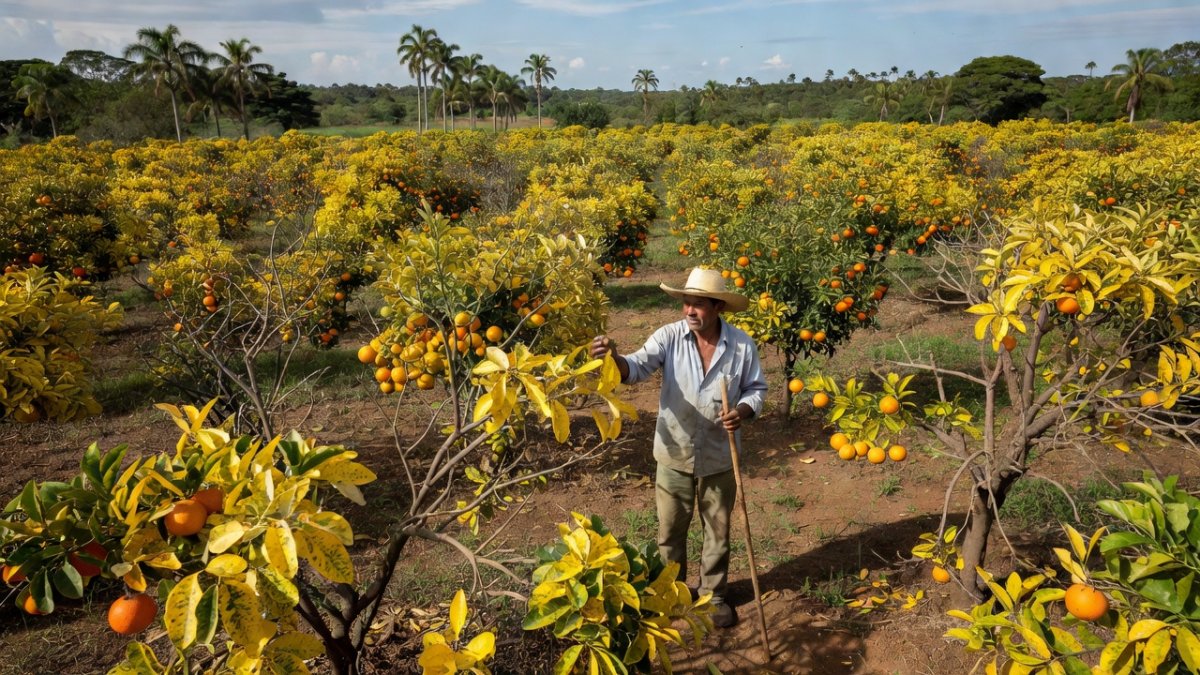
Brazil's citrus belt faces one of the most severe invasive threats in modern agriculture as citrus greening disease, spread by the Asian citrus psyllid, infected 47.63 percent of orange trees in São Paulo and Triângulo/Southwest Minas Gerais during 2025 according to Fundecitrus data. This region produces the majority of the world's orange juice, and the disease causes fruit drop, bitter flavor and eventual tree death. Citrus growers have implemented intensive vector control and removal of infected trees, yet the psyllid continues advancing through dense production areas. The economic stakes mirror those in US vineyards, with small and medium producers bearing disproportionate costs for repeated sprays and lost production. Fundecitrus coordinates statewide surveys and research into resistant varieties, yet the scale of infection shows how quickly an invader can dominate when introduced without natural enemies. The situation parallels the spotted lanternfly's spread across multiple US states and reinforces the lesson that prevention infrastructure costs far less than managing widespread establishment. Brazilian authorities have increased border inspections and grower training, measures that echo recommendations now under discussion in the US Senate bill. The 47.63 percent infection rate stands as a warning that delayed or underfunded responses allow exponential damage across entire agricultural regions.
The Sterile Barrier: 50 Years of Regional Cooperation
The Mediterranean fruit fly program marks its 50th anniversary in 2026, having used the sterile insect technique since 1975 through a partnership among the United States, Mexico and Guatemala. The El Pino facility in Guatemala, the world's largest sterile insect production center, releases 1.2 billion sterile Mediterranean fruit flies each week, creating a living barrier that has kept the pest from the US-Mexico border since 1982. This sustained regional cooperation demonstrates how consistent investment in prevention infrastructure protects entire continents from invasive species. APHIS and partner agencies have maintained the program through decades of political and budgetary shifts, proving that long-term funding yields compounding returns. Latin American nations have applied similar sterile insect approaches against other pests, showing scalable models that US researchers could adapt for the spotted lanternfly. The program's success rests on weekly production targets, rigorous quality control and cross-border coordination that prevents reintroduction. Smallholder farmers on both sides of the border benefit from reduced pesticide use and preserved market access. The 50-year milestone offers a concrete example of how the United States and its neighbors can collaborate on high-priority research initiatives like the one proposed in the new Senate bill. Such barriers require upfront capital yet deliver decades of protection that reactive measures cannot match.
The Bottom Line — Prevention Beats Eradication
Latin America's experience proves that containment and prevention infrastructure, including sterile insect barriers, regional cooperation and early detection networks, costs far less than fighting an entrenched invader after establishment. The spotted lanternfly's continued expansion across 18 US states illustrates the consequences of underinvesting in research before populations surge. The bipartisan Spotted Lanternfly Research and Development Act represents a step toward applying these lessons domestically by funding NIFA and USDA ARS efforts on biological controls and improved monitoring. Grape growers, hop producers and state agriculture officials in Pennsylvania and beyond stand to gain from coordinated federal action that moves beyond public egg-scraping campaigns. Coffee smallholders in Colombia and citrus producers in Brazil have already paid the price of delayed prevention, offering clear evidence that early regional investment protects livelihoods and export markets. The 137 billion dollar annual cost of invasive pests to US agriculture underscores the urgency of shifting resources toward proactive strategies. By learning from Latin America's successes and failures, the United States can avoid repeating costly mistakes that have devastated farms across the hemisphere. Sustained funding for high-priority research initiatives offers the most direct path to protecting American agriculture from the next wave of invaders.
By Elena Vasquez, Staff Writer
This article was produced with AI-assisted research and editorial support. Reporting is based on sources cited in the article.
What's Your Reaction?
 Like
0
Like
0
 Dislike
0
Dislike
0
 Love
0
Love
0
 Funny
0
Funny
0
 Wow
0
Wow
0
 Sad
0
Sad
0
 Angry
0
Angry
0

Latin America Correspondent at Global1.News. Based in Mexico City, covering politics, economics, energy, and culture across the region. Brings an on-the-ground perspective to stories spanning from the Rio Grande to Patagonia.















Comments (0)