
Shadow Fleet Oil Spill Threatens Oman's Marine Reserve
A Russian shadow-fleet tanker, the Caroline Bezengi, has leaked crude off Oman's Hallaniyat Islands since June, with oil now reaching mainland beaches at Ras Madrakah. Ambrey is leading salvage amid monsoons as the slick threatens a marine reserve home to endangered whales and turtles.
The Gulf of Oman has long been a highway for the world's energy, but the 800,000 barrels of Russian crude now bleeding from a grounded tanker off Oman's Dhofar coast represent a new kind of cargo: a liability with no owner, no insurance, and no end in sight. The Caroline Bezengi, a sanctioned Russian shadow-fleet vessel, has been leaking since late June, and the slick has now fouled mainland beaches, placing one of the Arabian Peninsula's most pristine marine reserves in the crosshairs of a slow-motion environmental catastrophe.
For the Gulf states, whose economies and security are built on maritime stability, this is not merely an ecological mishap. It is a stress test of their ability to manage the fallout of a shadow economy that moves sanctioned crude through their waters with opaque ownership and no credible accountability.
Russia's Ghost Tanker Becomes Oman's Environmental Nightmare: The Caroline Bezengi Spill
Muscat, Oman - August 15, 2026 - The 274-meter (899-foot) Suezmax tanker Caroline Bezengi sits broken on the rocks of Jazirat Al Qibliyyah, one of the Hallaniyat Islands, with up to 40 million gallons of crude still in its holds. What began as a June 8 explosion report has evolved into a regional emergency, with oil now washing ashore at Ras Madrakah, roughly 200 kilometers (125 miles) north of the wreck, and the threat extending toward Masirah Island.
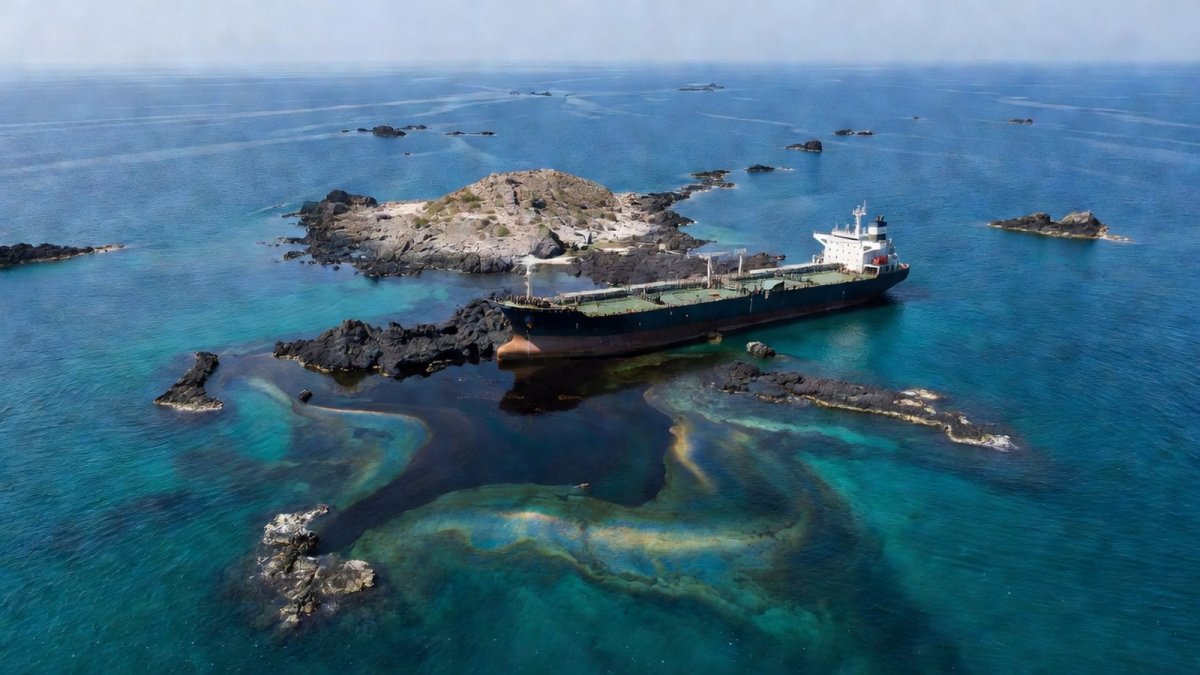
The Vessel: A Case Study in Shadow Fleet Obfuscation
The Caroline Bezengi (IMO 9224439), built in 2001, is a 159,168 deadweight-ton tanker that has operated under a Cameroon flag since 2023—a flag that appears to have been false. In June 2026, during a crackdown on sanctioned tankers, the vessel was forced out of the Cameroon registry, a move that stripped away even the thin veneer of legitimacy it had maintained. The ship is sanctioned by the European Union, the United Kingdom, the United States (OFAC), Switzerland, Canada, and Ukraine, and has past associations with the Russian state shipowner Sovcomflot.
Its corporate structure reads like a map of evasion. The nominal owner is Rentoor Shipmanagement (Shanghai), with Villar Shipmanagement (China) listed as operator, according to OpenSanctions. An investigation by The Insider linked the vessel to the Cyprus-based Lagosmarine Ltd group, which has been transporting Russian oil from the Baltic ports of Primorsk and Ust-Luga, as well as Kozmino in the Far East, to buyers in India and China. This is the anatomy of the shadow fleet: aging hulls, layered shell companies, and flags of convenience that dissolve under scrutiny.
The Voyage and the Explosion
In May 2026, the Caroline Bezengi loaded its cargo at Novorossiysk on Russia's Black Sea coast—roughly 800,000 barrels per MarineRadar, or nearly 1 million barrels per CGTN and AP reports—and set a course for Gujarat, India. The voyage ended abruptly on June 8, 2026, when the crew reported an explosion while the vessel was off the Dhofar coast. The crew abandoned ship approximately three days later.
The cause of the explosion has never been conclusively established. The OSINT project Russian Forces Spotter suggested the possibility of magnetic "limpet" mines, but no party has claimed responsibility, and the theory remains speculative. What is known is that by June 12, the vessel had run aground on rocks at the southwest tip of Jazirat Al Qibliyyah, left adrift and at the mercy of the Khareef monsoon seas that batter Oman's southern coast this time of year.
A Slick That Keeps Growing
The first signs of an oil leak were detected on June 30 by John Amos of SkyTruth, a nonprofit that uses satellite imagery to monitor environmental disasters. By August 7, hundreds of thousands of gallons had spilled. The slick's expansion has been dramatic and accelerating: approximately 45 square kilometers until July 26, growing to roughly 150 square kilometers by August 2, and then exploding to about 600 square kilometers by August 4. Greenpeace Germany satellite analysis described a "fourfold increase over just the last two days."
Omani authorities have offered a more conservative figure of 390 to 400 square kilometers (as of August 10-11), stressing that this represents the area where pollution was detected, not the quantity spilled. MarineRadar, however, reported the slick exceeding 2,000 square kilometers by August 14, with the nearest point approximately 7 kilometers from shore and an observed extension of about 449 kilometers. Forecasts from August 10 projected the slick advancing roughly 121 kilometers in 48 hours.
Nina Noelle, international environmental disaster expert at Greenpeace Germany, framed the acceleration starkly: "This is a drastic increase, indicating a deterioration of the vessel's condition." The ship's condition is indeed worsening. An onboard survey by Omani maritime authorities on July 12 showed considerable deterioration compared to aerial surveys conducted just a week prior. Five of six cargo holds remain filled with oil, and the only tank not breached shows signs of seawater contamination. The vessel is sinking deeper, its list increasing, with crude leaking into the ballast and double hull—creating potentially explosive fumes. It remains exposed to heavy monsoon seas, with rocks off its port side and 500 yards off the stern.
Oil Reaches Omani Shores
On August 12-13, the slick reached the beaches of Ras Madrakah on the Omani mainland, affecting up to 40 kilometers (25 miles) of coastline. The southern coast of Masirah Island, located more than 300 kilometers north and about 15 kilometers offshore, has been warned it may be affected in the coming hours. As of August 15, no pollution has been detected on Masirah's shores, but surveillance has been stepped up and response equipment positioned.
Oman's National Committee for Emergency Management (NCEM) is coordinating the response, with the Hazardous Materials Handling Sector led by the Civil Defence and Ambulance Authority (CDAA) and the Environment Authority (EA). On Friday, August 14, Maj Gen Sulaiman Ali Al Husseini, CDAA Chairman, and Dr Abdullah Ali Al Amri, EA Chairman, visited Ras Madrakah to oversee operations. Daily water tests at Ras Madrakah and Duqm have so far come back safe, and Masirah's coastal wells have been prepared as backup for desalination. Waste is being directed to an engineered landfill at Duqm, with the state-owned be'ah coordinating shoreline cleanup. The Food Safety and Quality Centre is monitoring fisheries and seafood safety, conducting inspections at fish landing sites, processing plants, and markets.
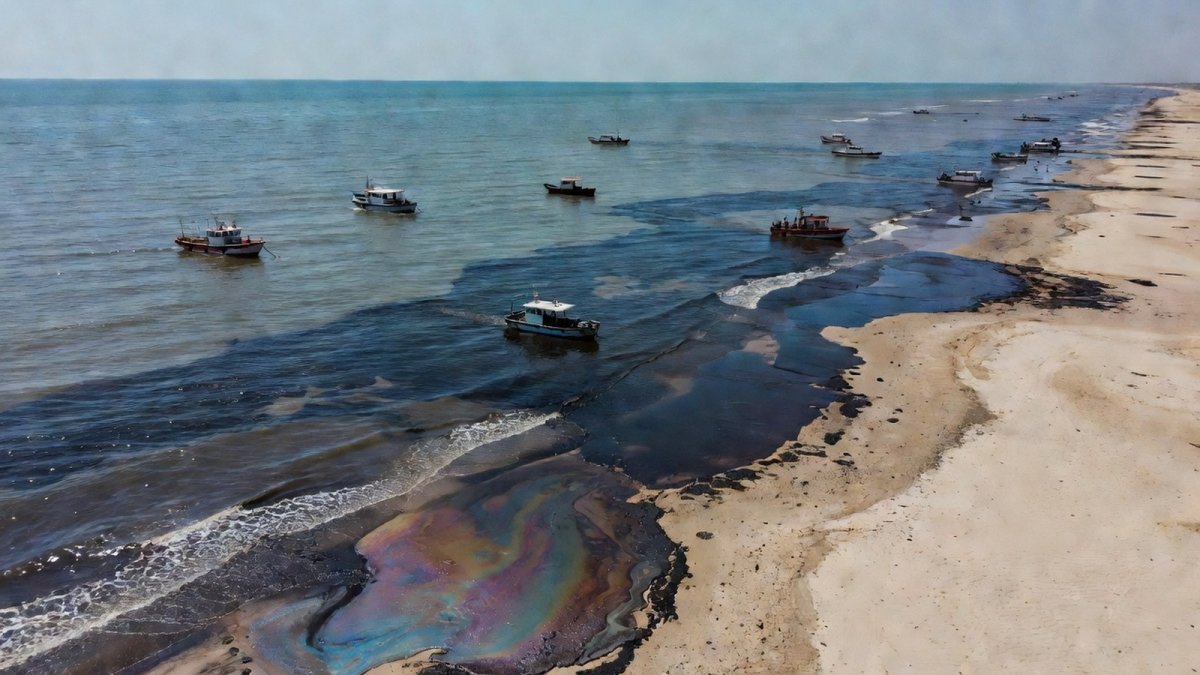
The Salvage: A Race Against Monsoon and Explosion
Omani authorities have demanded that the owners remove the vessel, but there has been no response from Rentoor Shipmanagement. The tanker may not have adequate insurance, leaving the question of who pays for salvage and cleanup dangerously open. Into this void has stepped Ambrey, a British maritime security and salvage firm, which is running the operation. A salvage team has been on board since Thursday, August 13, with approximately 100 metric tons of equipment flown in with support from Oman's Royal Air Force. Containment support is en route.
The feasible plan involves offloading the cargo via a 1,000-yard pipeline to a receiving tanker anchored in the lee of the island, then refloating the vessel as it is lightened. The risks are severe: onboard explosions from the fumes accumulating in the ballast and double hull, and further breakup from the "extreme adverse weather and sea conditions influencing vessel stability" that Ambrey has cited from the monsoon storms. Hanen Keskes, Greenpeace MENA regional campaigns lead, noted that the full extent of the leak may not be known until offloading is completed—a sobering thought given that the vessel has already been leaking for over six weeks.
The Environmental Stakes: A Marine Reserve Under Siege
The Hallaniyat Islands are not just any archipelago. In 2025, Oman established the Hallaniyat Islands Marine Buffer Zone, a marine reserve that is home to endangered Arabian Sea humpback whales, sea turtles, Socotra cormorant colonies, rare coral reefs, and serves as a critical stopover for migratory birds. Greenpeace has warned of the risk of an "unprecedented oil disaster" without urgent action.
The experts are blunt about the limits of response. John Amos of SkyTruth put it succinctly: "Once the oil hits the water, you've already lost." Spill response typically recovers only about 20 percent of the oil. Christopher D'Elia, professor emeritus at Louisiana State University and an oil spill specialist, called 800,000 barrels a "fairly large spill" and highlighted the structural problem: "These illegal tankers don't comply with the 'polluter pays' principle... In this case, there is no responsible party." For context, the Exxon Valdez spilled at least 11 million gallons off Alaska in 1989; Exxon spent approximately $2.1 billion (about $5.8 billion today) on cleanup. The Caroline Bezengi is carrying up to 40 million gallons.
Regional Implications: The Shadow Fleet's Reckoning
This incident has not been linked to the Iran war, per US News and AP reporting, and it would be a mistake to read geopolitics into every maritime mishap. But the strategic implications for the Gulf are profound. Russia relies on hundreds of aging tankers in its shadow fleet to move sanctioned crude, with opaque ownership structures and little or no credible insurance. The Gulf of Oman corridor is one of the world's most vital shipping lanes, with MarineRadar logging 222 devices in the region. Every shadow-fleet vessel transiting these waters is a potential Caroline Bezengi.
For Oman, a state that has historically positioned itself as a neutral mediator and a steward of its marine environment, this is a double bind. The sultanate must now spend significant resources on a cleanup for which it may never be compensated, while the vessel's owners remain silent and unaccountable. The precedent being set here matters: if the shadow fleet can spill with impunity in Omani waters, what happens when the next aging tanker breaks down off Fujairah, or in the Strait of Hormuz, or near desalination plants that supply millions with drinking water?
The Gulf states are watching closely. The response infrastructure being built in Oman—the containment equipment, the salvage coordination, the environmental monitoring—will become a template for the region. But the deeper lesson is that the shadow fleet is not just a sanctions-evasion problem; it is a maritime security and environmental governance crisis. The Caroline Bezengi is a warning, written in crude, that the cost of Russia's oil war is being externalized onto the waters and shores of the Middle East. And as the monsoon continues to batter the wreck, the question is no longer whether this disaster can be prevented, but how much of the damage can be contained.
By Malik Hassan, Staff Writer
This article was produced with AI-assisted research and editorial support. Reporting is based on sources cited in the article.
What's Your Reaction?
 Like
0
Like
0
 Dislike
0
Dislike
0
 Love
0
Love
0
 Funny
0
Funny
0
 Wow
0
Wow
0
 Sad
0
Sad
0
 Angry
0
Angry
0

Middle East Correspondent at Global1.News. Based in Beirut, covering politics, conflict, energy, and society across the Middle East. Brings context and depth to a region often reduced to headlines.













Comments (0)