
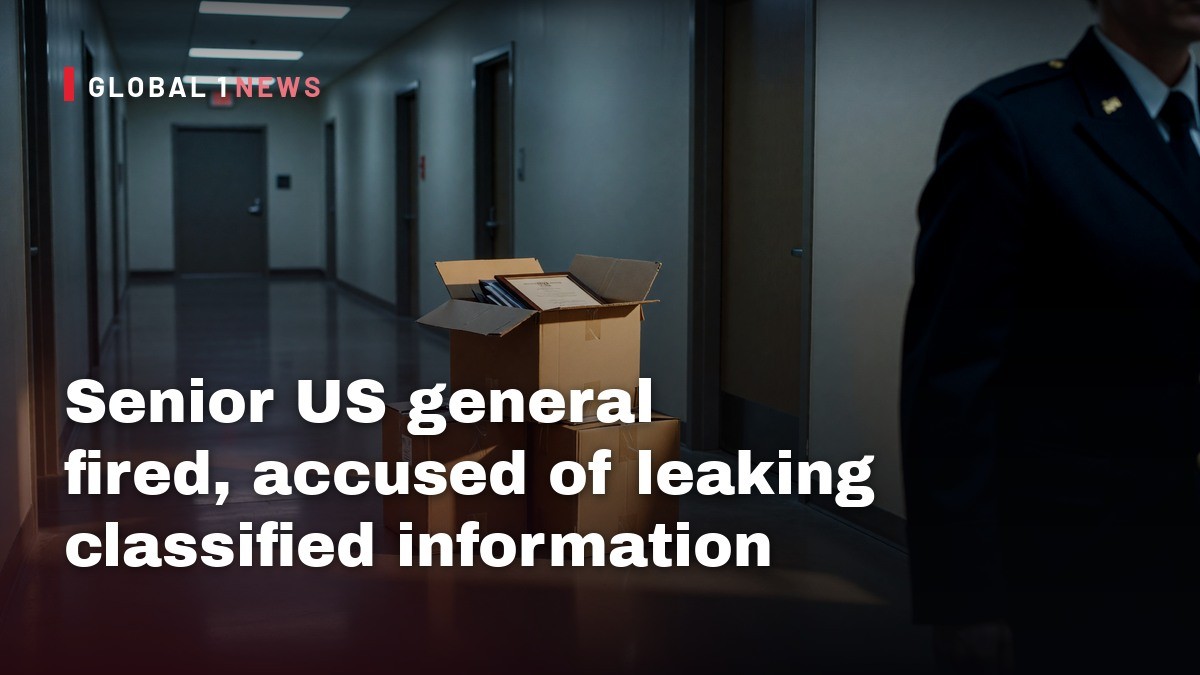
Senior US general fired, accused of leaking classified information
Defense Secretary Pete Hegseth’s aggressive crackdown on leaks has reached a new high point with the dismissal of Lieutenant General Brett Sylvia, a senior planner on the Pentagon’s Joint Staff.
Defense Secretary Pete Hegseth’s aggressive crackdown on leaks has reached a new high point with the dismissal of Lieutenant General Brett Sylvia, a senior planner on the Pentagon’s Joint Staff. The move, announced on 29 October 2026, underscores the heightened sensitivity of the U.S. command structure as the protracted Iran war enters its ninth month. While the firing itself is a headline‑grabbing development, the broader context—an expanding leak‑hunt, a costly war effort, and the political rhetoric surrounding the conflict—offers a window into how U.S. policy is shaping the strategic environment that Israel watches closely.
The immediate trigger: a leak investigation turns into a dismissal
The Pentagon’s decision to fire General Sylvia was presented as a direct response to accusations that he leaked classified material to the public. According to a senior Pentagon official who spoke on condition of anonymity, Sylvia failed three polygraph examinations that probed his involvement in unauthorized disclosures. The official described the leak as “critical” enough to demand “urgent action” that could not wait any longer.
Secretary Hegseth’s task force, which has been tasked with identifying the source of leaks, has relied heavily on polygraph testing of senior officials. The use of such examinations, combined with a sweeping media policy introduced last year, reflects a broader effort to tighten information control amid a war that has proved unpopular both domestically and abroad. The policy, which led to the revocation of press credentials for journalists who refused to sign it, has already raised legal concerns among media organizations.
Political fallout: President Trump’s reaction and the public narrative
President Donald Trump, who mistakenly referred to Sylvia as a woman, seized on the dismissal to reinforce his broader anti‑leaker stance. In remarks to reporters, Trump warned that Sylvia “has big problems, long‑term problems,” echoing the administration’s message that any breach of secrecy will be met with severe consequences. The president’s characterization of the Iran war as “another little Epic Fury” further illustrates the high‑stakes rhetoric that frames the conflict as a decisive, albeit controversial, military undertaking.
These public statements serve a dual purpose: they signal to the American public that the administration is taking decisive action against perceived internal threats, and they reinforce a narrative of resolve that resonates with allies, including Israel, who are closely monitoring U.S. military policy and its implications for regional security dynamics.
Operational implications: The J5 role and the cost of the Iran war
General Sylvia’s former position as head of the Directorate for Strategy, Plans, and Policy—known within the Joint Staff as the J5—placed him at the heart of the Pentagon’s long‑range planning apparatus. The J5 advises the Chairman of the Joint Chiefs of Staff, General Dan Caine, on strategic options and policy coordination. Removing a senior planner from this role during an ongoing conflict raises questions about continuity in strategic planning and the potential for internal disruption.
Compounding the strategic concern is the financial burden of the Iran war. Reuters reported that an internal Pentagon analysis estimates the cost of munitions alone to exceed $29 billion, forming the bulk of the more than $47 billion spent on operations to date. While these figures are not broken down further in the source material, the sheer scale underscores the pressure on U.S. defense budgeting and the need for sustained logistical support—a factor that Israel’s own defense procurement and budgeting processes monitor closely.
The legal and investigative dimension: Air Force Office of Special Investigations
Sean Parnell, the Pentagon’s chief spokesperson, linked the decision to fire Sylvia to an extensive investigation conducted by the Air Force Office of Special Investigations (AFOSI). Parnell emphasized that the matter, along with other related cases, has been referred to the Justice Department for potential further legal action. This referral signals that the administration is prepared to pursue criminal or civil proceedings against individuals deemed responsible for compromising classified information.
The involvement of AFOSI, a body traditionally focused on counter‑intelligence and security violations, highlights the seriousness with which the Pentagon treats leaks. For Israeli security agencies, which regularly cooperate with U.S. counterparts on intelligence sharing, the escalation of legal actions against leakers may affect future information exchange protocols and the trust framework that underpins joint operations.
Impact on U.S. military morale and internal communications
The withdrawal of an initial statement praising Sylvia’s 32 years of service—later retracted for not reflecting “the full circumstances”—illustrates the tension between honoring long‑standing service and maintaining operational security. The Joint Staff’s spokesperson emphasized respect for the service member and the ongoing personnel process, opting not to comment further. This cautious approach suggests an effort to balance morale considerations with the need to avoid further disclosures that could undermine the investigation.
For Israeli defense establishments, the episode serves as a reminder of the delicate balance between public acknowledgment of service and the imperative of secrecy in wartime. The Israeli Defense Forces and the Ministry of Economy’s Innovation Authority have long navigated similar challenges when dealing with high‑profile tech projects and defense collaborations that attract media scrutiny.
Regional reverberations: How the Iran war and U.S. leak crackdown affect Israel
The Iran war, now in its ninth month, remains a focal point for regional security calculations. Israel, which has historically viewed Iranian missile and nuclear ambitions as existential threats, watches U.S. operational tempo and strategic messaging closely. The possibility of a renewed intensive bombing campaign, hinted at by senior officials, could alter the security calculus for Israeli forces stationed near the northern border and for Israeli intelligence agencies monitoring Iranian movements.
Moreover, the heightened U.S. emphasis on information security may influence Israel’s own internal policies regarding classified data. Israeli ministries, including the Ministry of Economy and the Israel Innovation Authority, have recently tightened protocols for handling sensitive research tied to defense applications. The U.S. example of polygraph testing and media credential revocation could inspire parallel measures within Israeli defense and high‑tech sectors, especially as companies increasingly collaborate on dual‑use technologies.
Looking ahead: Potential legal outcomes and strategic continuity
With the Justice Department now involved, the legal trajectory for General Sylvia remains uncertain. If formal charges are pursued, the case could set a precedent for how senior military officials are held accountable for leaks, potentially reshaping the culture of internal reporting and whistleblowing within the Pentagon. The broader leak‑hunt, already encompassing polygraph examinations and a revised media policy, is likely to continue as long as the Iran conflict persists.
For Israel, the unfolding U.S. internal security measures reinforce the importance of robust safeguards around strategic information, especially as Israeli tech firms deepen ties with American defense contractors. The interplay between U.S. policy shifts, the cost and duration of the Iran war, and Israel’s own security priorities will shape the regional security environment for months to come. Observers will be watching how the U.S. balances the need for operational secrecy with the democratic expectations of transparency—a balance that Israel has long navigated in its own high‑tech and defense ecosystems.
This article was produced with AI-assisted research and editorial support. Reporting is based on the source material cited below. Sources: Al-Monitor; al-monitor.com; Global1.News (30 October 2026).
By Hannah Berg, Staff Writer
What's Your Reaction?
 Like
0
 Dislike
0
 Love
0
 Funny
0
 Wow
0
 Sad
0
 Angry
0

Israel Correspondent at Global1.News. Based in Tel Aviv, covering Israeli politics, security, technology, and society. Provides balanced, deeply-sourced reporting on one of the most closely-watched regions in the world.









Comments (0)