
Russia Designates Opposition Delegation at PACE as ‘Undesirable’
Russia’s Justice Ministry has formally added the Dialogue with Russian Democratic Forces (DRDF) – the opposition delegation to the Parliamentary Assembly of the Council of Europe (PACE) – to its ever‑growing list of “undesirable” organisations.
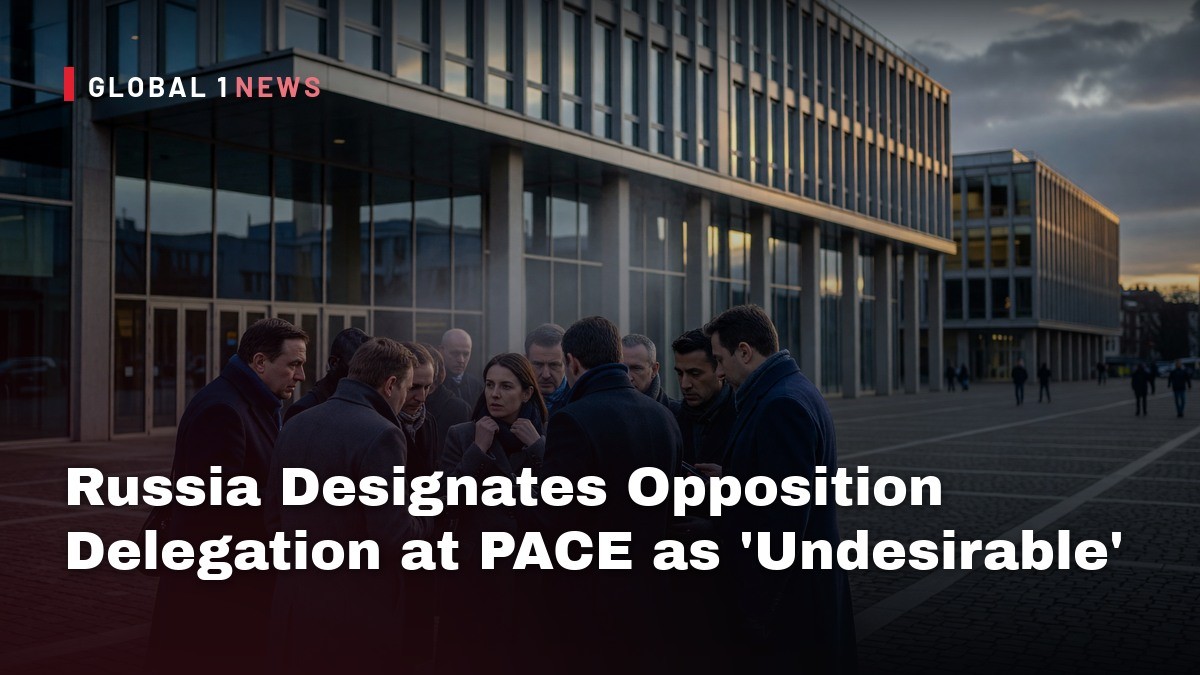
Russia’s Justice Ministry has formally added the Dialogue with Russian Democratic Forces (DRDF) – the opposition delegation to the Parliamentary Assembly of the Council of Europe (PACE) – to its ever‑growing list of “undesirable” organisations. The designation, approved on 24 October 2026, makes any affiliation with the anti‑war group illegal under Russian law and raises the spectre of criminal prosecution for participants and supporters.
Legal ramifications of the “undesirable” label
The “undesirable” regime, introduced in 2015, permits Russian authorities to criminalise a wide range of activities linked to foreign or opposition entities. Under the current statutes, an individual who merely affiliates with an “undesirable” organisation faces up to four years in prison, while organising the work of such a group can attract a maximum sentence of six years. These penalties apply regardless of whether the alleged activity occurs inside or outside Russian territory, effectively extending the reach of Kremlin repression to the diaspora.
In the case of the DRDF, several high‑profile members – including opposition figure Vladimir Kara‑Murza and Pussy Riot co‑founder Nadya Tolokonnikova – are already under criminal investigation in Russia. Their inclusion in the “undesirable” register therefore exposes them to immediate legal jeopardy should they return to Russian jurisdiction or engage with Russian citizens. The move also signals a broader intent to stifle any organised anti‑war platform that enjoys visibility on an international stage such as PACE.
Origins and composition of the DRDF delegation
The DRDF delegation was assembled in January 2026 after years of lobbying by leading exiled opposition activists. Former businessman Mikhail Khodorkovsky, a long‑time critic of the Kremlin, played a central role in coordinating the effort, seeking to give a voice to Russian civil society within Europe’s premier human‑rights forum. The delegation’s mandate is to represent the anti‑Kremlin opposition at PACE, presenting reports on political repression, war crimes, and the curtailment of civil liberties inside Russia.
Beyond Kara‑Murza and Tolokonnikova, the delegation includes a range of activists, journalists, and former officials who have fled persecution. Their collective presence at PACE has been framed by the Kremlin as a direct challenge to Russian sovereignty, prompting the Prosecutor General’s Office to issue the “undesirable” ruling on 21 October 2026, a decision subsequently endorsed by the Justice Ministry on Thursday.
Broader crackdown on foreign and opposition entities
The DRDF designation is part of a wider sweep undertaken by the Justice Ministry on the same day. In total, eleven additional foreign organisations were blacklisted, among them Vidim Books – a Slovakian publishing house founded in 2023 to print works censored or banned within Russia. This pattern underscores the ministry’s strategy of targeting not only political opposition but also cultural and informational channels that bypass state censorship.
Since Russia’s expulsion from the Council of Europe and PACE in March 2022, following its full‑scale invasion of Ukraine, the “undesirable” list has expanded to include hundreds of entities. Notable examples include independent media outlets such as The Moscow Times, which was added to the register earlier this year. The cumulative effect is a tightening of the legal straitjacket around any external influence deemed hostile to the Kremlin’s narrative.
Impact on Russian civil society and the diaspora
The designation of the DRDF delegation carries profound implications for Russian civil society abroad. By criminalising affiliation, the Kremlin seeks to deter diaspora communities from organising, fundraising, or even communicating with the labelled group. This creates a chilling effect that could fragment opposition networks and limit their capacity to coordinate advocacy at international institutions.
For activists already under investigation, the “undesirable” status raises the stakes of any future engagement with Russian citizens. Even indirect contact, such as participating in webinars or publishing joint statements, could be construed as illegal activity, exposing participants to the four‑year imprisonment risk outlined in the law.
International reaction and the limits of diplomatic pressure
While the source material does not contain official statements from foreign governments, the timing of the designation – coinciding with the Justice Ministry’s broader blacklist – suggests a calculated move to pre‑empt further scrutiny at European bodies. By labelling the DRDF as “undesirable,” Moscow attempts to delegitimize the delegation’s work and to portray it as a foreign‑backed interference, a narrative that has been repeatedly employed by the Kremlin to justify crackdowns on NGOs and media.
Historically, such designations have been met with condemnation from European institutions, which view the “undesirable” law as a tool to suppress dissent. However, the effectiveness of diplomatic censure is limited when the Kremlin frames external criticism as hostile propaganda, a stance that has hardened since the 2022 expulsion from the Council of Europe.
Implications for independent journalism
The Moscow Times, itself designated “undesirable” earlier in 2026, illustrates the broader assault on independent reporting. In its own editorial note, the outlet describes the label as a direct attempt to silence independent journalism, accusing the authorities of claiming that its work “discredits the decisions of the Russian leadership.” The newspaper’s appeal for financial support underscores the precarious position of media organisations operating under the threat of criminal prosecution.
By extending the “undesirable” regime to the DRDF, the Justice Ministry signals that not only media but also political advocacy groups will face similar repression. This convergence of legal pressure on both information channels and opposition platforms deepens the climate of fear and self‑censorship among Russian exiles and those still inside the country.
Strategic outlook for the opposition and the Kremlin
From a strategic perspective, the Kremlin’s use of the “undesirable” label serves multiple objectives. It marginalises opposition voices on the international stage, discourages diaspora activism, and reinforces a narrative of external subversion. For the opposition, the designation forces a recalibration of tactics – shifting from overt affiliation with labelled groups to more covert forms of coordination, potentially leveraging encrypted communications and informal networks.
Looking ahead, the durability of the “undesirable” regime will depend on the Kremlin’s ability to maintain domestic support while fending off international isolation. As long as the state can portray dissent as foreign‑engineered, the legal tools at its disposal – such as the “undesirable” law – will remain a potent instrument in its arsenal. Conversely, sustained international attention to the plight of groups like the DRDF and media outlets such as The Moscow Times may keep pressure on Moscow, highlighting the human cost of its repression and reminding the world that the battle over information and political freedom in Russia is far from over.
This article was produced with AI-assisted research and editorial support. Reporting is based on the source material cited below. Sources: The Moscow Times; themoscowtimes.com; Global1.News (31 October 2026).
By Irina Volkov, Staff Writer
What's Your Reaction?
 Like
0
 Dislike
0
 Love
0
 Funny
0
 Wow
0
 Sad
0
 Angry
0
Russia/Eastern Europe Correspondent at Global1.News. Covering Russian politics, energy, security, and the shifting dynamics of the post-Soviet space. Provides clear-eyed analysis on one of the world's most opaque regions.












Comments (0)