
Russia Designates Novaya Gazeta a 'Foreign Agent' Ahead of Duma Elections
Russia's Justice Ministry designated the independent newspaper Novaya Gazeta a 'foreign agent' ahead of this month's State Duma elections, adding more than 100 affiliated individuals including Yabloko chairman Nikolai Rybakov in an escalating crackdown on independent media.
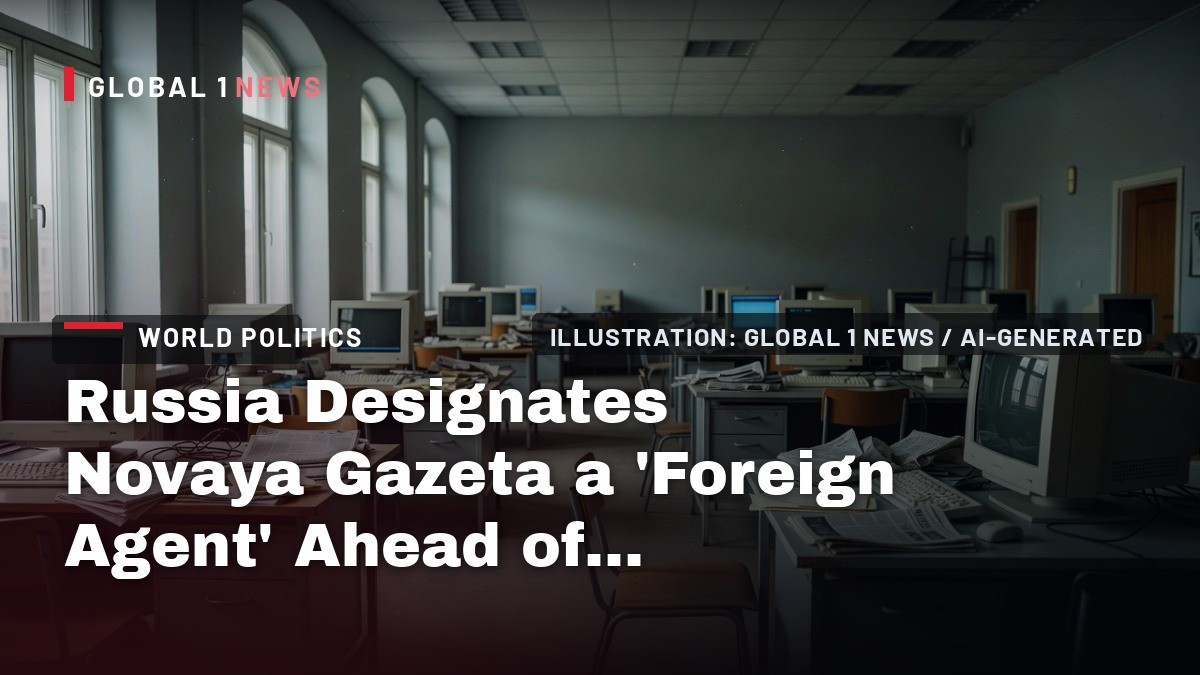
The Russian Justice Ministry has designated the independent newspaper Novaya Gazeta as a "foreign agent," marking the first time the Kremlin's flagship media-repression label has been applied to the outlet itself, three years after its Nobel-winning editor was individually branded. The move lands weeks before Russia's State Duma elections this month.
Russia Designates Novaya Gazeta a 'Foreign Agent' Ahead of Duma Elections
Moscow - September 2026 - Russia's Justice Ministry on Friday added the independent news outlet Novaya Gazeta to its registry of "foreign agents," a designation that forces the newspaper to carry lengthy disclaimers on all its public output and signals a new phase in the Kremlin's campaign against independent media. The ministry simultaneously published a list of more than 100 individuals deemed "affiliated" with the outlet, including prominent opposition figures and journalists, raising the stakes for anyone connected to the publication during the current election season.
The Designation
The Justice Ministry's Friday announcement accused Novaya Gazeta of publicly opposing Russia's full-scale invasion of Ukraine, spreading what it called "false information" about the electoral system, and collaborating with other entities already on the foreign agents registry. According to the ministry's statement, the newspaper disseminated materials that undermined government policy and published content produced by existing "foreign agents" or "undesirable" organizations.
The designation requires Novaya Gazeta to include a lengthy disclaimer in all of its public appearances and statements, including posts on social media. Failure to comply carries administrative penalties that have, in practice, been applied aggressively to other designated outlets and individuals. The newspaper ceased print publication shortly after the February 2022 invasion of Ukraine due to censorship laws passed as part of a broader government crackdown on the press, but it has continued to publish articles and videos online.
The 'Participants' List and Electoral Stakes
Beyond the designation of the outlet itself, the Justice Ministry expanded its registry of persons "affiliated with foreign agents" by adding more than 100 individuals connected to Novaya Gazeta's work. The list reportedly includes Yabloko party chairman Nikolai Rybakov, journalist Elena Milashina, former editor-in-chief Dmitry Muratov, and politician Lev Shlosberg.
Individuals on the affiliated list are not subject to the same strict requirements imposed on full "foreign agents," but they face significant new obligations. According to the ministry's rules, affiliated persons must declare their status on all electoral campaign materials if they run for office. In practice, they are also required to label any posts related to the activities of the designated organization, and authorities have shown a willingness to penalize affiliated individuals for failing to label posts that have nothing to do with the foreign agent's activities.
The timing is particularly charged. The designation lands during the campaign for Russia's State Duma elections this month, and independent candidates and parties have faced mounting barriers throughout the campaign season. Yabloko, whose chairman is now on the affiliated list, has been barred from ballots in several regions. Moscow police detained Yabloko candidates running in the Duma elections on Friday, the same day the ministry published its new designations.
From Nobel Prize to Foreign Agent
Novaya Gazeta was founded in 1993 and built a reputation as one of Russia's last independent newsrooms, known for its investigative reporting on corruption, human rights abuses, and the wars in Chechnya and Ukraine. In 2021, its then editor-in-chief Dmitry Muratov was awarded the Nobel Peace Prize alongside Filipino journalist Maria Ressa for their efforts to safeguard freedom of expression.
The newspaper's fortunes deteriorated sharply after Russia launched its full-scale invasion of Ukraine in February 2022. That year, Moscow's Basmanny District Court stripped the paper of its media license, effectively ending its print edition. In 2023, authorities designated Muratov himself as a "foreign agent," and he subsequently stepped down as editor-in-chief, with Sergey Sokolov taking over as the publication's new head.
The trajectory from Nobel laureate to foreign agent reflects the broader transformation of Russia's media landscape since 2022. Hundreds of cultural figures, journalists, businesspeople, and news outlets have been branded "foreign agents" since Russia introduced the label in 2012, but the pace has accelerated dramatically in recent years. The registry now includes more than 1,250 individuals and organizations.
How the Foreign-Agents Label Works
The "foreign agent" label, introduced in 2012, applies to individuals and organizations that authorities view as enemies of the state, according to the Justice Ministry's own framing. Those designated are required to append a lengthy disclaimer to every public statement, appearance, and social media post, a rule that has turned routine journalism and commentary into a legal minefield for those affected.
Individuals on the separate "affiliated" registry face lighter but still consequential requirements. They must declare their connection on electoral campaign materials if they run for office, and they are expected to label posts related to the designated organization's activities. In practice, affiliated individuals have faced administrative penalties even for failing to label posts that have nothing to do with the foreign agent's activities, according to reporting by Novaya Gazeta Europe.
The mechanism also has a technical dimension: Roskomnadzor, Russia's media and telecommunications regulator, can block websites classified as foreign agents at the Justice Ministry's request, according to Freedom House's 2026 report on Russia. The combination of individual labeling duties, affiliation lists, and website blocking gives authorities multiple tools to choke off independent information channels.
A Widening Crackdown
Friday's announcement was not limited to Novaya Gazeta. The Justice Ministry also added writer Felix Sandalov, former editor-in-chief of the Individuum publishing house; poet Sergei Leibgrad; scientist Tatiana Tatarinova; and the academic journal Historical Expertise to the foreign agents registry. All were accused of systemically distributing materials produced by existing "foreign agents" or "undesirable" organizations and spreading "false information" about government policy.
The crackdown on Novaya Gazeta has been building for months. In April 2026, police conducted a 13-hour search of the newspaper's Moscow office. Following the raid, columnist Oleg Roldugin was charged with "illegally accessing computer information" as part of a group and placed in pre-trial detention. On September 2, a Russian court extended Roldugin's house arrest. Roldugin has said he was rebuked for even answering the door to police during the initial search.
The broader context is sobering. Freedom House's 2026 Russia report notes that Roskomnadzor, the federal media and telecommunications agency, can block websites classified as foreign agents at the Justice Ministry's request. Hundreds of media outlets have been forced to suspend activities, and more than 300 outlets and individual journalists have been designated as foreign agents. Dozens of journalists have been sentenced to prison terms since 2022. The Moscow Times itself has been designated an "undesirable" organization by Russia's Prosecutor General's Office and earlier labeled a "foreign agent."
Analysis and Implications
The designation of Novaya Gazeta itself, rather than merely its individual journalists, could indicate that authorities are seeking to dismantle the outlet's remaining institutional infrastructure. Analysts suggest this signals a deliberate strategy to target the last independent media organizations that retain any capacity to reach Russian audiences, particularly during an election period.
The inclusion of Nikolai Rybakov on the affiliated persons list carries particular significance given the upcoming Duma elections. As chairman of the Yabloko party, Rybakov now faces the requirement to disclose his affiliated status on any campaign materials, a burden that could complicate his party's already difficult electoral prospects. The detention of Yabloko candidates on the same day as the designation suggests a coordinated effort to marginalize opposition voices during the campaign.
The timing of the designation, coming weeks before the September elections, could also be read as a warning to other media outlets and journalists covering the vote. With the foreign agents label now applied to the outlet itself, any publication that cites Novaya Gazeta or collaborates with its journalists risks drawing scrutiny from authorities. The practical effect may be to further isolate the newspaper from the Russian information ecosystem.
Looking Ahead
For Novaya Gazeta, the designation raises immediate questions about its ability to continue operating. The newspaper has maintained an online presence despite losing its print license, but the foreign agents label imposes new legal obligations and creates additional legal exposure for its staff. The more than 100 individuals now listed as affiliated face their own compliance burdens, and any misstep could result in administrative penalties or worse.
The newspaper's leadership has not yet issued a formal response to Friday's designation. Sergey Sokolov, who took over as editor-in-chief after Muratov's 2023 designation, now leads an outlet that has been formally classified as an agent of a foreign power by the state it covers. The irony is unlikely to be lost on the newspaper's remaining staff, who have continued their work under increasingly difficult conditions.
As Russia heads into its Duma elections this month, the designation of Novaya Gazeta serves as a stark reminder of the constraints facing independent media and opposition voices. The foreign agents law, originally introduced in 2012, has evolved into a comprehensive mechanism for labeling and marginalizing critics of the government. With the registry now exceeding 1,250 entries and expanding weekly, the space for independent journalism in Russia continues to narrow.
By Irina Volkov, Staff Writer
This article was produced with AI-assisted research and editorial support. Sources: The Moscow Times, Novaya Gazeta Europe, Meduza.
What's Your Reaction?
 Like
0
Like
0
 Dislike
0
Dislike
0
 Love
0
Love
0
 Funny
0
Funny
0
 Wow
0
Wow
0
 Sad
0
Sad
0
 Angry
0
Angry
0
Russia/Eastern Europe Correspondent at Global1.News. Covering Russian politics, energy, security, and the shifting dynamics of the post-Soviet space. Provides clear-eyed analysis on one of the world's most opaque regions.










Comments (0)