
Putin Signs Decree Allowing State Seizure of Key Infrastructure
Vladimir Putin signed a decree on Monday that lets the Russian state seize temporary control of critical infrastructure if private owners can’t keep it safe from Ukrainian drones or fix it fast enough. It sounds like a bureaucratic footnote, but it’s actually a quiet revolution in how Russia does business in wartime. Here’s what it means for the war, for Russia’s economy, and for the rest of the world watching a nuclear power improvise its way through a crisis.
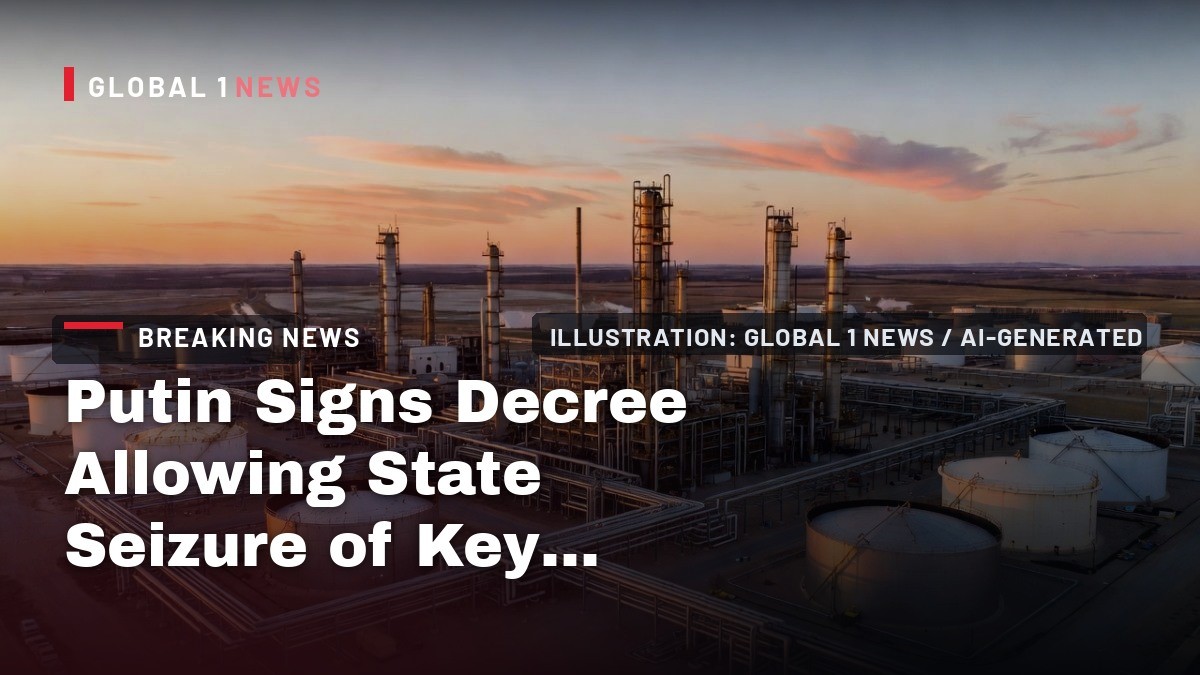
Vladimir Putin signed a decree on Monday that lets the Russian state seize temporary control of critical infrastructure if private owners can’t keep it safe from Ukrainian drones or fix it fast enough. It sounds like a bureaucratic footnote, but it’s actually a quiet revolution in how Russia does business in wartime. Here’s what it means for the war, for Russia’s economy, and for the rest of the world watching a nuclear power improvise its way through a crisis.
Putin Signs Decree Allowing State Seizure of Key Infrastructure
Moscow, Russia — Russian President Vladimir Putin on Monday signed a decree formally titled "On measures to ensure the security of critical infrastructure facilities of the Russian Federation," granting the state broad new powers to take temporary control of refineries, energy plants, and other vital facilities when private owners are deemed to have failed against Ukrainian drone attacks. The move, reported by multiple outlets including Reuters and the Institute for the Study of War, is the latest escalation in Moscow’s wartime economic management, and analysts say it signals a deepening crisis behind the front lines.
What the Decree Does
The decree, signed August 24, 2026, allows the Federal Agency for State Property Management — known as Rosimushchestvo — to step in and place critical infrastructure facilities under temporary external management. The trigger is straightforward: if an owner fails to adequately protect a facility from security threats, including Ukrainian drone strikes, or fails to restore damaged facilities in a timely manner, the state can take over operations.
Rosimushchestvo, which normally manages federal property, gains what analysts describe as full ownership powers under this arrangement — except for one key limitation: it cannot sell the assets. That distinction matters. This isn’t outright confiscation in the legal sense, but it’s close enough that economists and legal experts are already calling it a form of wartime nationalization.
The decree doesn’t spell out a timeline for how long "temporary" management might last, nor does it define what counts as "timely" restoration. That vagueness is deliberate, according to observers. It gives the Kremlin maximum flexibility to decide case by case, which in practice means political loyalty and operational competence are now judged by the same standard.
For private owners of refineries, fuel depots, and other critical sites, the message is blunt: protect your assets or lose control of them. There’s no appeals process mentioned in the decree, and no compensation mechanism outlined. The state simply moves in.
Why Now: Ukraine’s Deep-Strike Campaign
This decree didn’t come out of nowhere. It follows the most intense phase yet of Ukraine’s long-range drone campaign inside Russian territory. According to an analysis by the Financial Times and Polish consultancy Rochan Consulting, reported in July 2026, Ukraine struck Russian oil refineries at least 194 times in 2026 — an 11-fold increase over the same period in 2025.
The numbers are staggering. The Guardian reported on August 27, 2026, that Ukraine carried out 18 attacks on Russian refineries in August alone, matching the previous month’s record. That’s not a symbolic gesture; that’s a sustained operational campaign aimed at the heart of Russia’s fuel economy.
On August 25, a Ukrainian drone attack in Russia’s Krasnodar region killed at least two people and sparked a fire at a refinery, per Al Jazeera and Reuters. The Afipsky oil refinery near Krasnodar had been hit the previous week in one of Ukraine’s deepest cross-border operations in months. These aren’t isolated incidents — they’re part of a pattern that has forced the Kremlin to respond.
CNN analysis on August 23 dubbed the moment "Black August" in Russia, and the label fits. The drone campaign has moved from nuisance to strategic threat, and Putin’s decree is a direct acknowledgment that private owners can’t — or won’t — keep up.
The Fuel Crunch at Home
The impact of Ukraine’s strikes isn’t just a matter of damaged equipment. Bloomberg reported that Ukraine’s summer campaign pushed Russia’s daily oil-processing rates to multiyear lows, straining fuel supplies across the country. Several regions are facing shortages and rationing, and in late June, Putin himself acknowledged the fuel shortages publicly.
That admission was a rare moment of candor from a leader who typically downplays domestic problems. When the president of a major oil-producing nation admits his people can’t get enough gasoline, you know the situation is serious.
The Guardian’s August 27 report went further, saying Russia is now "desperately scrambling for oil imports." That’s a remarkable reversal for a country that ranks among the world’s top oil producers. The refineries that turn crude into usable fuel are the bottleneck, and Ukraine has figured out how to hit them where it hurts.
Fuel shortages have real-world consequences for ordinary Russians. Truckers can’t deliver goods, farmers can’t harvest, and commuters can’t get to work. The Kremlin’s response isn’t to fix the refineries faster — it’s to take control of them and hope the state can do a better job than the private sector.
On August 19, just days before the decree, Putin ordered the government to help rebuild warehouses destroyed in Ukrainian attacks. That order, combined with the new decree, paints a picture of a state scrambling to patch holes in its own economy while fighting a war it can’t afford to lose.
A Pattern of State Takeovers
This isn’t the first time Russia has used temporary external administration to seize control of assets. Since 2023, under Presidential Decree No. 302, Russia has applied this tool against foreign-owned companies, including AkzoNobel and CANPACK. Those cases were framed as responses to "unfriendly" foreign ownership — a way to keep Western companies from walking away with assets or shutting down operations.
But the August 24 decree extends that logic to domestic owners. That’s a significant shift. It means the Kremlin is now willing to go after Russian businesses, not just foreign ones, when they fail to meet wartime expectations.
The Institute for the Study of War (ISW) assessed the decree in its Russian Offensive Campaign Assessment, linking it directly to the ongoing drone-strike campaign. ISW’s analysis notes that the decree is part of a broader effort to centralize control over the economy as the war drags on and domestic vulnerabilities become more apparent.
For Russian business owners, the message is chilling. The state can now decide, on its own terms, whether you’re doing enough to protect your assets. If you’re not, you lose them — at least temporarily. And "temporary" in Russia has a way of becoming permanent.
'Creeping Nationalization' Concerns
Economists and analysts describe the move as a further step toward wartime nationalization, sometimes called "creeping nationalization." The term captures the incremental, piecemeal way the Russian state is expanding its control over the economy — not through a sweeping nationalization decree, but through a series of targeted interventions that add up to the same thing.
The concern is that this decree gives the Kremlin a tool it can use selectively, against owners who are politically inconvenient or who simply can’t meet impossible demands. The standard of "adequate protection" is undefined, and the timeline for "timely restoration" is vague. That ambiguity is a feature, not a bug.
For the Russian economy, the implications are significant. Private investment in critical infrastructure is likely to dry up. Why would anyone invest in a refinery or a power plant if the state can take it over at any moment? The decree creates a climate of uncertainty that discourages the very investment Russia needs to rebuild its damaged infrastructure.
There’s also a broader question about efficiency. State-run enterprises in Russia have a mixed track record, and there’s little evidence that Rosimushchestvo can run a refinery better than a private company. The decree may solve a short-term control problem, but it could create long-term productivity problems.
Some analysts argue the move is less about efficiency and more about political control. By holding the threat of seizure over business owners, the Kremlin ensures loyalty. No one wants to be the next target of a state takeover, so owners will fall in line, protect their assets as best they can, and avoid any appearance of disloyalty.
What Comes Next
The decree takes effect immediately, but its real impact will unfold over the coming weeks and months. The first test will come when a refinery gets hit and the owner fails to restore operations quickly enough. Will Rosimushchestvo actually step in? And if it does, will it do any better?
Ukraine shows no signs of letting up. The drone campaign has been relentless, and the August numbers suggest it’s accelerating. If Ukraine can keep up the pressure, Russia will face a choice: pour more resources into defending refineries, or watch its fuel economy crumble further.
The decree is a stopgap, not a solution. It doesn’t protect refineries from drones; it just changes who’s in charge when they get hit. The underlying problem — that Ukraine can strike deep inside Russia at will — remains unresolved.
For the international community, this is a signal of Russian vulnerability. A country that has to seize its own refineries to keep them running is a country under real strain. The war isn’t just being fought on the front lines; it’s being fought in the fuel depots and power plants that keep Russia functioning.
What This Means for You
You might be wondering why a Russian decree about refineries matters to you in the United States. The answer is simple: energy markets are global, and Russia is a major player. When Russian refineries go offline, global fuel prices can spike. When Russia scrambles for oil imports, it competes with other buyers, driving up costs.
You’ve already felt this in your gas prices, your heating bills, and the cost of goods that depend on transportation. The drone campaign in Russia isn’t just a Ukrainian military operation — it’s a factor in your household budget.
There’s also a geopolitical dimension. A Russia that’s struggling to fuel its own economy is a Russia that’s more desperate, and desperation can lead to unpredictable behavior. The Kremlin’s willingness to seize private assets is a warning sign about how it views property rights and the rule of law. That has implications for international investors, for global markets, and for the stability of the entire region.
The decree is a reminder that war has consequences far beyond the battlefield. It affects how countries govern, how economies function, and how ordinary people live their lives. The next time you fill up your tank, remember: the price you pay is shaped, in part, by a drone strike on a refinery in southern Russia and a decree signed in Moscow.
By Jessica Ali, Staff Writer
This article was produced with AI-assisted research and editorial support. Sources: Reuters, Al Jazeera, The Guardian, Bloomberg, CNN, Institute for the Study of War.
What's Your Reaction?
 Like
0
Like
0
 Dislike
0
Dislike
0
 Love
0
Love
0
 Funny
0
Funny
0
 Wow
0
Wow
0
 Sad
0
Sad
0
 Angry
0
Angry
0

Editor-in-Chief at Global1.News. Atlanta-based journalist who cuts through the BS and tells it like it is. Lead anchor, host, and the voice you hear when the spin stops and the truth starts.











Comments (0)