
NIMS Robotic Feat Narrows India's Healthcare Divide
Hyderabad, Telangana – August 5, 2026 — Nizam's Institute of Medical Sciences has reached 1,000 robotic-assisted surgeries since the programme began, crossing the threshold in under three years. More than 900 of these operations were provided at zero cost to patients through state-supported schemes.
Nizam's Institute of Medical Sciences in Hyderabad has completed 1,000 robotic-assisted surgeries in less than three years, with more than 90 per cent delivered free under Aarogyasri and the Chief Minister's Relief Fund. This achievement at one of India's leading public tertiary hospitals demonstrates how advanced technology can reach patients who would otherwise face costs of Rs 1.5-3 lakh per procedure in private settings. The milestone carries direct implications for equitable access across Telangana and the wider Indian healthcare system.
NIMS Robotic Feat Narrows India's Healthcare Divide
Hyderabad, Telangana – August 5, 2026 — Nizam's Institute of Medical Sciences has reached 1,000 robotic-assisted surgeries since the programme began, crossing the threshold in under three years. More than 900 of these operations were provided at zero cost to patients through state-supported schemes. The numbers establish a concrete benchmark for public-sector adoption of high-precision surgical technology in India.
The 1,000-Milestone: What the Numbers Show
The Department of Urology performed 590 procedures, Surgical Gastroenterology 248, and Surgical Oncology 162. These figures were achieved at a single government institution where capital equipment costs for imported systems range from Rs 10-20 crore. The timeline of less than three years reflects coordinated investment in infrastructure and training by the Telangana government.
For patients and taxpayers, the milestone shows that robotic platforms can be integrated into existing public hospitals without shifting the financial burden onto families. It also sets a measurable target for other states evaluating similar procurements under schemes such as Aarogyasri.
The distribution across departments reveals a strategic emphasis on high-volume specialties within a single public institution. Urology's dominant share aligns with the prevalence of urological cancers and transplant needs in India, while gastroenterology and oncology contributions demonstrate how robotic platforms support multi-organ interventions without requiring separate capital investments for each field. This concentration allows efficient utilisation of one system across diverse case types at NIMS.
Public hospitals typically face constraints in acquiring equipment priced at Rs 10-20 crore, yet the milestone shows that coordinated state funding can overcome these barriers. The achievement positions NIMS as a reference point for evaluating procurement decisions under schemes like Aarogyasri, where measurable procedure volumes justify ongoing infrastructure support rather than one-time purchases.
How Robotic-Assisted Surgery Works
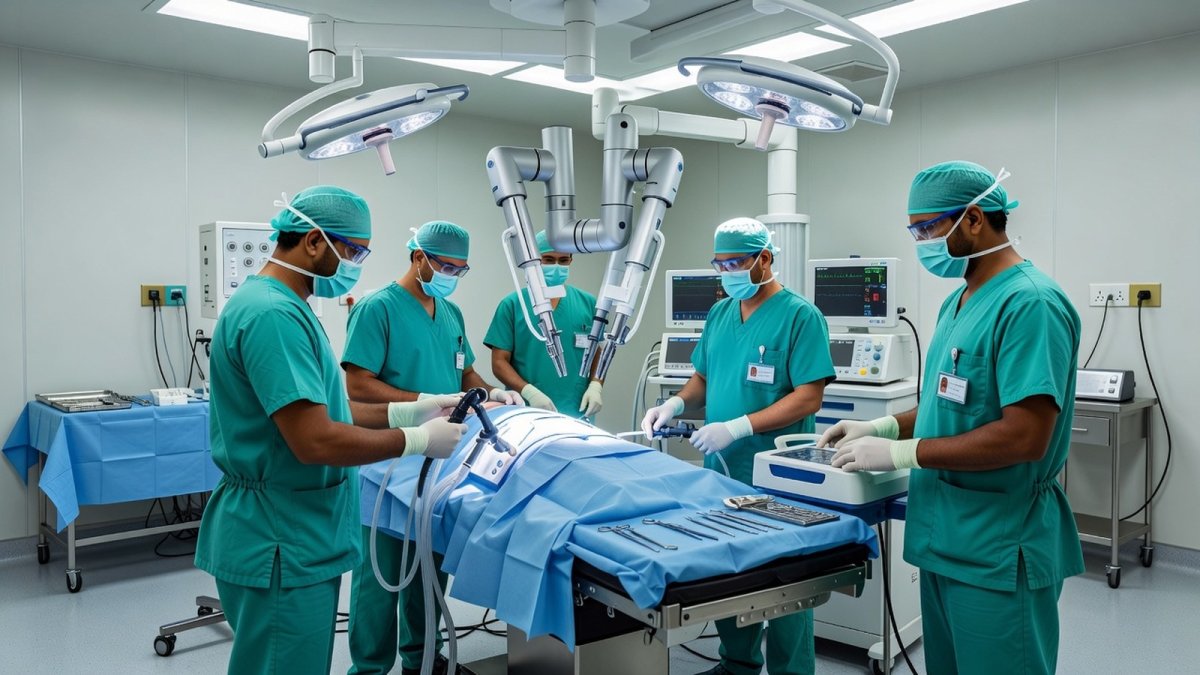
Robotic systems translate surgeon hand movements into precise instrument actions through smaller incisions than conventional open surgery. This reduces blood loss, postoperative pain, and average hospital stay length while accelerating return to normal activity. At NIMS these clinical advantages were delivered across age groups from one year to over 80 years without additional out-of-pocket expenditure for the majority of cases.
The technology therefore addresses both quality and affordability metrics that matter to Indian citizens covered by state health assurance programmes.
Precision offered by robotic systems enables organ-preservation and nerve-sparing approaches in oncology cases involving ovarian, uterine and colorectal sites, outcomes that reduce long-term functional impairments for patients. In gastroenterology applications, the technology supports complex hepatobiliary and pancreatic resections where manual dexterity limits conventional laparoscopy, extending advanced options to procedures on the liver, pancreas and intestines at government facilities.
These technical capabilities translate into system-wide efficiencies for tertiary centres managing mixed caseloads from paediatric reconstructions to geriatric cancer operations. By integrating such platforms, public institutes can standardise care pathways that previously depended on referrals, thereby optimising both clinical throughput and resource allocation across Telangana's network of empanelled hospitals.
Urology Leads the Field
Urology accounted for 590 of the 1,000 cases, including radical prostatectomy, radical cystectomy, robotic renal transplantation, and reconstructive procedures such as Boari flap and paediatric pyeloplasty. The department's case mix demonstrates capability for complex cancer and transplant work that previously required referral to private centres or overseas facilities.
Patients spanning the full paediatric-to-geriatric spectrum received these interventions under the same free-of-cost framework, illustrating how robotic precision can be applied uniformly across demographic groups within a public system.
Urology's 590 procedures encompass radical interventions for prostate and bladder cancers alongside renal transplantation and reconstructive work. This breadth of practice addresses conditions that affect broad population segments in India, where access to transplant and cancer surgery has historically varied by income level and geographic location.
Such range also reduces the need for external referrals and supports continuous skill development among surgeons, nurses and operating theatre staff at NIMS, strengthening institutional capacity for future programme scaling.
Gastroenterology and Oncology Expand the Frontier
Surgical Gastroenterology completed 248 procedures covering hepatobiliary, pancreatic, colorectal, and upper gastrointestinal cases. Surgical Oncology performed 162 operations that included organ-preservation and nerve-sparing techniques for ovarian, uterine, and colorectal cancers. Together these departments extended robotic access beyond urology into multi-organ cancer and gastrointestinal care.
The combined volume shows that once a robotic platform is operational, multiple specialties can utilise it efficiently, maximising return on the state's capital outlay.
The oncology figures carry particular significance for Indian cancer care, where surgical resection remains a primary treatment modality for solid tumours. Organ-preservation and nerve-sparing techniques can reduce long-term complications such as urinary and bowel dysfunction that disproportionately affect quality of life after pelvic cancer surgery. By offering these procedures free of cost, NIMS has removed the financial barrier that often pushes patients towards delayed or incomplete treatment.
In gastroenterology, the robotic caseload spanning hepatobiliary and pancreatic work demonstrates that public hospitals can take on procedures traditionally concentrated in a handful of private super-specialty centres. Combined with the urology programme, the multi-department use of a single robotic platform gives Telangana's tertiary network a diversified surgical capability that would otherwise require years of separate investments.
Free Surgery Through Aarogyasri and CMRF
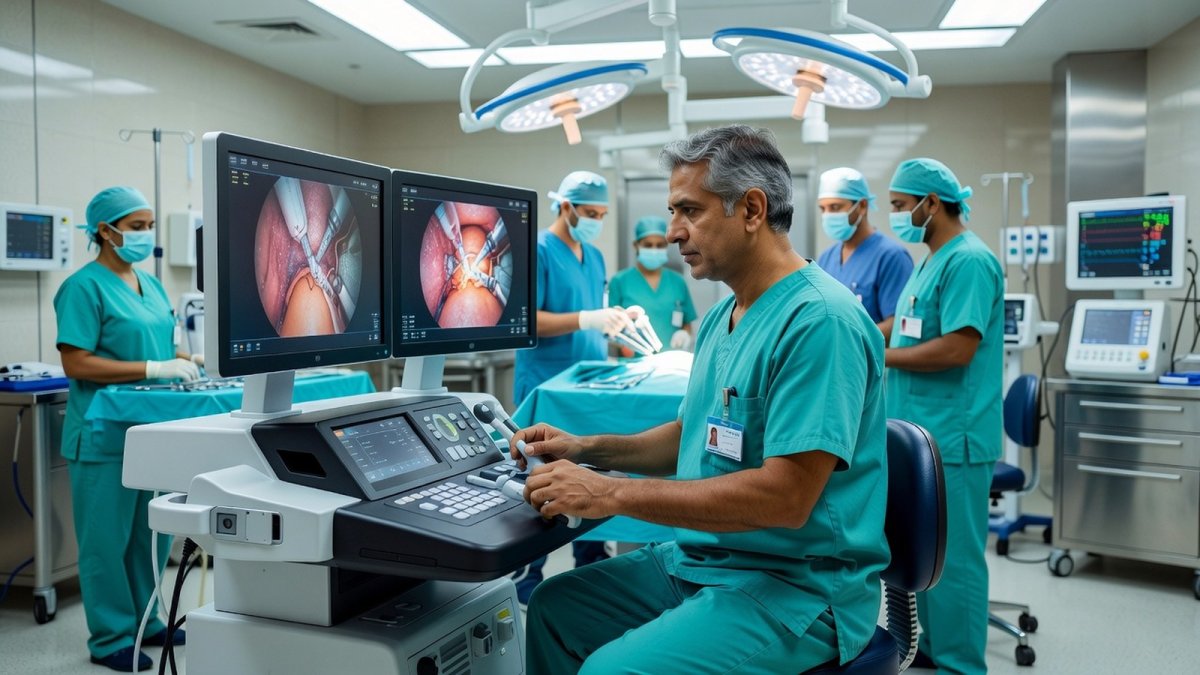
More than 90 per cent of the 1,000 procedures were funded through Aarogyasri, which covers up to Rs 5 lakh per family per year for below-poverty-line households, and the Chief Minister's Relief Fund. NIMS Director Dr Rahul Devraj credited the Telangana Health Minister and Chief Minister A. Revanth Reddy for infrastructure support that enabled the programme.
Chief Minister Reddy called the milestone transformative for bringing world-class robotic surgery within reach of patients who could not otherwise afford it. Health Minister C. Damodar Raja Narasimha noted that the free provision through existing schemes directly reflects the government's commitment to advanced care for every citizen.
The funding mechanism combines Aarogyasri's annual cap of Rs 5 lakh per below-poverty-line family with CMRF support to absorb capital and operational costs at NIMS. This layered approach ensures that equipment depreciation and consumables do not translate into patient charges, a model that directly addresses affordability gaps documented in private-sector pricing of Rs 1.5-3 lakh per procedure.
By embedding robotic services within existing welfare frameworks, Telangana demonstrates how state governments can extend high-end interventions to the majority of beneficiaries without creating parallel financing streams. The result narrows disparities in treatment access between income groups while maintaining fiscal accountability through established empanelment and reimbursement processes.
What This Means for India
India ranks as the fourth-largest and fastest-growing surgical robotics market in Asia Pacific, with over 300 systems installed and approximately 60,000 procedures performed annually. Imported da Vinci platforms cost Rs 10-20 crore, while the indigenous SSI Mantra system is priced at less than one-third that amount. NIMS has shown that public hospitals can deploy such technology at scale and absorb the cost through existing welfare schemes rather than passing it to patients.
Other states now have a documented model: combine Aarogyasri-style coverage with targeted procurement to close the gap between rich and poor access to precision surgery. The Telangana example also aligns with national momentum toward indigenous platforms that further reduce capital barriers.
NIMS's experience converts what has largely been a private-hospital story in India into a public-sector proof point. Because the institute absorbed high acquisition costs through state financing rather than patient billing, it demonstrates that robotic surgery growth need not remain confined to metropolitan private chains. The milestone also builds institutional capacity — surgeons, anaesthesiologists, nursing staff and operating theatre teams at NIMS have developed skills that strengthen Telangana's public healthcare delivery system for the years ahead.
Indigenous developments such as the SSI Mantra system, priced at less than one-third of imported alternatives and validated through cross-continental telesurgery, further lower entry barriers for additional states. Telangana's integration of robotic programmes with Aarogyasri and CMRF therefore provides both an operational precedent and a pathway toward wider adoption of cost-effective platforms across India's public healthcare landscape.
The Bottom Line
The NIMS achievement of 1,000 robotic surgeries, 90 per cent free, within three years supplies concrete evidence that advanced surgical technology can be integrated into India's public healthcare framework without creating new financial barriers. It signals that states investing in both imported and indigenous robotic systems, paired with robust assurance schemes, can deliver measurable equity gains. Taxpayers and patients in Telangana and beyond now have a clear reference point for what scaled public-sector robotic surgery looks like.
— By Dr. Raj Patel, Staff Writer
This article was produced with AI-assisted research and editorial support. Reporting is based on sources cited in the article.
What's Your Reaction?
 Like
0
Like
0
 Dislike
0
Dislike
0
 Love
0
Love
0
 Funny
0
Funny
0
 Wow
0
Wow
0
 Sad
0
Sad
0
 Angry
0
Angry
0

India/South Asia Correspondent at Global1.News. Analytical voice with a background in science and health journalism. Based in New Delhi, covering Indian politics, education, healthcare, technology, and policy. Breaks down complex data into clear, actionable reporting.












Comments (0)