
Yekaterinburg Drone Executive Vladimir Tkachuk Targeted in Car Bomb Attack
A car bomb seriously wounded Vladimir Tkachuk, founder and CEO of the sanctioned Russian drone maker Uraldronzavod, near Yekaterinburg in the second attack on a Russian defense executive in a week. His driver was killed; investigators opened an attempted murder case as Ukraine's drone war reaches...
Yekaterinburg Drone Executive Vladimir Tkachuk Targeted in Car Bomb Attack
Moscow — A car bomb seriously wounded Vladimir Tkachuk, founder and CEO of the Yekaterinburg-based drone manufacturer Uraldronzavod, in the village of Bolshoy Istok on Tuesday night, marking the second attack on a Russian defense industry executive in recent days.
The Explosion in Bolshoy Istok
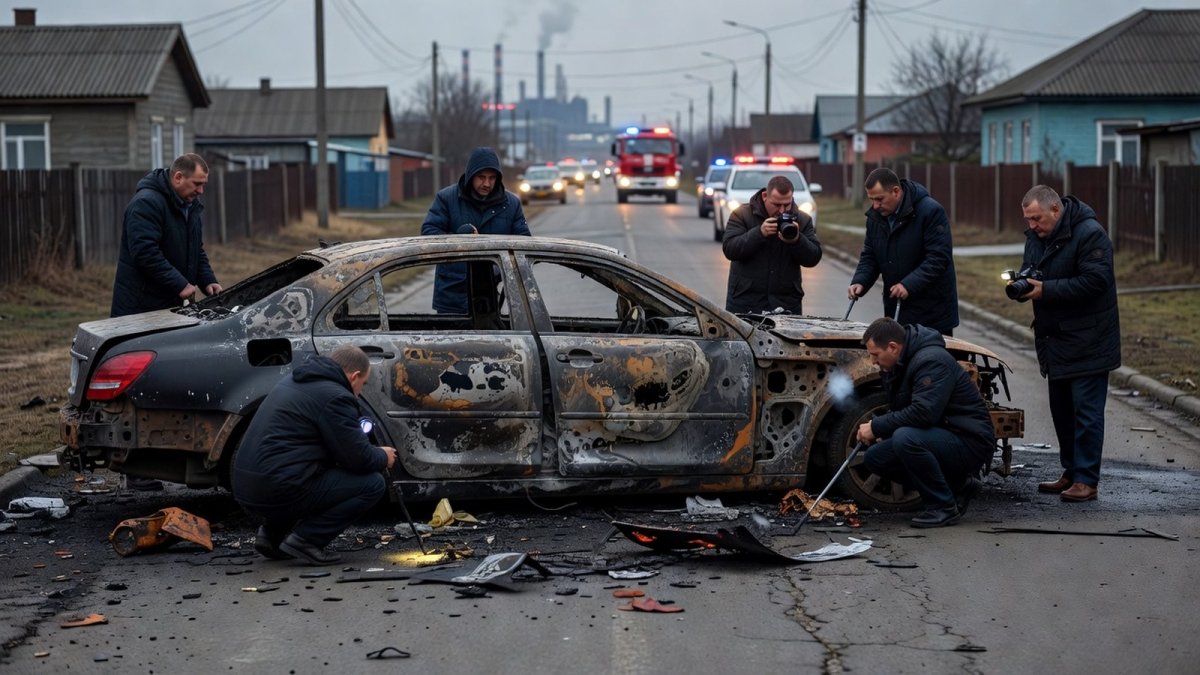
A device detonated beneath Tkachuk's Mercedes in Bolshoy Istok, roughly 25 kilometers from Yekaterinburg in the Sverdlovsk region. Eyewitnesses reported hearing a loud blast followed by flames engulfing the vehicle. Social media images showed the charred wreckage with blood stains on the pavement nearby.
Tkachuk, 35, was rushed to intensive care. His Telegram channel confirmed an assassination attempt and stated he remained in stable condition. TASS sources described his condition as critical, with doctors fighting for his life. His driver and bodyguard was killed in the blast.
The timing of the blast late Tuesday evening, with initial reports emerging only the following day, points to a possible effort by local authorities to contain early information flow before wider dissemination. Eyewitness accounts circulating on social media platforms described the immediate aftermath in vivid detail, suggesting that the incident quickly became a focal point for online speculation even as official channels remained measured in their updates.
Competing assessments of Tkachuk's condition, ranging from stable to critical, could indicate inconsistencies in how medical information is being coordinated or released to the public. The opening of a criminal investigation under attempted murder statutes underscores the legal framing authorities are applying, yet the absence of immediate arrests leaves room for analysts to suggest that the probe may be navigating complex jurisdictional or evidentiary hurdles in its early stages.
Company Profile and Wartime Production
Uraldronzavod operates as a full-cycle drone manufacturer that Tkachuk established as a startup in 2023. The firm produces compact models, heavy-lift multicopters, and fixed-wing systems at its Yekaterinburg facility. It is best known for the Upyr FPV kamikaze drone, built with 3D-printing technology and deployed by Russian forces in Ukraine.
The company and Tkachuk personally face U.S. and EU sanctions over their support for Russia's military operations. In 2024, President Vladimir Putin toured the factory with Tkachuk. Uraldronzavod belongs to a network of private contractors that emerged after the full-scale invasion to supply drones to the front.
Telegram Channel and Fundraising Role
Tkachuk founded the pro-war Telegram channel Povernutye na voine, which has more than 650,000 subscribers. The channel has raised funds and procured equipment for Russian troops. Its reach has made Tkachuk a visible figure in wartime propaganda and logistics networks.
Pro-war Telegram channels occupy a central position in Russia's wartime information ecosystem by blending real-time battlefield updates with direct appeals for equipment donations, allowing figures like Tkachuk to cultivate donor networks that bypass traditional procurement routes. Channels such as Povernutye na voine exemplify this model, where subscriber engagement translates into tangible supply chains for frontline units through targeted fundraising campaigns.
Tkachuk's emergence as a recognizable wartime personality through these platforms highlights how such influencers bridge propaganda and logistics, potentially making them high-value targets for actors seeking to disrupt both morale and material flows. Analysts suggest that striking a propagandist-logistician in this manner could signal an intent to erode the perceived safety of public-facing supporters who facilitate unofficial supply lines.
Earlier Attack on Andrey Cherezov
One week earlier, Andrey Cherezov, founder and chief designer of the Tula-based Russian Laboratory of Air Transport, was wounded in a shooting on July 29. An unidentified gunman fired three shots outside Cherezov's apartment door before fleeing. Cherezov was hospitalized in serious condition.
RLAT produces Ovod FPV drones used by Russian forces. The company recently secured contracts worth 29.7 million rubles to supply multirotor kits and control systems to Voronezh State Technical University. Russia's Investigative Committee opened a case on suspicion of attempted murder but has not identified the victim publicly or stated a motive.
The contrast between the car-bomb method used against Tkachuk and the stairwell shooting targeting Cherezov may reflect differing operational approaches by the perpetrators, with one emphasizing remote execution and the other requiring closer proximity. Such variations could indicate either distinct groups or an evolution in tactics adapted to the target's security profile.
In the Cherezov case, the involvement of the Investigative Committee without any publicly stated motive has left the incident framed primarily as an isolated criminal matter rather than part of a broader pattern. The context of RLAT and its Ovod drone production adds a layer where analysts suggest these attacks may intersect with efforts to hinder specific defense manufacturing nodes operating under private contracts.
Official Investigations and Attribution
Russian authorities opened a criminal case on suspicion of attempted murder following the Tkachuk bombing, according to TASS and E1 reports. No arrests have been announced, and law enforcement has issued no public statements on possible motives. The Investigative Committee handled the earlier Cherezov case under similar charges.
Russian state media have not named suspects. Independent outlets such as Meduza and Kommersant have noted the absence of official details on either incident.
Russian law enforcement typically manages high-profile cases through centralized bodies like the Investigative Committee, applying charges that distinguish between completed acts and attempts based on survival outcomes. The choice of attempted murder framing in Tkachuk's case aligns with this procedural approach while leaving open the possibility of reclassification.
The lack of reported arrests in these incidents, combined with limited official commentary, could indicate that investigators are prioritizing information control or awaiting developments that might clarify perpetrator identities. Analysts suggest this measured public stance may reflect an assessment that premature disclosures could compromise ongoing leads or expose vulnerabilities in protective measures for similar figures.
Pattern of Strikes on Defense Figures
The Moscow Times described the Tkachuk bombing as the second attempted assassination of a defense executive in Russia over the past week. The Guardian reported that Russian authorities are likely to attribute the attack to Ukraine. The incidents fit a broader series targeting military commanders, defense executives, and pro-war figures inside Russia in recent months.
Ukraine has not claimed responsibility for these attacks. Russian officials routinely point to Kyiv in such cases. Western governments maintain sanctions on companies like Uraldronzavod, citing their contribution to Russia's drone output.
Incidents such as the Moscow restaurant explosion directed at Col. Gen. Aleksandr Chayko illustrate a recurring focus on senior aerospace and military figures, extending the scope beyond industrialists to operational commanders. The Kremlin's consistent attribution of these events to Ukrainian orchestration serves to reinforce a narrative of external aggression, even as Ukraine maintains official silence on any involvement.
Analysts suggest that the pattern of clandestine operations inside Russia points to sophisticated infiltration capabilities that challenge domestic security assumptions. This sequence of strikes on defense-linked individuals could indicate a strategic emphasis on psychological and logistical disruption rather than solely kinetic battlefield gains.
Drone Industry Context and Sanctions Impact
Russia's wartime drone production relies heavily on private contractors like Uraldronzavod and RLAT. Kyiv stated in May that Moscow planned to manufacture 7.3 million FPV drones and 7.8 million warheads in 2026. These firms operate under U.S. and EU sanctions that restrict components and financing.
Analysts suggest the attacks could signal efforts to disrupt supply chains that sustain Russian operations in Ukraine. The Kremlin's dependence on such contractors leaves the industry exposed to targeted actions. Ordinary Russians face indirect effects through restricted technology imports and heightened security measures around defense sites.
Russia's wartime drone sector depends heavily on private contractors who can rapidly scale production of low-cost FPV systems, often leveraging 3D printing to circumvent traditional manufacturing bottlenecks and achieve favorable unit economics. This model allows smaller firms to contribute meaningfully to the overall output despite broader industrial constraints.
Sanctions have complicated access to critical electronic components and financing channels, forcing reliance on alternative suppliers or domestic substitutes that may affect quality and timelines. Analysts suggest that targeting drone makers in this environment underscores their role as strategic nodes whose disruption could ripple through both production capacity and the informal networks sustaining frontline equipment supplies.
Recent Moscow Incident and Security Concerns
The Tkachuk bombing follows an explosion outside an upmarket Moscow restaurant that killed five people days earlier. Pro-Kremlin bloggers and independent Russian media suggested the target may have been Col. Gen. Aleksandr Chayko, commander of Russia's aerospace forces. Authorities have not confirmed the intended victim.
These events underscore vulnerabilities in Russia's rear areas despite official narratives of control. Western sanctions continue to limit access to dual-use components, forcing manufacturers to seek alternative suppliers.
By Irina Volkov, Staff Writer
This article was produced with AI-assisted research and editorial support. Reporting is based on sources cited in the article.
What's Your Reaction?
 Like
0
Like
0
 Dislike
0
Dislike
0
 Love
0
Love
0
 Funny
0
Funny
0
 Wow
0
Wow
0
 Sad
0
Sad
0
 Angry
0
Angry
0

Russia/Eastern Europe Correspondent at Global1.News. Covering Russian politics, energy, security, and the shifting dynamics of the post-Soviet space. Provides clear-eyed analysis on one of the world's most opaque regions.














Comments (0)