
Mekong Floods Thai-Lao Border Market as Water Nears Crisis Level
The Mekong's Rising Wrath: A Border Community Under Water NAKHON PHANOM — The Mekong River, the lifeblood of the Isaan region, has once again demonstrated its immense power, overflowing its banks and submerging the bustling Thai-Lao border trading market here. On Wednesday morning, hydrological officials recorded the river level at a precarious 11.98 metres, a mere 2 centimetres below the critical threshold, marking a 15-centimetre surge from the previous day....
The Mekong's Rising Wrath: A Border Community Under Water
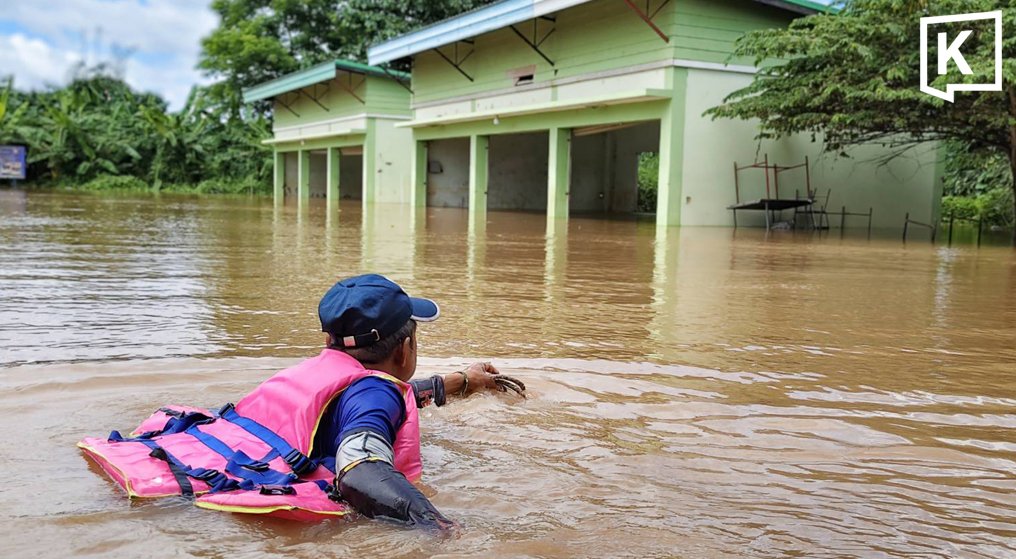
NAKHON PHANOM — The Mekong River, the lifeblood of the Isaan region, has once again demonstrated its immense power, overflowing its banks and submerging the bustling Thai-Lao border trading market here. On Wednesday morning, hydrological officials recorded the river level at a precarious 11.98 metres, a mere 2 centimetres below the critical threshold, marking a 15-centimetre surge from the previous day. For the families and traders who have built their lives along this mighty waterway, the rising water is not just a statistic; it is a daily reality that threatens their homes, their livelihoods, and their connection to the river that sustains them.
The situation has escalated rapidly, prompting Nakhon Phanom municipal authorities to take urgent defensive measures. All four floodgates at key pumping stations along the river have been ordered closed to prevent the Mekong from flowing backward into the city's heart. This is a race against time, as authorities have warned that the water level could reach the critical point by the afternoon, testing the limits of the city's infrastructure and the resilience of its people.
Ban Klang Subdistrict: The Frontline of the Flood
The impact is being felt most acutely in the rural communities that line the riverbank. In Ban Klang subdistrict, Muang district, approximately 28 kilometres from Nakhon Phanom town, runoff from Bueng Kan province and the Lao side of the river has converged, inundating vast agricultural lands. More than 100 rai of banana, bamboo, and aromatic coconut plantations are now submerged under roughly 1 metre of water. A concrete road stretching over 3 kilometres has also disappeared beneath the floodwaters, cutting off access and isolating communities.
The temporary border trading area and the OTOP (One Tambon One Product) goods buildings have been particularly hard hit. The scene is one of chaos and loss: five or six rubbish bins were swept away by the current, while ice boxes, tables, and chairs belonging to vendors were left floating in the murky water after traders failed to move their belongings in time. Some vendors, in a desperate attempt to salvage their assets, used ropes to secure their possessions to fixed structures, hoping to ride out the flood. The market, once a vibrant hub of cross-border commerce, now stands as a silent testament to the river's unpredictable nature.
A Farmer's Plight: Daosawan's 2,000-Kilogramme Challenge
For 59-year-old Daosawan, a bamboo farmer from the area, the flood is a personal catastrophe. She owns three bamboo plantations covering more than 30 rai, with over 200 clumps of bamboo. The rapidly rising Mekong has flooded two of her plantations to a depth of about 1 metre since 9 August. She normally harvests bamboo shoots to sell to fresh markets in town, with daily orders of at least 50 kilogrammes. But on Wednesday, a vendor placed a massive order for 2,000 kilogrammes—a windfall that now seems impossible to fulfil.
"Only one plantation, with about 50 bamboo clumps, remains above the floodwaters," she said, her voice heavy with uncertainty. She fears substantial losses and may have to resort to using a boat to navigate the flooded fields and harvest the bamboo from the two submerged plantations. Her story is a microcosm of the broader struggle facing Isaan's agricultural communities, where the river that provides sustenance can, in a matter of days, become the source of ruin. The economic ripple effect of her loss will be felt in the local fresh markets, where bamboo shoots are a staple ingredient in many Thai dishes.
Cross-Border Struggles: The Lao Traders of Pak Peng
The flood has not respected national borders. Booncharoen Phrombutr, 67, a kamnan inspector in Ban Klang subdistrict, explained that rapid runoff from upstream areas combined with heavy rain had caused the Mekong to gradually overflow its banks over the past two to three days. Floodwaters have reached about 1 metre in some areas and as deep as 1.5 metres in others. This has severely disrupted the lives of traders from Pak Peng on the Lao side, opposite Ban Nad village in Ban Klang subdistrict.
These traders, who regularly cross the border to sell forest products such as rats, squirrels, mushrooms, and insects, are now struggling to make the journey as flooding has also affected the Lao side. Some goods that traders were unable to remove from the temporary border trading buildings have been swept away and are still floating on the water, awaiting collection by boat. This disruption to the informal cross-border trade is a significant blow to the local economy, which relies heavily on these exchanges. It also highlights the shared vulnerability of communities along the Mekong, underscoring the need for regional cooperation in disaster preparedness and response, a key tenet of ASEAN community building.
Si Songkhram: A Second Front Opens
Further downstream, the situation is equally dire. The Songkhram River in Si Songkhram district overflowed its banks on the afternoon of 11 August, opening a second front in the battle against the flood. The flooding has particularly affected Tha Bo Songkhram village in Tha Bo Songkhram subdistrict and Pak Un village in Si Songkhram subdistrict. Water has entered homes built close to the river, inundating around eight to 10 houses to an average depth of 50 centimetres to 1 metre.
In a display of community leadership, Si Songkhram district chief Kornkan Kaewdee led staff from two health-promoting hospitals and village leaders in taking flat-bottomed boats into the affected areas. Their mission was to deliver essential supplies and provide support to residents, many of whom are elderly or have limited mobility. Officials have been instructed to pay particular attention to waterborne diseases and the needs of elderly people, children, and patients requiring special care until the situation returns to normal. This proactive response is crucial in preventing a secondary health crisis in the wake of the flooding.
Municipal Response: A City on Guard
Back in Nakhon Phanom town, Mayor Niwat Chiawiriyabunya confirmed that the Mekong level had continued to rise, putting the city's infrastructure to the test. The four automatic pumping stations along the Mekong—on Thetsapradit Road, Samut Banharn Road, at the post office junction, and in front of Wat Pho Si—normally pump water from the city into the river. However, the river level has now risen beyond the stations' capacity, prompting authorities to close all floodgates at the four locations.
In a strategic move, authorities will instead deploy remote pumping equipment and more than 10 large mobile water pumps from the Department of Disaster Prevention and Mitigation's Sakon Nakhon regional office. The equipment will be stationed at key locations and along the Mekong so that if heavy rain causes floodwater to flow back into the city, officials can quickly pump it back into the river. This adaptive approach reflects the lessons learned from past floods and the importance of having a flexible, well-equipped disaster response plan.
For the people of Nakhon Phanom, this flood is a stark reminder of their enduring relationship with the Mekong. It is a river that brings life, trade, and cultural connection with our Lao neighbours, but it also demands respect. As the waters continue to rise, the community's spirit of cooperation—from the kamnan inspectors to the district chiefs and the everyday farmers like Daosawan—remains their greatest strength. The road to recovery will be long, but the resilience of the Isaan people, deeply rooted in their Buddhist faith and communal bonds, will see them through this trial.
This article was produced with AI-assisted research and editorial support. Sources: Khaosod English.
By Ann Srisawat, Staff Writer
What's Your Reaction?
 Like
0
Like
0
 Dislike
0
Dislike
0
 Love
0
Love
0
 Funny
0
Funny
0
 Wow
0
Wow
0
 Sad
0
Sad
0
 Angry
0
Angry
0

Southeast Asia Correspondent at Global1.News. Based in Bangkok, covering Thai and Southeast Asian politics, economy, technology, and culture. Deep regional perspective on one of the world's most dynamic regions.













Comments (0)