
8 Killed, 8 Missing as Kerala Landslides and Floods Hit 12 Districts
Heavy monsoon rains triggered deadly landslides and flooding across Kerala, claiming eight lives—including three children—and leaving eight people missing as of Sunday, August 2, 2026.
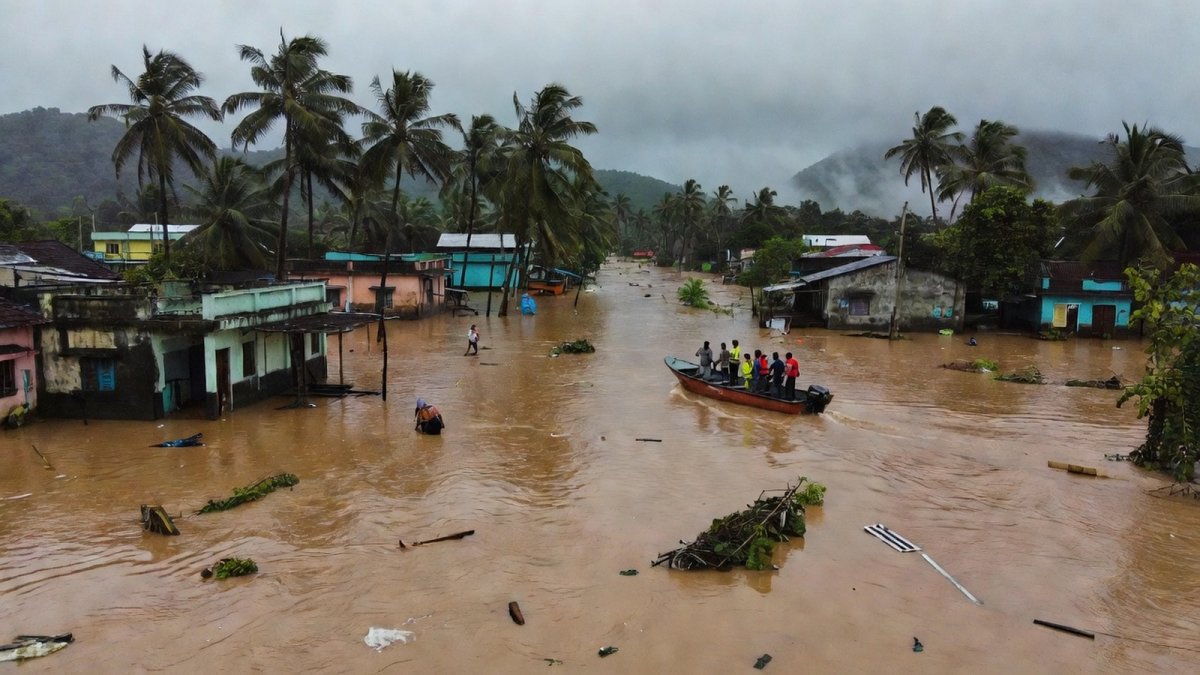
Heavy monsoon rains triggered deadly landslides and flooding across Kerala, claiming eight lives—including three children—and leaving eight people missing as of Sunday, August 2, 2026. The deluge, which dumped up to 361 mm in 24 hours at Vadasserikkara, struck 12 districts under IMD orange alerts and exposed the limits of existing early-warning systems in the Western Ghats. This latest crisis adds to the mounting toll from recurrent extreme weather events that continue to strain state resources and taxpayer-funded recovery efforts.
8 Killed, 8 Missing as Kerala Landslides and Floods Hit 12 Districts
Thiruvananthapuram, Kerala – August 3, 2026 — Kerala’s latest monsoon crisis has left eight dead, eight missing and 13 injured after intense rainfall from July 31 to August 2 triggered landslides and floods in 12 districts, testing the state’s disaster management infrastructure once again.
Death Toll and Human Impact
Heavy monsoon rains that began the night of Friday, July 31, 2026, and intensified through Saturday, August 1, killed eight people across Kerala, left eight missing and injured 13 others by Sunday morning, August 2. Three children were among the dead. Abdul Muhaini, aged 3, and Adam Ayman, aged 4, drowned after falling into a swollen stream in Malappuram. Milan K. Shinu, 11, died after falling into a waterlogged pit dug for a Jal Jeevan Mission project at Vakathanam in Kottayam. Sumathi, 69, was killed when a landslip buried her home in Kudayathoor panchayat near Thodupuzha. Prabhakaran Nair, 72, died in a mudslide at Kolahalamedu near Vagamon. Josephin Johny, 28, and his mother Regina Johny, 48, were buried under debris when a hillside collapsed onto their home at Kaippally in Kottayam. One person died by electrocution in Wayanad. Two women were among the killed.
Rainfall Records and the IMD Alert System
The India Meteorological Department issued an orange alert for 12 districts on August 2: Pathanamthitta, Alappuzha, Kottayam, Ernakulam, Idukki, Thrissur, Palakkad, Malappuram, Kozhikode, Wayanad, Kannur and Kasaragod. A yellow alert covered Thiruvananthapuram and Kollam. Orange alert signals very heavy rainfall of 11-20 cm, while yellow indicates 6-11 cm. Parts of Pathanamthitta, Kottayam and Idukki recorded extremely heavy rainfall above 204.4 mm. The highest 24-hour total reached 361 mm at Vadasserikkara in Pathanamthitta, measured by a KSDMA rain gauge. Other readings included 357 mm at Athikkayam, 314 mm at Vagamon, 307 mm at Angamoozhy, 340 mm at Anakkampoyil over 35 hours, 250 mm at the IMD station at Laha, and 177 mm at Meppadi in Wayanad. KSDMA recorded up to 320 mm on Saturday at Ayyankunnu in Kannur.
The India Meteorological Department’s graded alert system, with orange warnings for 11-20 cm rainfall across twelve Kerala districts and yellow for 6-11 cm in two others, highlights the challenge of capturing extreme spatial variability during monsoon events. A single gauge recording 361 mm in 24 hours at Vadasserikkara alongside 250 mm at Laha within the same window illustrates how localised convection, often following dry spells in the Western Ghats, can rapidly overload slopes and drainage networks. KSDMA’s denser network of manual and automatic gauges, which captured peaks such as 320 mm at Ayyankunnu, complements IMD automatic stations but also exposes gaps in real-time integration when rainfall intensifies within hours.
Damage, Dams and Relief Operations
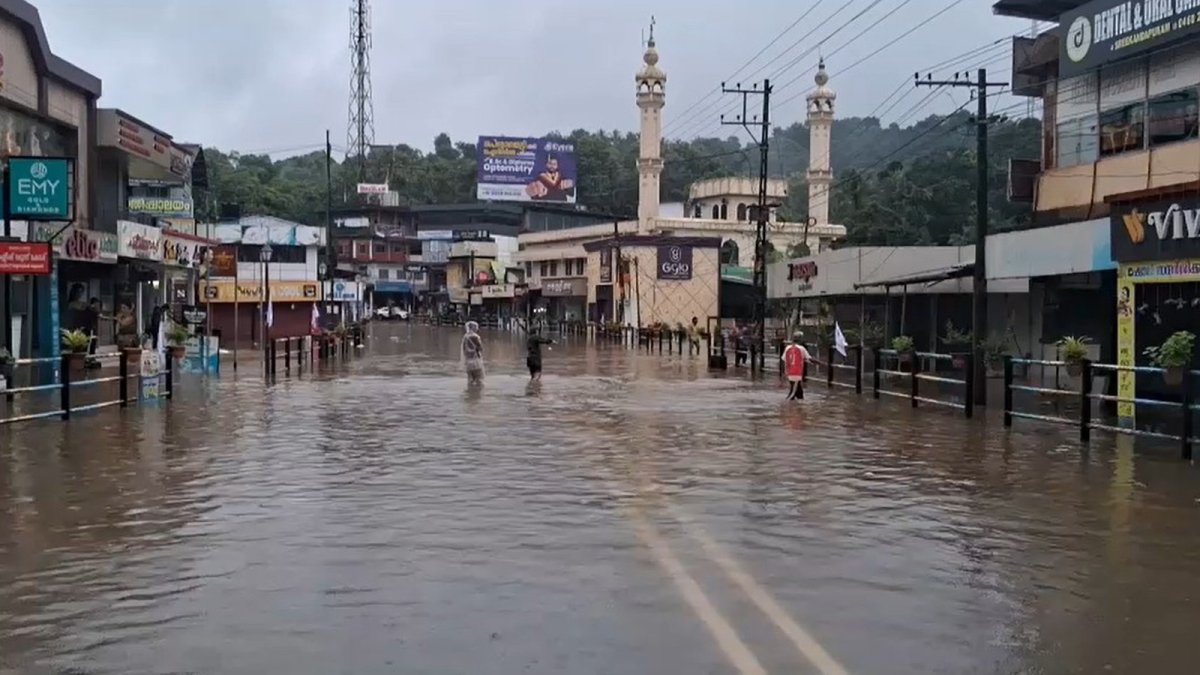
Kerala Chief Minister V.D. Satheesan’s office confirmed 27 houses completely destroyed and 196 partially damaged. Authorities shifted 5,792 people to 209 relief camps statewide. Worst-affected districts were Pathanamthitta, Idukki and Kottayam. In Idukki alone, 187 people moved to 13 camps after Peerumade and Thodupuzha taluks received more than 200 mm on Saturday morning. Ranni town in Pathanamthitta submerged when the Pamba river overflowed. Parts of Kuttanad in Alappuzha remained underwater, forcing residents to use small boats. Water levels in hydropower dams across Idukki, Pathanamthitta and Thrissur stayed in the red-alert zone, prompting shutter releases. Rapid dam-shutter operations at hydropower reservoirs in Idukki, Pathanamthitta and Thrissur districts illustrate the downstream flood trade-offs inherent in reservoir management during intense rainfall. The activation of 209 relief camps housing 5,792 people reflects both institutional preparedness and the persistent scale of slope-side exposure across the Western Ghats.
Rescue Deployment and State Response
NDRF and SDRF units were stationed in vulnerable zones, with an additional NDRF team deployed in Pathanamthitta and Aranmula. Extra Fire and Rescue Services personnel arrived from Thiruvananthapuram, Palakkad and Ernakulam. Revenue Minister A.P. Anilkumar stated the situation remained under control as traffic resumed on many roads. NDRF, fire and rescue, police and local residents rescued two people alive from debris in Idukki. The Kasaragod District Disaster Management Authority, chaired by District Collector Arjun Pandian, placed the district on high alert for two days. Under the Disaster Management Act 2005, NDRF and SDRF deployments operate through a structured chain of command that places district collectors at the centre of coordination via District Disaster Management Authorities. In the current event, additional NDRF teams in Pathanamthitta and Aranmula, supported by personnel from neighbouring districts, enabled rapid rescues such as those in Idukki, while the Kasaragod DDMA maintained high alert status.
Marine Tragedies and Coastal Warnings
A fishing boat carrying four fishermen overturned near Muthalappozhy around 8:30 p.m. on July 31 after strong waves struck it 100 metres from the estuary. The body of Freemon, 28, from Anchuthengu, was recovered off Kannanthura 20 km away in a joint operation by Coastal Police, Fisheries Department’s Marine Enforcement Wing and the Indian Coast Guard. Shijin, 32, also from Anchuthengu, remained missing. Jose and Smith swam to safety. The state government requested Indian Navy assistance following protests by fishermen and relatives. Two fishermen went missing off Vizhinjam, and two Kannur residents who fell into a river were unaccounted for. INCOIS warned of high waves of 2.7-3.5 metres along the northern Kerala coast. Fishermen were advised against venturing into the Kerala-Karnataka-Lakshadweep coast on August 2 and 3 due to winds up to 60 kmph.
The Fishermen’s Dilemma
Kerala’s fishing communities face acute livelihood trade-offs when INCOIS issues high-wave warnings of 2.7-3.5 metres and wind speeds up to 60 kmph along the northern coast. Blanket prohibitions on venturing out for multiple days translate into complete income loss for low-income crews operating from harbours such as Muthalappozhy and Vizhinjam, where daily earnings depend on continuous access to near-shore waters. INCOIS wave forecasts provide essential scientific guidance under national coastal management protocols, yet officials acknowledge persistent difficulties in enforcing departures amid economic pressures. The economics of Kerala’s marine sector amplify these vulnerabilities, as recurrent weather disruptions compound recovery costs already borne by fishing households.
Policy Lessons from Recurrent Crises
This event follows the July 2024 Wayanad landslides that claimed over 200 lives and Kerala’s major flood crises since 2018. The IMD alert hierarchy of yellow, orange and red provides graded warnings, yet short-distance variations in rainfall loads on slopes and drains continue to challenge ground-level response. KSDMA rain gauges and NDRF rapid deployment demonstrate institutional progress, but the Western Ghats demand accelerated investment in disaster-resilient infrastructure, early-warning dissemination to panchayats, and climate-adaptation measures for India’s monsoon belt. Kerala’s recurrent exposure to short-duration extremes aligns with broader climate trends of intensifying monsoon convection over peninsular India. The Western Ghats Ecology Expert Panel recommendations continue to underscore the ecological sensitivity of Kerala’s hill districts, where recurrent crises since the 2018 floods and the 2024 Wayanad landslides have exposed gaps between policy intent and implementation. Landslide hazard zonation at the panchayat level, combined with accelerated early-warning dissemination, offers a pathway to lower the recurring cost of recovery that taxpayers across monsoon-belt states ultimately shoulder.
The Bottom Line
Indian citizens in high-rainfall districts face repeated disruption to homes, livelihoods and safety. Strengthened coordination between IMD, KSDMA, NDRF, SDRF, INCOIS and district authorities such as DDMA can reduce future losses, yet sustained funding for slope stabilisation, drainage upgrades and community-level alerts remains essential. The August 2-3 and August 6 forecasts of further heavy rain with 40-50 kmph winds underscore the need for proactive governance across the Western Ghats states. Climate projections indicate further intensification of short-duration rainfall extremes over peninsular India, increasing the frequency of events that overwhelm conventional alert hierarchies. Prioritising prevention through updated zonation maps and climate-adaptive infrastructure would shift the balance from repeated post-disaster expenditure toward durable risk reduction under national frameworks. These mechanisms demonstrate measurable progress in state-level response capacity, yet they also reveal the recurring fiscal burden on state and central taxpayers when extreme events recur.
— By Dr. Raj Patel, Staff Writer
This article was produced with AI-assisted research and editorial support. Reporting is based on sources cited in the article.
What's Your Reaction?
 Like
0
Like
0
 Dislike
0
Dislike
0
 Love
0
Love
0
 Funny
0
Funny
0
 Wow
0
Wow
0
 Sad
0
Sad
0
 Angry
0
Angry
0

India/South Asia Correspondent at Global1.News. Analytical voice with a background in science and health journalism. Based in New Delhi, covering Indian politics, education, healthcare, technology, and policy. Breaks down complex data into clear, actionable reporting.













Comments (0)