
Israeli forces detain 53 Palestinians in occupied West Bank
In the early hours of Monday, Israeli forces launched a sweeping raid on the West Bank town of Biddu, northwest of Jerusalem, detaining at least 53 Palestinians.
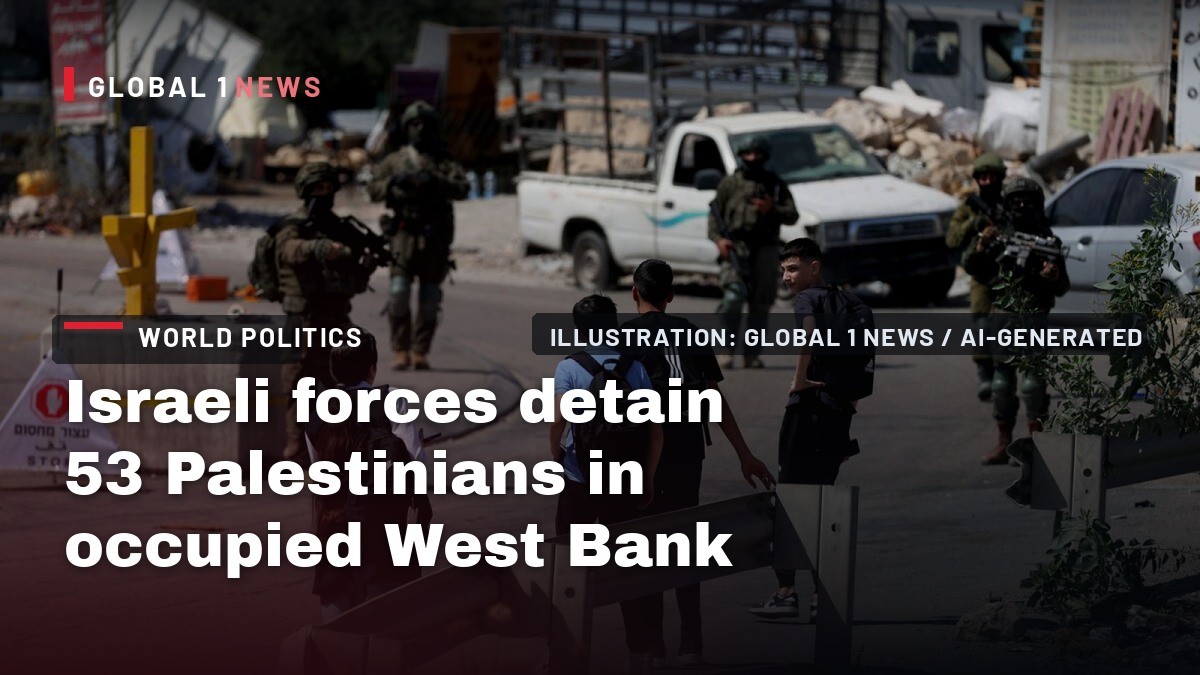
In the early hours of Monday, Israeli forces launched a sweeping raid on the West Bank town of Biddu, northwest of Jerusalem, detaining at least 53 Palestinians. The operation, described by the Palestinian Jerusalem Governorate as involving the seizure of a private home turned into an improvised interrogation and detention centre, highlights a troubling escalation in the use of field interrogations and the militarisation of civilian spaces across the occupied territories. As the Israeli army continues its campaign of raids, searches, and home invasions, the human cost for families and communities deepens, and the legal ramifications under international law become increasingly stark.
Scale of the latest raid and its immediate impact
The raid on Biddu was part of a broader wave of operations that saw Israeli forces detaining dozens of Palestinians in a single day. According to the Palestinian Jerusalem Governorate, the detainees were held inside a house that had been seized during the raid, where they were subjected to interrogation under harsh conditions. The group reported that the soldiers vandalised and damaged several homes, and physically assaulted Palestinians during the operation. Such tactics—turning private residences into makeshift military posts—blur the line between combatant and civilian spaces, exposing families to direct violence and intimidation.
Witnesses described “dozens of young men” being confined within the seized house, handcuffed and blindfolded, with visible restraint marks on some of their hands. The use of blindfolds and handcuffs, coupled with the presence of restraint marks, points to a pattern of coercive tactics that raise serious concerns under the Geneva Conventions, which prohibit humiliating and degrading treatment of detainees.
Field interrogations across the West Bank
The Palestinian Prisoners Society reported that over the past two days, more than 100 Palestinians were subjected to field interrogation throughout the occupied West Bank. These interrogations were concentrated in towns such as al‑Mughayyir, east of Ramallah, and again in Biddu. While the majority of those questioned were later released, the very act of field interrogation—conducted outside formal detention facilities—circumvents established legal safeguards, including the right to counsel and protection against arbitrary detention.
Field interrogations have become a hallmark of recent Israeli raids, according to the Prisoners Society. The practice involves detaining individuals in makeshift sites, often homes or temporary checkpoints, and subjecting them to questioning under duress. The group highlighted that these operations often involve the seizure of mobile phones, with soldiers searching the devices and using the information as leverage, further eroding privacy rights and the integrity of personal communications.
Human rights abuses reported during the raids
Beyond the detentions, the Palestinian Prisoners Society documented a range of abuses accompanying the raids. Palestinians were reportedly used as “hostages and human shields,” a tactic that places civilians directly in harm’s way to deter resistance or to protect Israeli soldiers. Such practices contravene the principle of distinction under international humanitarian law, which obliges parties to a conflict to differentiate between combatants and civilians.
The group also noted the physical assaults on detainees, with some individuals bearing visible restraint marks. The use of blindfolds, handcuffs, and the transformation of homes into military barracks collectively contribute to an atmosphere of intimidation that permeates daily life for residents, undermining their sense of security and dignity.
Link between raids and broader patterns of violence
The surge in field interrogations and home raids follows a pattern of intensified Israeli military activity in the West Bank that began in October 2023. Since then, the occupied territories have experienced a steady increase in raids, arrests, and restrictions on movement, alongside a rise in settler‑related violence and the closure of town entrances. The Prisoners Society linked the recent spike in interrogations to ongoing occupier violence against Palestinians and their property, suggesting a feedback loop where security operations fuel further tensions and resistance.
These developments have affected a broad cross‑section of the population, including children, women, and the elderly. The impact on vulnerable groups is profound: children witness the militarisation of their neighbourhoods, women bear the burden of caring for detained family members, and the elderly often lack the means to flee or protect themselves from home invasions.
Legal implications under international law
The practices described—home seizures, makeshift detention centres, field interrogations, and the use of civilians as human shields—raise serious questions under the Fourth Geneva Convention and the International Covenant on Civil and Political Rights. The Convention prohibits collective punishments and the forced displacement of civilians, while the Covenant guarantees the right to liberty and security of person, as well as protection against arbitrary arrest. The transformation of private homes into military posts can be interpreted as a form of collective punishment, which is expressly prohibited.
Moreover, the visible restraint marks and reports of physical assaults suggest possible violations of the prohibition against torture and cruel, inhuman, or degrading treatment. International human rights bodies have consistently warned that any form of coercive interrogation that inflicts physical or psychological harm must be investigated and prosecuted.
Community response and resilience
Despite the pervasive atmosphere of fear, Palestinian communities continue to organise and document these violations. The Palestinian Prisoners Society has issued statements detailing the raids, providing a crucial record that can be used for future accountability efforts. Local activists have also highlighted the broader impact on daily life, noting that the raids disrupt schooling, economic activity, and the basic rhythm of community life.
The resilience of residents is evident in their continued resistance to the occupation’s encroachments. Families of detainees often rally to demand the release of their loved ones, while community leaders call for international attention to the escalating human rights abuses. Such collective action underscores the human cost of the occupation and the determination of Palestinians to assert their rights despite mounting pressures.
International reaction and the path forward
International observers have repeatedly called for urgent intervention to halt the escalation of raids and field interrogations. While the source material references a broader context of regional diplomatic statements, the immediate focus remains on documenting the human impact of these operations. The pattern of raids, home seizures, and field interrogations underscores the need for robust monitoring mechanisms and accountability measures.
For the international community, the challenge lies in translating condemnation into concrete action—whether through diplomatic pressure, investigations by international bodies, or support for Palestinian civil society documenting these abuses. As the cycle of raids continues, the human toll on families, the erosion of legal protections, and the deepening of trauma within Palestinian society demand sustained attention and a firm commitment to upholding international law.
This article was produced with AI-assisted research and editorial support. Reporting is based on the source material cited below. Sources: Middle East Monitor; middleeastmonitor.com; Global1.News (22 September 2026).
By Fatima Al-Rashid, Staff Writer
What's Your Reaction?
 Like
0
Like
0
 Dislike
0
Dislike
0
 Love
0
Love
0
 Funny
0
Funny
0
 Wow
0
Wow
0
 Sad
0
Sad
0
 Angry
0
Angry
0
Gulf/MENA Correspondent at Global1.News. Based in Doha, covering Gulf politics, energy markets, diplomacy, and development across the Middle East and North Africa. Tracks the economic transformation of the Gulf states.











Comments (0)