
Who Will Stand at the Machine? Inside the Labor Crunch Paralyzing Israel's Production Lines
The machines are running, but the hands are missing. Across Israel’s industrial heartland—from the dairy plants of the Sharon plain to the pharmaceutical lines outside Jerusalem—factory floors are operating at reduced capacity, not for lack of orders, but for...
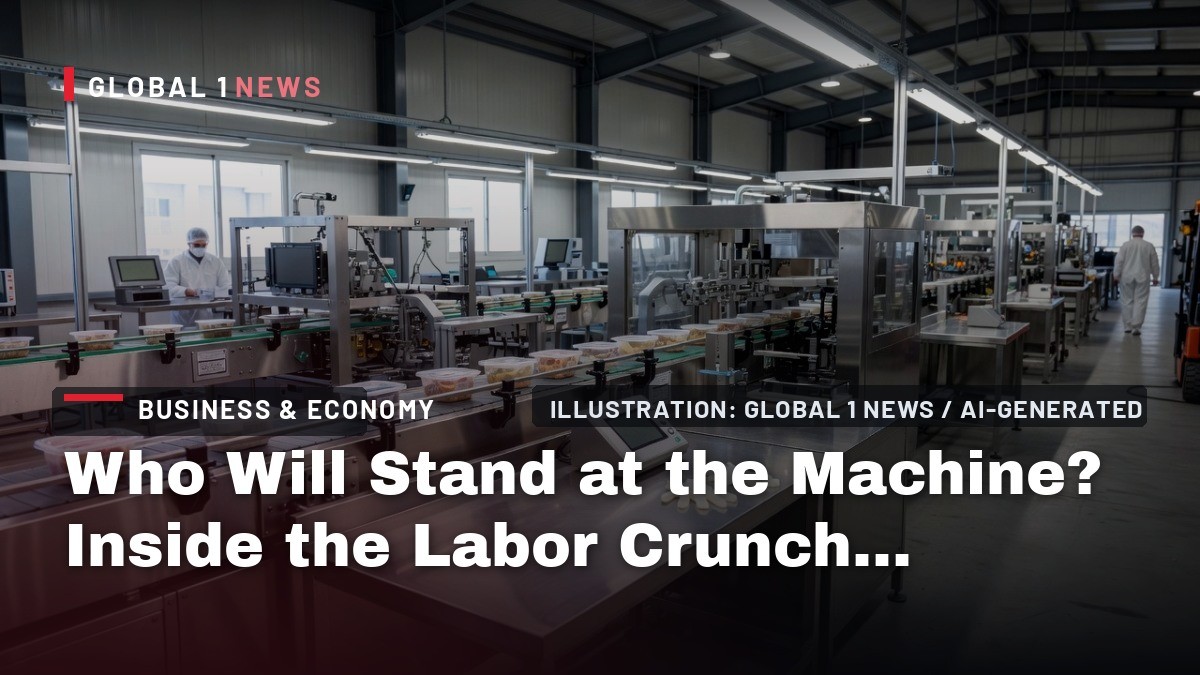
The machines are running, but the hands are missing. Across Israel’s industrial heartland—from the dairy plants of the Sharon plain to the pharmaceutical lines outside Jerusalem—factory floors are operating at reduced capacity, not for lack of orders, but for lack of workers. The problem is no longer a temporary wartime hiccup; it has become a structural paralysis. Manufacturers describe a systemic failure: many vacant positions, factories left without hands to work, and a bureaucracy that stalls the very economy it is meant to support. Following the war, demand for foreign workers is rising sharply, but in practice, only a few arrive. The result is a production-line crisis that threatens not just corporate bottom lines, but the price of basic goods on Israeli supermarket shelves.
The Scope of the Vacancy Crisis
The numbers paint a stark picture of an industrial sector gasping for air. Israeli manufacturers report a structural, not cyclical, shortage of skilled production workers. This is not a seasonal dip or a post-holiday lull; it is a fundamental mismatch between the workforce available and the needs of the factory floor. The vacancies are concentrated in precisely the roles that keep the economy humming—machine operators, quality control technicians, logistics coordinators, and maintenance crews. These are not entry-level positions that can be filled by anyone with a pulse; they require training, experience, and a level of commitment that is increasingly hard to find.
The aging of the existing workforce compounds the problem. As veteran factory workers retire, there is no younger generation stepping up to replace them. The pipeline of skilled labor, once fed by vocational schools and on-the-job apprenticeships, has run dry. Manufacturers across the country are finding that the positions they post remain open for months, and in some cases, they have stopped posting altogether, resigned to operating with skeleton crews. The result is a drag on output that ripples through the entire supply chain, affecting everything from food processing to advanced manufacturing.
The Post-October 7 Turning Point
The crisis did not emerge from a vacuum; it was ignited by the seismic events of October 7. In the immediate aftermath of the attack, when Palestinian entry into Israel was banned, the labor shortage became acute overnight. For decades, Israeli industry had relied on a steady, if controversial, pipeline of Palestinian workers from the West Bank to fill the lower rungs of the manufacturing ladder. That pipeline was severed in a single day, and it has not been restored.
The sudden loss of thousands of workers sent shockwaves through the economy. Factories that had planned production schedules months in advance were forced to scramble. The state’s initial response was to look further afield, beginning the process of importing workers from India, Sri Lanka, and the Philippines to take their place. But the transition has been anything but smooth. The bureaucratic machinery required to vet, transport, house, and employ these workers has proven slow and cumbersome, leaving factories in a state of limbo, waiting for hands that have yet to arrive.
The Turn to India, Sri Lanka, and the Philippines
The government’s pivot to South and Southeast Asia was a recognition that the old model was gone for good. The recruitment drive targeting India, Sri Lanka, and the Philippines was meant to provide a reliable, long-term substitute for the Palestinian labor force. In theory, the plan was sound: these countries have large, willing workforces with experience in manufacturing and agriculture. In practice, the implementation has been fraught with delays.
Manufacturers report that the quota system, while expanded, is not being filled at the pace required. The logistics of bringing in workers from thousands of miles away—securing visas, arranging flights, providing housing, and navigating health and security screenings—are immense. Each step is subject to bureaucratic oversight that seems designed for a slower, more predictable era. The result is that while the demand for foreign workers has surged, the actual arrival rate remains a trickle, leaving production lines short-staffed and managers frustrated.
The Parallel Crisis: Technicians Refusing to Travel
The labor crunch is not limited to the factory floor. A more insidious problem is emerging at the level of high-tech maintenance. Foreign technicians are refusing to travel to Israel to install, maintain, and repair imported industrial machinery. This is a critical bottleneck, as much of Israel’s advanced manufacturing equipment—particularly in the dairy, pharmaceutical, and food-processing sectors—is sourced from abroad and requires specialized expertise for setup and servicing.
The refusal is driven by a combination of security concerns and insurance complications. The elevated regional tensions that have followed the war have made international technicians wary of flying into the country. Without these experts on the ground, a simple malfunction can become a production-stopping catastrophe. The impact was felt acutely in July when a malfunction in an advanced foreign-made production system at Tnuva, one of Israel’s largest food manufacturers, led to a shortage of Tnuva cottage cheese. The episode, reported by VINnews and Bloomberg, was a wake-up call for the industry: the supply chain is only as strong as its weakest link, and that link is currently the human expertise required to keep foreign machinery running.
The Tnuva Cottage Cheese Episode
The Tnuva incident serves as a case study in the fragility of the current system. When the advanced production line failed, the company could not simply call a local technician to fix it. The machinery, likely manufactured in Europe or North America, required a specialist who was unwilling to make the trip. The result was a shortage of a staple product, a cottage cheese that is a fixture in Israeli refrigerators. The empty shelves were a visible, tangible sign of the labor crisis for ordinary citizens.
The episode highlighted a deeper vulnerability: Israel’s reliance on imported capital goods is not matched by a domestic capacity to service them. The lack of local technicians trained on these specific systems is a gap that cannot be filled overnight. It requires a long-term investment in vocational training and technology transfer, a commitment that has been lacking for years. For now, manufacturers are left to negotiate with foreign service providers, often paying premium rates for emergency visits or waiting weeks for a scheduled maintenance slot.
Government Quota Expansions and the 3.3% Framework
The government has not been idle in the face of this crisis, but its responses have been a mix of ambition and bureaucratic inertia. In January, the government approved a substantial increase in the quota for foreign workers in trade and services, raising it from 12,800 to 25,000 workers. Most of these slots are to be filled through direct private recruitment, a move intended to bypass the slower, state-run channels. It is a recognition that the private sector is often more agile in sourcing labor than the public bureaucracy.
More broadly, the government has established a new quota framework that allows for up to about 3.3% of Israel’s population to be foreign workers. This translates to roughly 330,000 individuals, a significant jump from the previous cap of approximately 130,000, which excluded the ~80,000 health care aides already in the country. The expansion signals a fundamental shift in policy, acknowledging that Israel’s economy cannot function without a substantial foreign workforce. However, the gap between the approved quota and the actual number of workers on the ground remains vast, a testament to the operational challenges of recruitment.
The Construction Sector’s Parallel Struggle
The manufacturing sector is not alone in its misery; the construction industry is facing a parallel and equally severe strain. Authorities recently suspended a major route for recruiting foreign construction workers in mid-2026, a move that has raised concerns about project timelines and the pace of housing construction. This suspension comes at a time when the country is already grappling with a housing shortage and soaring prices.
About 200 licensed foreign-labor corporations operate in the construction sector, and they have the capacity to bring workers from Vietnam, India, Sri Lanka, and Thailand within roughly three months. But the suspension of the major recruitment route has thrown these plans into disarray. The uncertainty is paralyzing. Developers are hesitant to commit to new projects without a clear picture of their labor supply, and existing projects are facing delays that could push completion dates back by months. The construction crunch is a direct threat to the government’s ability to address the cost-of-living crisis, as housing supply continues to lag behind demand.
Productivity, Wages, and the Cost of Living
The labor crunch is having a profound effect on the Israeli economy’s fundamentals. With factories unable to run at full capacity, productivity is stagnating. This is not a recipe for wage growth; in fact, it is likely to put downward pressure on real wages even as the cost of living continues to climb. The shortage of workers in key sectors gives those who are employed some bargaining power, but it also forces employers to offer higher wages to attract scarce talent, costs that are often passed on to consumers.
The result is a classic supply-side squeeze. The shortage of cottage cheese was just one example; similar pressures are likely to emerge across a range of goods, from dairy products to pharmaceuticals to construction materials. For the average Israeli family, this means higher prices at the supermarket and longer waits for essential services. The Bank of Israel and the Ministry of Economy are watching these trends with concern, aware that the labor market dysfunction is a primary driver of inflationary pressure.
The Outlook Amid War-Related Economic Uncertainty
The broader economic outlook remains clouded by the regional conflict. The IMF’s Article IV consultation, completed in June, revised Israel’s 2026 growth forecast down to 3.5%, a significant drop from the 4.8% projected before the war in the Middle East. This revision reflects a sharp contraction in the first quarter of the year, and the IMF noted that elevated regional tensions continue to cast a shadow on the economy. The Bank of Israel’s research staff estimated that GDP grew by about 2.8% in 2025, a modest figure that underscores the headwinds facing the economy.
The labor crisis is both a symptom and a cause of this economic malaise. The war disrupted supply chains and labor markets, and the slow recovery is being hampered by the inability to fill vacant positions. The fiscal strain is also spreading to other institutions; the University of Haifa, for example, faces tens of millions of shekels in annual cuts over pension obligations, forcing layoffs. This is a sign of the broader fiscal pressure across Israeli institutions, as the government grapples with the costs of the war and the need to support a struggling economy.
The path forward is uncertain. The government’s quota expansions are a step in the right direction, but they are meaningless if the workers do not actually arrive. The private recruitment channels need to be streamlined, and the security concerns that deter foreign technicians need to be addressed. For now, the machines in Israel’s factories are running, but they are running on borrowed time, waiting for the hands that have yet to come.
This article was produced with AI-assisted research and editorial support. Sources: Jerusalem Post; VINnews; Bloomberg; IMF Article IV consultation, June 2026; Bank of Israel.
By Hannah Berg, Staff Writer
What's Your Reaction?
 Like
0
Like
0
 Dislike
0
Dislike
0
 Love
0
Love
0
 Funny
0
Funny
0
 Wow
0
Wow
0
 Sad
0
Sad
0
 Angry
0
Angry
0

Israel Correspondent at Global1.News. Based in Tel Aviv, covering Israeli politics, security, technology, and society. Provides balanced, deeply-sourced reporting on one of the most closely-watched regions in the world.















Comments (0)