
Iran will fight ‘until our last breath,’ president says in UN speech
Iranian President Masoud Pezeshkian delivered a starkly defiant address to the United Nations General Assembly on Wednesday, framing his nation as a victim of terrorism while warning that Iran will fight “until our last breath.” The speech came a day after U.S.
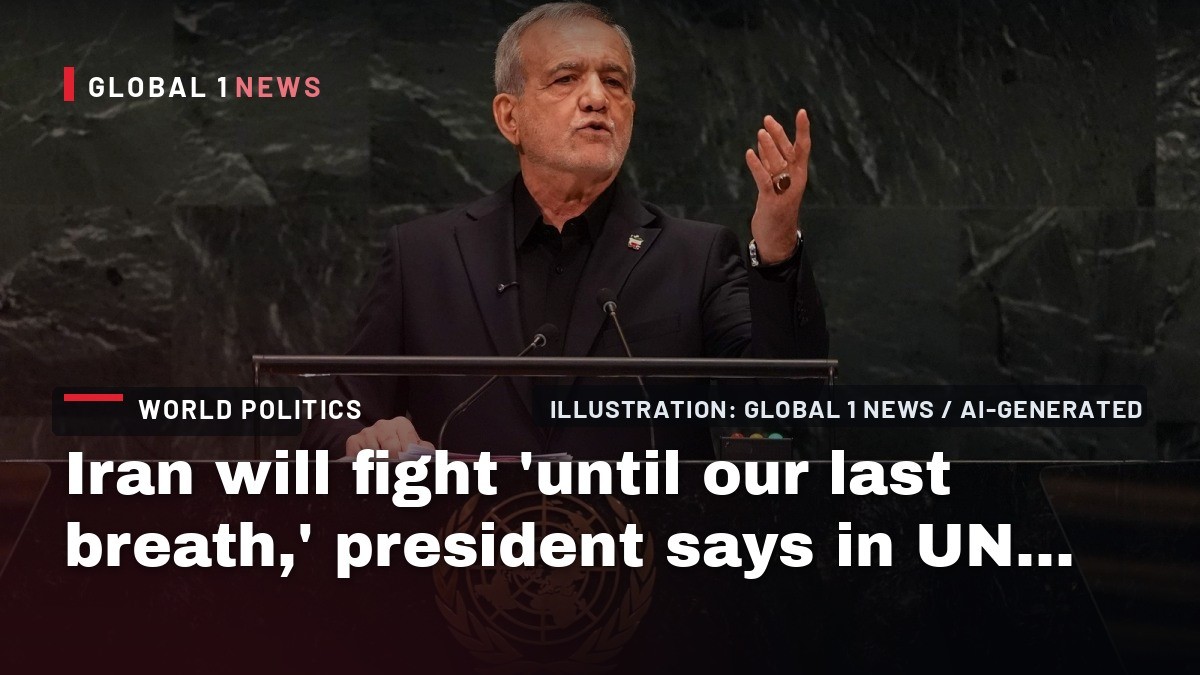
Iranian President Masoud Pezeshkian delivered a starkly defiant address to the United Nations General Assembly on Wednesday, framing his nation as a victim of terrorism while warning that Iran will fight “until our last breath.” The speech came a day after U.S. President Donald Trump threatened to “annihilate” the Islamic Republic if a swift deal to end the nearly seven‑month war was not reached. Pezeshkian’s remarks, punctuated by images of the late Supreme Leader Ali Khamenei and the more than 150 Iranian schoolchildren killed in the early days of the conflict, underscored the deepening diplomatic fissure between Tehran and Washington.
Context of the UN Address
President Pezeshkian’s appearance at the UN marked a rare moment when a foreign leader addresses the world body while their country is at war with the host nation. In his speech, he asserted that Iran “has only defended ourselves” and denied any terrorist intent, positioning the United States and Israel as the aggressors. By holding up photographs of the late Supreme Leader and the slain schoolchildren, he sought to humanise the Iranian populace and rally international sympathy for what he described as “cowardly attacks and aggressions” imposed upon Iran.
The speech was delivered under heavy security, reflecting the heightened tensions surrounding the gathering. Pezeshkian, described within Iran’s political landscape as a moderate, used the platform to call for dialogue without “accepting the language of force,” directly addressing President Trump by name in a bid to temper the U.S. leader’s recent threats.
Trump’s Threats and Diplomatic Overtures
President Trump’s remarks on Tuesday, delivered on the same UN stage, were starkly confrontational. He posed a binary choice: negotiate a deal that would allow Iran to “rebuild and create a far greater country,” or “annihilate the Islamic Republic” quickly, denying any further chance for Iran to “kill and destroy people and countries again.” The rhetoric signalled a possible escalation, echoing a broader U.S. stance that has characterised Iran as a destabilising force in the region.
Despite the threatening tone, Trump later told reporters that his chief envoys, Steve Witkoff and Jared Kushner, had met with Iranian officials for about three hours on the sidelines of the UN gathering. He described the meeting as “very good,” though he qualified the Iranian delegation as “not the highest level.” The lack of detail left observers uncertain about any substantive progress, while the meeting itself represented the first indirect contact between U.S. and Iranian officials since a June cease‑fire collapsed.
U.S. and Israeli Reactions
U.S. Secretary of State Marco Rubio dismissed Pezeshkian’s address as hypocritical, questioning Iran’s moral authority to lecture on human rights given its “habitual” violations. Rubio’s comments echoed a broader sentiment among U.S. and Israeli officials that Iran’s portrayal of victimhood conflicted with its own record of regional aggression and domestic repression.
Israeli officials, while not quoted directly in the source, joined the chorus of criticism, reinforcing the narrative that Iran’s diplomatic overtures were a façade for continued hostility. The combined U.S. and Israeli rebuke highlighted the difficulty Tehran faces in reshaping its international image amid ongoing military confrontations.
Iran’s Negotiating Position
Iranian Foreign Ministry spokesperson Esmail Baghaei reiterated Tehran’s core demands: an end to the U.S. blockade of Iranian ports and the release of frozen Iranian assets. Baghaei framed the recent indirect talks, facilitated by Qatari mediators, as “not anything new,” suggesting a continuity of diplomatic efforts despite the recent flare‑ups.
Rubio, while condemning Iran’s human‑rights record, acknowledged that the discussions were a continuation of prior conversations and characterised them as “positive in that regard,” though he cautioned against viewing them as a “major breakthrough.” The modest tone from both sides underscored the tentative nature of any progress and the likelihood that substantive concessions remain distant.
Military Situation on the Ground
Pezeshkian’s address referenced the ongoing intermittent attacks in the Strait of Hormuz, a strategic chokepoint where commercial shipping has not yet returned to pre‑war levels. The continued hostilities illustrate the broader stalemate that has characterised the conflict for more than a year, with neither side achieving a decisive victory.
The speech also recalled the 12‑day Israel‑Iran war of the previous year, which resulted in the assassination of many of Iran’s senior military and political leaders and further derailed weeks of negotiations with the United States. The memory of that brief but intense confrontation continues to shape Tehran’s resolve to resist what it perceives as external aggression.
Implications for Canadian Policy
For Canada, the escalation between Iran and the United States raises several policy considerations. Ottawa has traditionally balanced a commitment to multilateral diplomacy with concerns over Iran’s regional activities and human‑rights record. The heightened rhetoric from Washington may pressure Canadian officials to reassess the strength of sanctions and the scope of diplomatic engagement.
Canada’s involvement in UN forums, including its support for resolutions that call for de‑escalation in the Persian Gulf, will likely be scrutinised in light of the latest developments. Moreover, any impact on global oil markets stemming from disruptions in the Strait of Hormuz could affect Canadian energy exporters and domestic fuel prices, reinforcing the need for careful monitoring of the situation.
Outlook and Prospects for Dialogue
While President Pezeshkian’s speech projected confidence and a willingness to engage in “dialogue and diplomacy,” the stark contrast with President Trump’s ultimatum underscores the fragility of the current diplomatic environment. The indirect talks facilitated by Qatar demonstrate that channels of communication remain open, yet the absence of high‑level Iranian participation signals Tehran’s cautious approach.
Both sides appear to be managing expectations: the United States, through Rubio, frames the talks as a continuation of prior efforts without promising a breakthrough; Iran, through Baghaei, reiterates core demands while downplaying the novelty of the recent contacts. As the UN General Assembly continues, the international community, including Canada, will watch closely for any shift that might move the conflict from the brink of escalation toward a more sustainable diplomatic pathway.
This article was produced with AI-assisted research and editorial support. Reporting is based on the source material cited below. Sources: Global News Canada; globalnews.ca; Global1.News (23 September 2026).
By Alex Thompson, Staff Writer
What's Your Reaction?
 Like
0
Like
0
 Dislike
0
Dislike
0
 Love
0
Love
0
 Funny
0
Funny
0
 Wow
0
Wow
0
 Sad
0
Sad
0
 Angry
0
Angry
0
Canada Correspondent at Global1.News. Based in Toronto, covering Canadian politics, energy, trade, and US-Canada relations. Provides the Canadian perspective on North American and global affairs.









Comments (0)