
At UNGA, Kyrgyz President Japarov Once Again Complains About Sanctions
While his remarks touched on a range of diplomatic concerns, the core of his speech was a pointed critique of unilateral sanctions and a commendation of U.S.
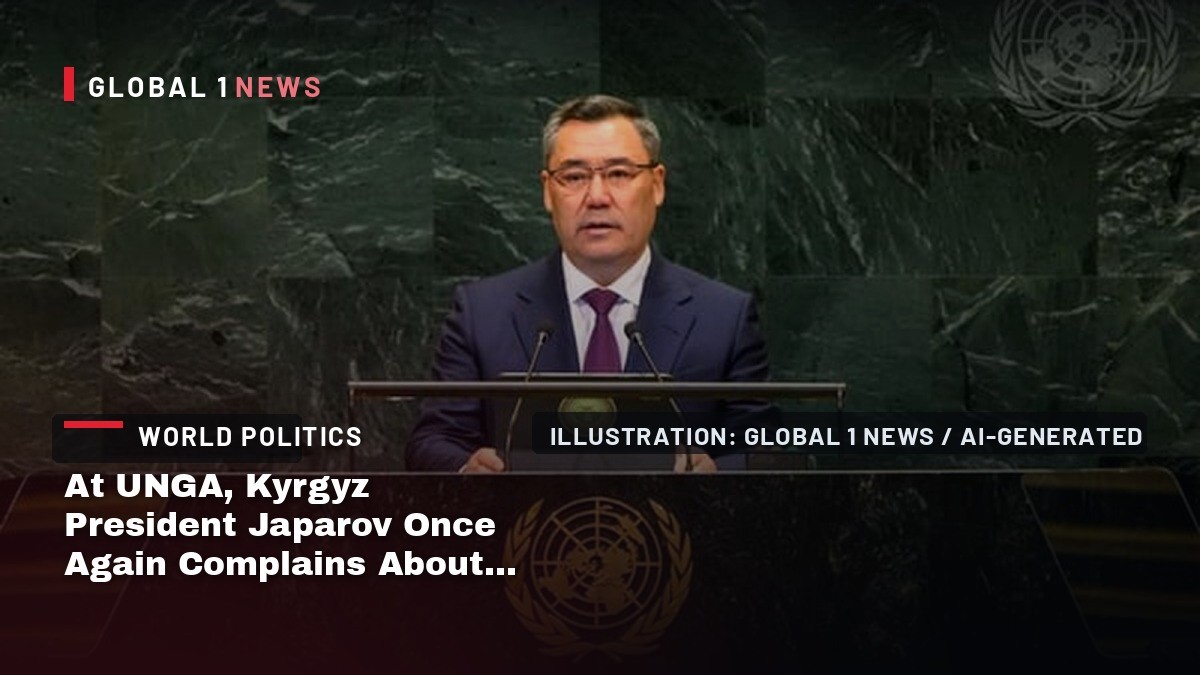
At the United Nations General Assembly this week, Kyrgyz President Sadyr Japarov used his allotted twenty‑minute address to reiterate a familiar theme: the burden of sanctions on small, developing states and the perceived benefit of curbing foreign non‑governmental organization (NGO) activity. While his remarks touched on a range of diplomatic concerns, the core of his speech was a pointed critique of unilateral sanctions and a commendation of U.S. President Donald Trump for ending funding to NGOs worldwide. The speech, delivered on 23 September 2026, offers a window into Kyrgyzstan’s ongoing struggle to navigate a sanctions‑laden international environment and to assert its voice within a fragmented United Nations Security Council.
Sanctions as an Instrument of Interference
President Japarov framed sanctions as a tool increasingly wielded by individual states to meddle in the internal affairs of sovereign nations. He argued that “unjustified unilateral sanctions also affect small countries such as ours, which are at the stage of formation and development,” suggesting that the impact extends beyond immediate economic pain to a broader erosion of national autonomy. By linking the issue to “other small states,” Japarov implied a collective vulnerability among emerging economies, positioning Kyrgyzstan as a representative voice for a broader cohort of nations.
The president did not name specific states he believes are applying pressure, leaving his accusation open‑ended. Nonetheless, his assertion that “some major states… put pressure on smaller countries… attempting to force them to bargain” resonates with Kyrgyzstan’s recent experiences of being named in EU anti‑circumvention measures and facing the prospect of secondary sanctions on its banking sector.
Linking NGOs to Sanctions
In a striking pivot, Japarov praised President Trump for halting funding to NGOs worldwide, claiming that “interference by NGOs in the internal affairs and policies of developing states has practically ceased.” This statement ties together two concerns: external economic pressure and perceived foreign influence through civil society actors. Japarov’s narrative suggests that NGOs have been instrumental in disseminating “false information” that led to Kyrgyz entities being listed on sanctions registers.
He referenced his own earlier UNGA remarks, wherein he alleged that sanctions were based on misinformation spread by “certain non‑governmental organizations and malicious citizens.” While he did not specify which NGOs, the source material notes a notable case involving the Open Dialogue Foundation (ODF). In April 2026, Kyrgyzstan’s Bakai Bank successfully sued the ODF in a Belgian commercial court, arguing that the NGO’s reports alleging sanction circumvention were unfounded. The court’s classification of the ODF as a “commercial enterprise” underscores Japarov’s contention that NGOs can act as market competitors, blurring the line between advocacy and commercial activity.
The EU’s Anti‑Circumvention Tool and Its Domestic Fallout
April 2026 marked the first time the European Union targeted Kyrgyzstan with its “anti‑circumvention tool,” a mechanism designed to prevent entities from evading sanctions on Russia and other sanctioned regimes. Following the EU’s move, Kyrgyz authorities announced a series of “pantomimed” actions: in June, two state‑owned banks claimed to have terminated relationships with more than 130 clients deemed at risk of sanctions violations; in August, another round of disconnections was announced. The lack of disclosed company names makes it difficult for external observers to assess the true scope of these measures.
According to RFE/RL’s Kyrgyz Service, as of June 2026, thirty‑one Kyrgyz companies—including five banks—were subject to Western sanctions. While some Tajik banks were recently removed from the EU list, Kyrgyz banks such as Keremet Bank, Kapital Bank, Eurasian Savings Bank, and EcoIslamicBank remain designated by the EU, the United Kingdom, and/or the United States. The persistence of these designations highlights the ongoing exposure of Kyrgyz financial institutions to external pressure, even as the government publicly protests the legitimacy of the sanctions regime.
Kyrgyzstan’s New Role on the UN Security Council
In a symbolic boost to its diplomatic standing, Kyrgyzstan secured a non‑permanent seat on the United Nations Security Council for 2026‑2027. President Japarov invoked this achievement to argue that sanctions decisions should be anchored in the UN Charter and the Security Council’s mandate. He asserted that “every decision of the United Nations should be implemented without delay,” and that failure to comply would amplify the effectiveness of sanctions.
However, the president’s optimism appears at odds with the current dynamics of the Security Council. The permanent members—China, Russia, France, the United Kingdom, and the United States—are entrenched in opposing geopolitical camps, often deadlocking the Council’s ability to act decisively. Recent vetoes, such as Russia’s 2022 block of a resolution condemning its own actions in Ukraine and China’s recent alignment with Russia to veto an Iran‑related sanctions monitoring effort, illustrate the structural limitations Japarov seeks to overcome.
The Paradox of Calling for a Sanctions‑Free World
Japarov’s call for the Security Council to become the “central clearinghouse for all sanctions” carries an implicit paradox. By concentrating sanction authority within the United Nations, he envisions a system where decisions are made collectively and, presumably, more fairly. Yet his broader argument—that sanctions should be avoided altogether—contradicts the very premise of a centralized mechanism. If the Council were to assume exclusive sanction‑setting power, the result could be a more coordinated but not necessarily less punitive regime.
The president’s stance reflects a broader sentiment among smaller states that sanctions, when applied unilaterally, can be weaponized for geopolitical leverage. By urging a return to multilateral decision‑making, Kyrgyzstan seeks to dilute the influence of any single major power. Whether this vision can be realized depends on the willingness of the permanent members to cede unilateral tools in favor of a more consensus‑driven approach—a prospect that appears remote given recent veto patterns.
Domestic Implications of Sanctions and NGO Funding Cuts
Beyond the diplomatic arena, the sanctions environment has tangible repercussions for Kyrgyz businesses and the broader economy. The opaque nature of the bank‑client disconnections announced in mid‑2026 has left many firms uncertain about their standing with international partners. The lack of transparency hampers the ability of Kyrgyz companies to manage risk, attract foreign investment, or even plan routine trade activities.
President Japarov’s praise for the cessation of NGO funding also carries domestic implications. By portraying NGOs as agents of “interference,” the administration may seek to justify tighter controls over civil society, aligning with a broader trend in the region where governments limit foreign‑funded NGOs under the banner of protecting sovereignty. While the source material does not detail any new legal measures, the rhetorical linkage between sanctions and NGO activity suggests a policy direction that could further constrain independent voices within Kyrgyzstan.
Outlook: Balancing Sovereignty and International Integration
Kyrgyzstan’s diplomatic posture at the UNGA reflects a delicate balancing act. On one hand, the nation seeks to protect its nascent institutions from external pressure, invoking the UN Charter and the Security Council as guarantors of a fair sanctions regime. On the other, it must navigate the practical realities of being listed on sanctions registers by the EU, the United Kingdom, and the United States, which affect its banking sector and broader trade prospects.
In the months ahead, Kyrgyzstan’s ability to leverage its Security Council seat will be tested. The president’s call for multilateral sanction decisions may find resonance among other small states, yet the entrenched rivalries among the permanent members limit the Council’s effectiveness. Meanwhile, the domestic fallout from both sanctions and the curtailment of NGO funding could shape public perception of the government’s foreign‑policy choices. As Kyrgyzstan continues to assert its sovereignty, the interplay between international pressure and internal governance will remain a central narrative in its pursuit of development and global standing.
This article was produced with AI-assisted research and editorial support. Reporting is based on the source material cited below. Sources: The Diplomat; thediplomat.com; Global1.News (23 September 2026).
By Kenji Tanaka, Staff Writer
What's Your Reaction?
 Like
0
Like
0
 Dislike
0
Dislike
0
 Love
0
Love
0
 Funny
0
Funny
0
 Wow
0
Wow
0
 Sad
0
Sad
0
 Angry
0
Angry
0

Japan Correspondent at Global1.News. Tokyo-based voice covering Japanese politics, technology, economy, and culture. Tracks the intersection of tradition and innovation in one of the world's most dynamic societies.










Comments (0)