
Huawei plans Q1 2027 launch of new AI chip as it takes on Nvidia
Huawei just shifted its AI‑chip calendar forward, announcing that the Ascend 960DT will land in the first quarter of 2027 instead of the third quarter as originally slated.
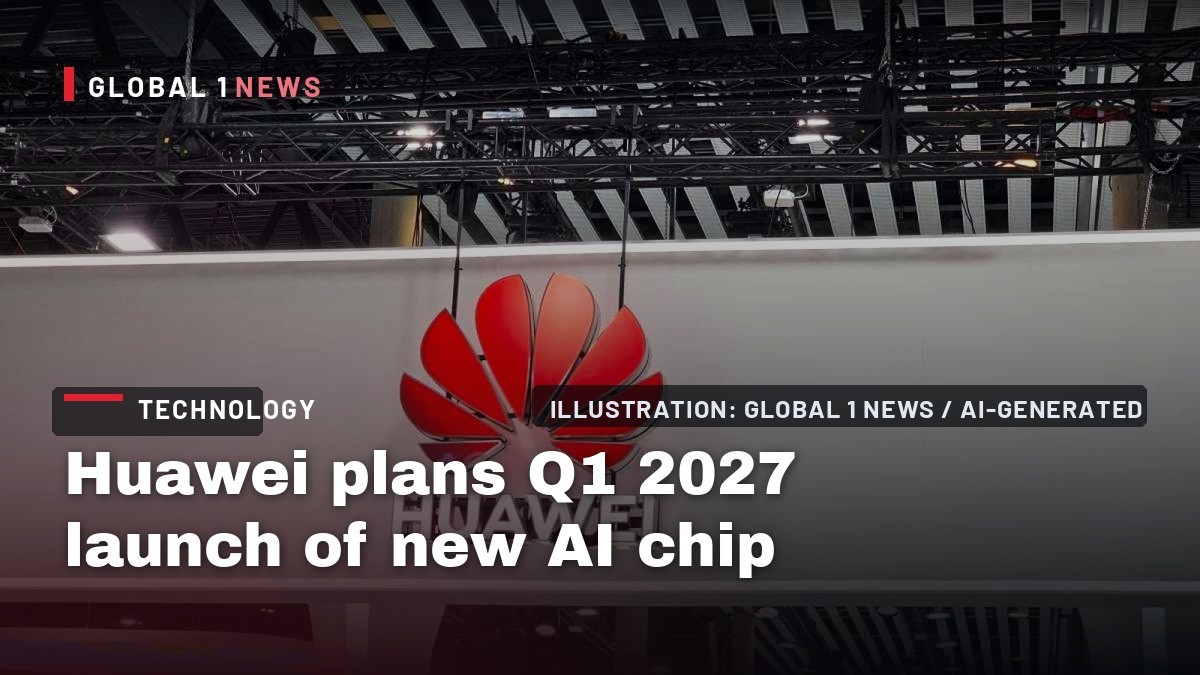
Huawei just shifted its AI‑chip calendar forward, announcing that the Ascend 960DT will land in the first quarter of 2027 instead of the third quarter as originally slated. The move, revealed at the company’s Huawei Connect conference on September 17, signals a full‑throttle sprint to narrow the AI‑computing gap with U.S. heavyweight Nvidia. For the tech‑savvy consumer, the shift means a new generation of Chinese‑made AI horsepower could appear on servers, data‑centers and even edge devices sooner than expected, reshaping the competitive landscape and the geopolitics of chip supply.
Why the accelerated timeline matters
The Ascend 960DT is Huawei’s next‑generation AI accelerator, positioned as a direct challenger to Nvidia’s dominant GPUs. By moving the launch up by six months, Huawei is not just meeting an internal product roadmap; it’s signaling intent to capture market share while geopolitical tensions simmer. The announcement came just a week before a high‑profile summit between U.S. President Trump and Chinese President Xi in Washington, a meeting likely to touch on technology trade restrictions. Launching early could give Huawei a bargaining chip in any post‑summit negotiations, showing that its AI ambitions are not stalled by external pressure.
Analysts note that the chip’s “doubling performance” claim—paired with a year‑over‑year advancement—places it squarely in the performance tier that currently powers large‑scale AI models. If the Ascend 960DT lives up to those expectations, it could provide Chinese cloud providers and enterprises with a home‑grown alternative to Nvidia’s offerings, reducing reliance on U.S. supply chains. For ordinary businesses, that could translate into lower costs and fewer compliance headaches when dealing with cross‑border chip imports.
The architecture behind the push
Huawei isn’t just selling a single chip; it’s promoting a whole ecosystem called Peerium Computing Architecture. At its core is UnifiedBus, a proprietary interconnect that ties processors, memory, storage and networking hardware into a single fabric. The architecture is designed to scale from a handful of accelerators to massive super‑clusters, effectively turning “hundreds of thousands, and eventually millions, of AI chips into one giant computer.”
Early deployments of the architecture include the Atlas 950 SuperPoD and the Atlas 950 SuperCluster. The latter can link up to 256,000 accelerator cards, according to Huawei’s own figures. This scale‑out capability is crucial for both training large AI models and delivering inference at the edge. If the Ascend 960DT integrates seamlessly with UnifiedBus, developers could see a smoother path from prototype to production, without the latency and bandwidth bottlenecks that plague heterogeneous setups.
Scaling expectations vs. reality
China tech analyst Rui Ma raised a note of caution on X, pointing out a mismatch between Huawei’s announced chip rollout and the size of the systems it plans to build around it. Earlier statements suggested the Atlas 960 SuperPoD would scale to 15,488 Ascend 960 chips, yet the latest announcement references a system with just 4,096 chips. “The chip itself is coming WAY earlier, but the SuperPoD they announced is much smaller than what they originally laid out,” Ma wrote.
This discrepancy could mean Huawei is prioritizing a quicker chip debut over the full‑scale hardware ecosystem it originally envisioned. For customers, it may translate to a phased rollout: first the chip, then the larger SuperPoD configurations as the supply chain and software stack mature. The gap also underscores the challenges of building a massive, home‑grown AI infrastructure under the weight of U.S. export controls.
U.S. restrictions and the self‑sufficiency drive
Huawei’s chip ambitions have unfolded against a backdrop of tightening U.S. restrictions on China’s access to advanced semiconductor technology. Despite those limits, Ma argues that the policy is unlikely to halt China’s semiconductor drive, noting that “the stakes for self‑sufficiency are just too high at this point.” The implication is clear: Beijing is willing to double down on domestic R&D, even if it means slower progress or higher costs.
For the global AI market, this self‑sufficiency push could fragment supply chains. Companies that rely on a single vendor for AI hardware may need to diversify, while startups could find new partnership opportunities with Chinese firms eager to showcase their home‑grown solutions. The ripple effect may also influence talent flows, as engineers and researchers gravitate toward projects that promise to keep China at the cutting edge of AI compute.
Political undercurrents: Trump, Xi and the AI race
President Trump has publicly pushed back against calls from AI industry leaders to slow development over safety concerns, arguing that the United States must maintain its lead over China. This stance aligns with Huawei’s narrative that “China needs to accelerate AI development to catch up with the U.S.”, as articulated by Huawei rotating chairman Eric Xu. The timing of Huawei’s early launch—just days before the Trump‑Xi summit—suggests the company is positioning itself as a strategic asset in the broader U.S.–China tech rivalry.
The political backdrop adds a layer of urgency for both sides. For the U.S., a faster‑than‑expected Chinese AI chip rollout could pressure policymakers to tighten export controls or accelerate domestic chip investments. For China, showcasing a home‑grown AI accelerator ahead of schedule bolsters the narrative of technological resilience, a point that resonates with national pride and the government’s long‑term “Made in China 2025” goals.
What this means for everyday tech users
While the Ascend 960DT is aimed at data‑center scale workloads, its downstream effects could touch everyday users sooner than expected. Cloud providers that adopt Huawei’s chips may pass cost savings onto customers, potentially lowering the price of AI‑powered services like language translation, image generation and recommendation engines. Moreover, a diversified chip market could spur innovation, as vendors compete on performance, power efficiency and price.
On the flip side, the geopolitical tug‑of‑war could introduce new compliance complexities. Companies operating across borders may need to navigate export‑control regimes, especially if they integrate Huawei hardware into products sold in the U.S. or allied markets. For developers, the emergence of a new AI stack means learning new toolchains, SDKs and performance tuning techniques—an added layer of technical overhead that could slow adoption.
Looking ahead: the next steps for Huawei and the AI chip arena
Huawei’s next milestone will be the actual silicon rollout in Q1 2027, followed by the scaling of its Peerium‑based systems. The company’s ability to deliver on the promised “doubling performance” will be the litmus test for its credibility against Nvidia, which continues to dominate the AI accelerator market. Meanwhile, the broader industry will watch how U.S. policy evolves post‑summit, as any new restrictions could either accelerate China’s push for self‑sufficiency or force a recalibration of its roadmap.
For investors, enterprises and the tech‑savvy public, the story is less about a single chip and more about the shifting balance of power in AI compute. Huawei’s early launch is a bold statement: the AI race is no longer a two‑player sprint between the U.S. and a few Western firms, but a multi‑front contest where supply‑chain resilience, political will and engineering ingenuity intersect. As the first quarter of 2027 approaches, the world will be watching whether Huawei can turn that statement into a tangible competitive edge.
This article was produced with AI-assisted research and editorial support. Reporting is based on the source material cited below. Sources: TechCrunch; techcrunch.com; Global1.News (17 September 2026).
By Nova Chen, Staff Writer
What's Your Reaction?
 Like
0
Like
0
 Dislike
0
Dislike
0
 Love
0
Love
0
 Funny
0
Funny
0
 Wow
0
Wow
0
 Sad
0
Sad
0
 Angry
0
Angry
0

Trend Reporter at Global1.News. Based in San Francisco, tracking the stories crossing from social platforms, forums, and community discussions into mainstream news — tech breakthroughs, cultural shifts, and world events that real people are engaging with right now.












Comments (0)