
Family linked to alleged Chinese spy donated $4.4m to Newsom, other California politicians; who is Fang Fang?
The revelations raise pressing questions about the intersection of diaspora philanthropy, political financing, and foreign influence operations, especially as the United States tightens its scrutiny of Chinese‑linked activities in the run‑up to the 2028 presidential election.
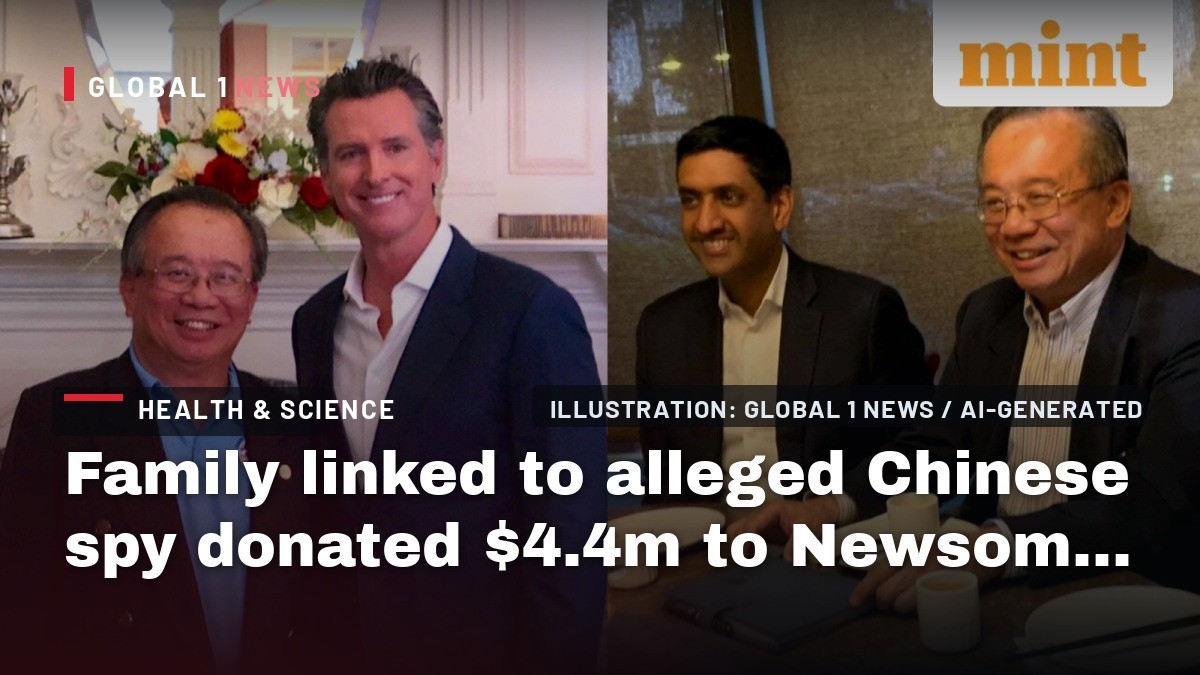
The Yin family’s political generosity in California, amounting to more than $4.4 million across state and federal campaigns, has drawn fresh scrutiny after newly de‑classified FBI files linked the family’s patriarch, Chei Chen Yin—known as C C Yin—to an alleged Chinese intelligence operative, Christine “Fang” Fang. The revelations raise pressing questions about the intersection of diaspora philanthropy, political financing, and foreign influence operations, especially as the United States tightens its scrutiny of Chinese‑linked activities in the run‑up to the 2028 presidential election.
Scale and channels of the Yin family’s donations
According to California state and Federal Election Commission records, the Yin family contributed nearly $3 million to state‑level political causes and an additional $1.455 million to federal campaigns. The bulk of these contributions flowed either directly from the family or through C C Yin’s McDonald’s franchise business, the source of the family’s wealth after C C Yin arrived in the United States from China in the 1960s.
Key allocations include $364,817 earmarked for Governor Gavin Newsom’s campaigns, $80,000 to his 2019 inauguration committee, and $50,000 to a nonprofit established at Newsom’s direction. The family also gave $221,700 to Lieutenant Governor Eleni Kounalakis between 2018 and 2025, $214,300 to former Vice President Kamala Harris’s campaigns from 2019 to 2024, and $115,680 to former State Treasurer John Chiang. These figures illustrate a pattern of targeting high‑profile Democratic office‑holders who shape California’s policy agenda.
Origins of the family’s political network: APAPA
The Asian Pacific American Public Affairs (APAPA) organisation, founded by C C Yin and his brother Henry Yin, sits at the centre of the family’s civic outreach. APAPA’s stated mission is to develop leadership skills among young people, foster understanding of government, and encourage participation in democratic processes. C C Yin told CBS News that the group was created to help community members engage in American civic life.
FBI files, however, identify Fang Fang as a point of contact for APAPA, suggesting that the organisation may have been used as a conduit for external actors seeking access to U.S. policymakers. While APAPA’s current leadership denies any formal role for Fang, the de‑classified documents note that a senior APAPA official—identified by sources as C C Yin—directed former Congressman Eric Swalwell to her.
Christine “Fang” Fang and the alleged espionage link
Christine Fang, also known as Fang Fang, emerged in FBI files as a suspected Chinese spy who cultivated relationships with American politicians. She is alleged to have had a sexual relationship with former California Congressman Eric Swalwell before fleeing to China in 2015. Interviews with Swalwell from 2015 and 2016, released by the White House in August, name Fang as his point of contact for APAPA, with a senior APAPA official—again identified as C C Yin—directing him to her.
Fang’s presence at an APAPA event in 2013, captured in a photograph posted by a City of Cupertino official, further cements her proximity to the Yin brothers. While APAPA’s president Kris Concepcion maintains that the organisation was unaware of Fang ever holding an official role, the FBI’s documentation of her involvement raises concerns about the potential for covert influence operations masquerading as community outreach.
Henry Yin’s China engagements and United Front ties
Henry Yin’s travel record adds another layer of complexity. Chinese‑language media reports, cited by CBS News, indicate that he attended ten events in China hosted by the United Front Work Department since 2013. Notable among these is a 2015 visit to Baoshan in Yunnan province, where he met officials from the Municipal Party Committee United Front Work Department. A United Front report described him as a designated contact for California‑China economic, trade, scientific, and technological interaction.
Further United Front statements note that Yin was offered a role as “Overseas Talent Recruitment Adviser for Sichuan Province” in 2013 and participated in a 2023 delegation of Silicon Valley entrepreneurs visiting Chengdu to explore investment cooperation. Henry Yin himself framed these trips as networking aimed at strengthening U.S.–China business relations, a narrative echoed in a 2016 East Bay Times interview.
Political intersections: Newsom, Khanna and the Yin advisory role
The Yin brothers have not only donated money but also provided advisory support to senior California politicians. C C Yin is credited with helping arrange Governor Newsom’s 2023 visit to China, a trip that included a meeting with President Xi Jinping. Henry Yin accompanied Newsom as an adviser during that October 2023 visit, underscoring the family’s proximity to high‑level diplomatic engagements.
Both brothers have also supported Congressman Ro Khanna, the ranking member of the House Select Committee on the Chinese Communist Party (CCP). Since 2017, they have contributed $15,800 to Khanna’s congressional campaigns. Khanna’s public statements have varied: a 2019 Facebook post described Yin as his “Senior Advisor on Foreign Trade and Economic Development,” while a 2020 post simply called him a “good friend.” Khanna’s LinkedIn profile listed Yin as a senior adviser beginning in 2019, but the entry was later removed, and a New York Post inquiry confirmed that Yin never held a formal role with the congressman.
National security implications and policy context
National security experts consulted by CBS News caution that the overlapping spheres of philanthropy, political financing, and foreign travel can serve both legitimate and covert objectives. The United Front’s mandate—to influence overseas Chinese communities and foreign elites—means that any contact with its officials warrants scrutiny, especially when paired with sizable political donations.
In India, similar concerns have prompted the Ministry of Home Affairs to tighten regulations on foreign contributions to political parties and to monitor diaspora organisations for potential foreign influence. The United States is moving in the same direction, with the Department of Justice expanding its focus on foreign‑linked political donors under the Foreign Influence Transparency Act, a legislative proposal that could require disclosure of any foreign government contacts for donors contributing above a set threshold.
What the Yin case means for California and beyond
The unfolding investigation into the Yin family underscores the need for robust transparency mechanisms in political fundraising. While the family’s contributions have undeniably supported Democratic candidates and progressive causes, the association with an alleged Chinese intelligence operative and repeated United Front engagements raise legitimate questions about the source and intent of the money.
California’s political establishment faces a delicate balancing act: preserving the legitimate civic participation of Asian‑American donors while safeguarding the state’s democratic processes from covert foreign influence. As the FBI continues to examine the de‑classified files, lawmakers may consider tightening disclosure requirements for donors with documented ties to foreign government entities, mirroring steps taken by several Indian states to regulate foreign‑linked political financing.
Ultimately, the Yin saga illustrates how diaspora philanthropy can become entangled with geopolitical competition. For policymakers in both the United States and India, the lesson is clear: robust, data‑driven oversight of political donations, combined with vigilant monitoring of foreign‑linked networks, is essential to protect the integrity of democratic institutions in an increasingly contested global arena.
This article was produced with AI-assisted research and editorial support. Reporting is based on the source material cited below. Sources: Livemint; livemint.com; Global1.News (22 September 2026).
By Dr. Raj Patel, Staff Writer
What's Your Reaction?
 Like
0
Like
0
 Dislike
0
Dislike
0
 Love
0
Love
0
 Funny
0
Funny
0
 Wow
0
Wow
0
 Sad
0
Sad
0
 Angry
0
Angry
0

India/South Asia Correspondent at Global1.News. Analytical voice with a background in science and health journalism. Based in New Delhi, covering Indian politics, education, healthcare, technology, and policy. Breaks down complex data into clear, actionable reporting.














Comments (0)