
Uganda to withdraw troops from DR Congo town amid diplomatic row
Uganda’s decision to pull its soldiers out of Lubero, a town in North Kivu, marks a sudden shift in a partnership that has been the backbone of the joint fight against the Allied Democratic Forces (ADF) for almost five years.
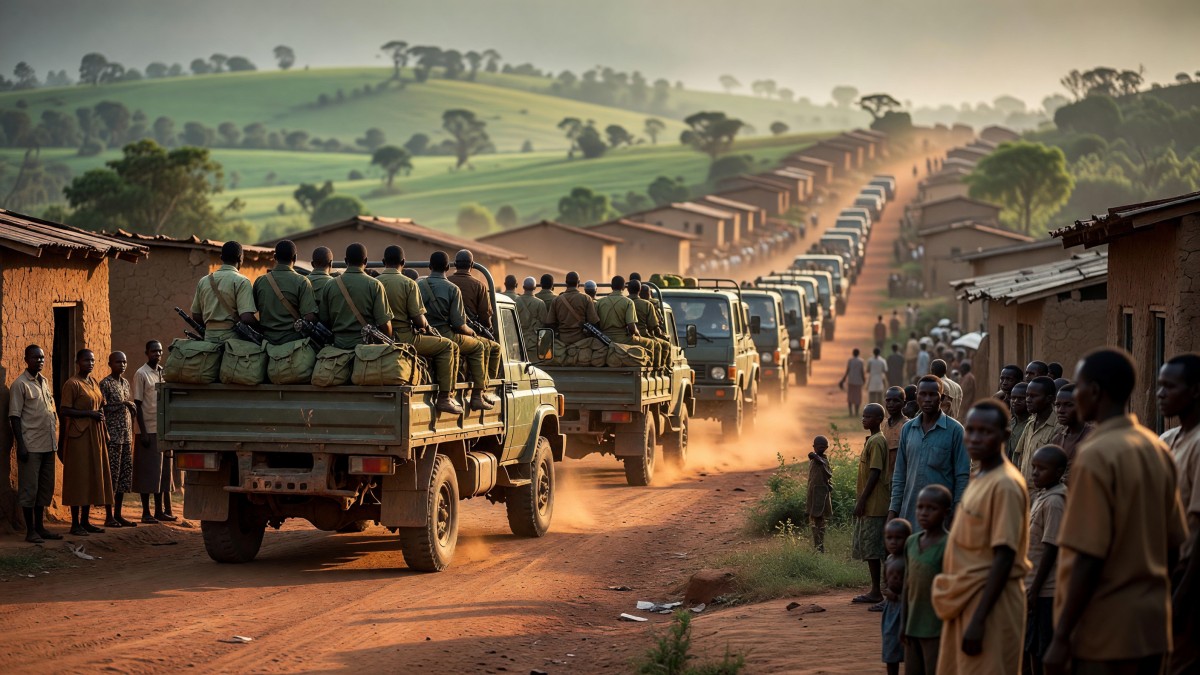
Uganda’s decision to pull its soldiers out of Lubero, a town in North Kivu, marks a sudden shift in a partnership that has been the backbone of the joint fight against the Allied Democratic Forces (ADF) for almost five years. The move, announced by the Ugandan army on Friday, comes as diplomatic tensions flare over recent comments by Gen Muhoozi Kainerugaba, the son of President Yoweri Museveni and head of Uganda’s military. While the Ugandan defence ministry offered no explicit reason for the withdrawal, the timing suggests a link to the growing row between Kampala and Kinshasa, a row that threatens to reshape security dynamics in the volatile eastern Congo.
Background to the joint operation
Ugandan troops first entered eastern DR Congo in November 2021, responding to a series of bombings in Kampala that were blamed on the ADF, an Islamist militia that originated in Uganda in the 1990s. The deployment was framed as part of “Operation Shujaa”, a joint campaign aimed at chasing ADF fighters who had fled into Congolese territory after the bomb attacks. Over the ensuing years, Ugandan forces have been stationed in several towns across North Kivu, with Lubero becoming a focal point of their effort to contain the group.
The ADF, now aligned with the Islamic State, has been responsible for deadly attacks on civilians in both countries. According to the conflict‑monitoring organisation Armed Conflict Location & Event Data (Acled), the group remains the deadliest armed faction in the DRC, even as its activity in Uganda has waned. Acled’s analyst John Ngono notes that the ADF is still killing an average of four civilians a day and has spread into areas of eastern Congo that were previously untouched by its violence.
The immediate trigger: diplomatic friction
The withdrawal announcement follows a diplomatic episode that began when DR Congo summoned Uganda’s top diplomat in Kinshasa over a series of controversial social‑media posts by Gen Kainerugaba. In those posts, the Ugandan chief appeared to endorse a rebel takeover of Walikale, a mineral‑rich territory in the east, and warned that Ugandan troops might seize the area themselves if the rebels failed. The Congolese foreign ministry called the remarks “particularly serious” and demanded clarification from Kampala.
While the Ugandan army did not explicitly tie the pull‑out to these tensions, the proximity of the two events suggests a connection. The statement that the troops would hand over security in Lubero to Congolese forces “within two weeks” signals an urgency that goes beyond routine operational adjustments.
Strategic implications for the ADF fight
Operation Shujaa has been credited with improving security inside Uganda, yet analysts argue that it has simply shifted the locus of violence across the border. Ngono’s assessment points to a pattern where the ADF’s reduced presence in Uganda coincides with its deeper entrenchment in eastern Congo, a shift that may be linked to the group’s growing interest in the region’s mineral resources. Acled notes that the militia has not carried out an attack in Uganda since June 2025, underscoring the success of the joint campaign in protecting Ugandan soil.
However, the ADF’s continued lethality in the DRC—averaging four civilian deaths per day—means that any reduction in Ugandan support could leave a security vacuum. The withdrawal from Lubero, a town that has served as a forward base for joint operations, may embolden the group to expand further into neighboring territories, especially as Congolese forces grapple with renewed fighting in the wider Lubero area.
Humanitarian concerns amid renewed fighting
The announcement arrives at a time when fighting between Congolese forces and rebel groups has intensified across the Lubero territory. Residents of the region have endured decades of conflict, with waves of displacement forcing millions to flee their homes. The prospect of Ugandan troops pulling back raises fresh worries about civilian safety, especially in an area already strained by the presence of multiple armed factions.
Humanitarian agencies have long warned that any weakening of security arrangements could exacerbate the already dire conditions for civilians. While the Ugandan army has not detailed plans for a coordinated handover, the speed of the withdrawal—within a fortnight—leaves little room for a measured transition that might protect vulnerable populations.
Economic undercurrents: minerals and the ADF
The ADF’s interest in mineral wealth, highlighted by Acled, adds an economic dimension to the security dilemma. Eastern DR Congo’s mineral‑rich territories, such as Walikale, have long attracted the attention of armed groups seeking to fund their operations. Gen Kainerugaba’s comments about Walikale hinted at a strategic calculus that goes beyond pure security concerns, suggesting that control over resource‑rich areas remains a contested prize.
By withdrawing from Lubero, Uganda may be signaling a shift in its approach to the resource‑linked aspects of the conflict. Whether this reflects a broader reassessment of its involvement in the DRC’s mineral politics or a reaction to diplomatic pressure remains to be seen. Nonetheless, the move could alter the balance of power among the various armed actors vying for control of mining sites.
Regional reactions and future outlook
Both governments have expressed strong positions. The Congolese foreign ministry demanded that Uganda clarify its stance and prevent further incidents like the Walikale endorsement. Meanwhile, Kampala has defended its presence in the east as a necessary response to security threats, emphasizing that the withdrawal does not signal an end to the joint campaign.
Ugandan army spokesperson Col Chris Magezi reiterated that Operation Shujaa will continue elsewhere in the DRC, indicating that the withdrawal from Lubero is not a wholesale retreat but a tactical redeployment. The next steps will likely involve a re‑allocation of Ugandan forces to other hotspots, while Congolese troops assume responsibility for Lubero’s security.
What the withdrawal means for ordinary people
For the people living in and around Lubero, the shift in military presence translates into uncertainty. The town has been a hub of joint patrols and joint security initiatives that, despite their imperfections, offered a measure of stability. As Congolese forces take over, civilians will be watching closely to see whether the new arrangement can maintain the fragile peace that has been built over nearly two years of Ugandan deployment.
The broader lesson from this episode is the delicate balance that underpins regional security cooperation in Africa. While shared threats like the ADF can bring neighbours together, divergent political calculations and diplomatic missteps can quickly unravel those partnerships. As Uganda steps back from Lubero, the region will be testing whether the existing frameworks for joint action can survive the strain, or whether new approaches will be needed to protect both lives and livelihoods in eastern DR Congo.
This article was produced with AI-assisted research and editorial support. Reporting is based on the source material cited below. Sources: BBC News Africa; bbc.co.uk; Global1.News (28 November 2026).
By Amara Diop, Staff Writer
What's Your Reaction?
 Like
0
 Dislike
0
 Love
0
 Funny
0
 Wow
0
 Sad
0
 Angry
0

West Africa/Sahel Correspondent at Global1.News. Dakar-based journalist covering politics, security, climate, and development across Francophone and Anglophone West Africa. Tells the stories of a region undergoing profound transformation.














Comments (0)