
Erdoğan begins South Korea visit, eyes new partnerships
President Recep Tayyip Erdoğan arrived in Seoul on Monday, accompanied by a senior delegation that included the foreign, energy and defence ministers, as well as First Lady Emine Erdoğan.
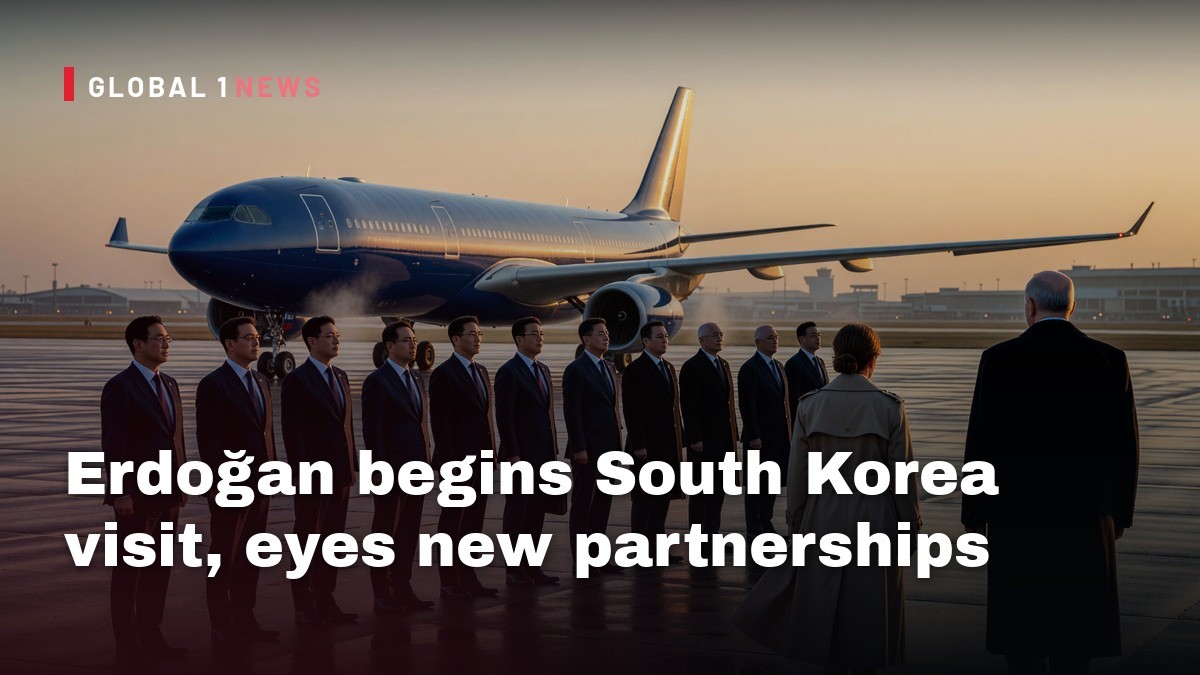
President Recep Tayyip Erdoğan arrived in Seoul on Monday, accompanied by a senior delegation that included the foreign, energy and defence ministers, as well as First Lady Emine Erdoğan. The visit, extended at the invitation of President Lee Jae Myung, is framed by Ankara’s broader strategy to diversify its economic partners and to secure reliable energy and technology sources amid a volatile regional environment. While the immediate agenda centres on nuclear power cooperation, the discussions also touch on defence, semiconductors, artificial intelligence and logistics – sectors that have become increasingly intertwined in the great‑power competition shaping the Middle East and the wider Indo‑Pacific.
Strategic backdrop: energy security and great‑power rivalry
The Turkish president’s emphasis on nuclear energy must be read against the backdrop of heightened uncertainty in global energy markets. Recent disruptions in the Strait of Hormuz, a flashpoint of the U.S.–Iran confrontation, have underscored the fragility of oil‑dependent supply routes. Ankara, which has long pursued a policy of energy diversification, sees South Korea’s mature nuclear expertise as a means to reduce reliance on imported hydrocarbons and to bolster its own industrial base.
Beyond the immediate energy calculus, the visit reflects a broader geopolitical calculus. Turkey’s outreach to Seoul aligns with its effort to balance relations with traditional Western allies while deepening ties with non‑Western powers that can offer technology and investment without the political strings often attached to Western assistance. In this sense, the partnership can be viewed as part of a wider Sunni‑Shia and great‑power contest in which regional actors seek alternative avenues for development and security.
Nuclear cooperation: the Sinop project and Korean expertise
Erdoğan highlighted the Sinop nuclear power station as a flagship project that could benefit from Korean involvement. The Turkish side is reviewing technical and economic terms with Korea Electric Power Corp, the state‑run utility that has overseen South Korea’s own nuclear expansion. The dialogue includes considerations of financing, electricity pricing and broader economic impact, indicating that Ankara is weighing the full cost‑benefit spectrum before committing to a partner.
During a Yonhap interview, the president recalled the memorandum of understanding signed in 2025 during President Lee’s visit to Turkey. That MOU covered reactor technology, site assessment, licensing, financing and business models, signalling a structured framework that can now be operationalised. Erdoğan’s remarks that Turkey is also consulting other countries suggest a competitive procurement process, but the emphasis on Korean experience underscores the strategic value Ankara places on Seoul’s proven nuclear track record.
Economic dimensions: trade targets and investment balance
The delegation’s economic agenda is anchored by a stated ambition to reach a $15 billion bilateral trade volume. While the exact current level is not disclosed, Erdoğan’s call for a more balanced trade structure implies that existing flows favour South Korea. He pointed to the need for greater Korean investment in Turkish transport and logistics projects that link Asia and Europe, a sector that could serve as a conduit for diversifying trade routes away from the volatile Persian Gulf corridor.
Erdoğan also cited recent South Korean corporate activity in Turkey as illustrative of the partnership’s potential. Hyundai’s launch of electric‑vehicle production in İzmit and Posco’s involvement in Turkish steel projects were highlighted as successful examples of joint ventures that combine Korean technology with Turkish manufacturing capacity. These cases reinforce the narrative that Turkish industry can act as a platform for Korean firms seeking a foothold in the broader Middle Eastern market.
Defence and high‑technology cooperation
Beyond energy and trade, the visit opened discussions on defence, semiconductors, artificial intelligence and robotics. The presence of Turkey’s defence minister and the defence industries secretary signalled the importance Ankara places on deepening security ties with Seoul. While specific programmes were not enumerated, the reference to these sectors suggests a desire to tap into South Korea’s advanced manufacturing and R&D ecosystem, particularly in areas where both countries face common challenges such as missile defence and autonomous systems.
The broader regional context adds weight to these overtures. Iran’s ongoing nuclear ambitions and the lingering volatility in the Gulf have prompted Turkey to seek alternative sources for high‑tech defence equipment, while South Korea, itself situated near a volatile peninsula, has cultivated a robust defence export industry. A convergence of interests could therefore translate into joint development projects or technology transfers that enhance both nations’ strategic autonomy.
Logistics and transport: building alternative trade corridors
Erdoğan framed Turkey’s logistics ambitions as a response to the “current crisis” that exposed the vulnerability of traditional maritime routes. By inviting Korean firms to invest in transport infrastructure, Ankara hopes to position itself as a hub linking Asian production networks with European markets. The emphasis on “reliable alternative routes” resonates with Turkey’s ongoing investments in rail, road and port upgrades, projects that could benefit from Korean engineering expertise and capital.
This logistics push dovetails with the broader energy security narrative. Secure overland corridors can mitigate the impact of disruptions in the Strait of Hormuz, while also facilitating the movement of nuclear fuel and related equipment. In this sense, the logistics dialogue is not merely commercial but also strategic, reinforcing Turkey’s role as a bridge between East and West.
Historical ties and soft power dimensions
Erdoğan invoked the shared history of Turkish troops fighting in the Korean War, describing the bilateral relationship as “forged in blood.” This rhetorical emphasis on a long‑standing friendship serves to deepen political goodwill and to create a narrative foundation for future cooperation. The upcoming 70th anniversary of diplomatic relations in 2027 provides a symbolic milestone that both sides can use to showcase the depth of their partnership.
Soft‑power considerations also surface in the president’s remarks about Turkey’s “strong manufacturing infrastructure, skilled workforce and strategic location.” By positioning Turkey as an attractive destination for Korean investment, Erdoğan is leveraging historical goodwill to secure tangible economic benefits. The interplay of historical memory and contemporary strategic interests illustrates how Ankara blends cultural diplomacy with pragmatic statecraft.
Implications for regional dynamics and future trajectories
The Seoul visit signals a calibrated shift in Turkey’s external orientation. By deepening ties with a technologically advanced, non‑Western partner, Ankara is diversifying its strategic portfolio at a time when the Middle East faces heightened great‑power competition and energy market volatility. The nuclear cooperation on Sinop, if realised, could set a precedent for further technology‑intensive collaborations, potentially encouraging other regional actors to seek similar partnerships beyond the traditional Western sphere.
For South Korea, the outreach aligns with its own strategy to expand economic footprints in the Middle East, a region rich in energy resources and emerging markets for high‑tech products. Engaging Turkey offers Seoul a gateway to the broader Eurasian land bridge, complementing its existing trade links with Gulf states and its own ambitions in the Belt and Road framework.
Overall, the visit underscores how both nations are navigating a complex matrix of energy security, technological competition and geopolitical rivalry. The outcomes—whether in the form of a signed nuclear cooperation agreement, increased Korean investment in Turkish logistics, or joint defence projects—will shape not only bilateral ties but also the broader pattern of South‑Korean engagement with the Middle East, a trend that could recalibrate regional economic and security architectures in the years ahead.
This article was produced with AI-assisted research and editorial support. Reporting is based on the source material cited below. Sources: Daily Sabah Middle East; dailysabah.com; Global1.News (02 November 2026).
By Malik Hassan, Staff Writer
What's Your Reaction?
 Like
0
 Dislike
0
 Love
0
 Funny
0
 Wow
0
 Sad
0
 Angry
0
Middle East Correspondent at Global1.News. Based in Beirut, covering politics, conflict, energy, and society across the Middle East. Brings context and depth to a region often reduced to headlines.










Comments (0)