
El Jalapeño: Ensenada fisherman says latest catch, a US Navy torpedo, is ‘a keeper’
Ensenada’s fishing community has become the unlikely stage for a diplomatic tug‑of‑war that reads like a modern‑day legend. How a torpedo became a catch of the day Aguilar’s story began on a typical morning out on the Pacific, when he cast his net hoping for a hefty dorado.
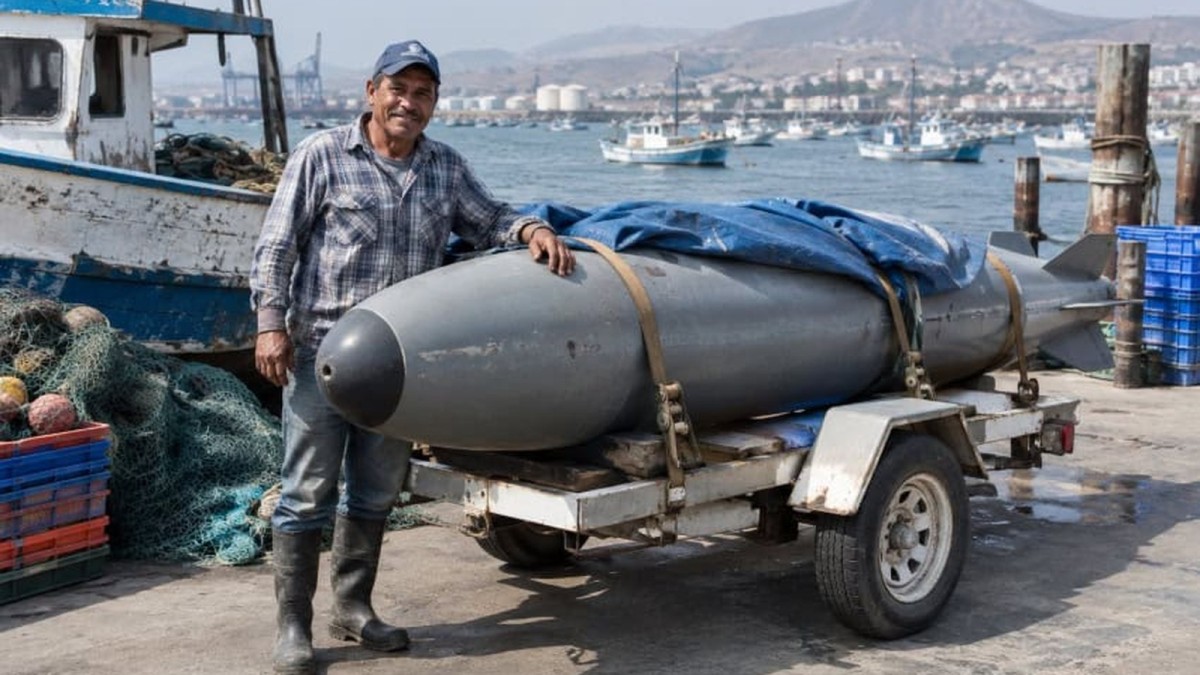
Ensenada’s fishing community has become the unlikely stage for a diplomatic tug‑of‑war that reads like a modern‑day legend. Tomás Aguilar, a 58‑year‑old fisherman from the Baja California coast, hauled aboard his modest panga a nine‑foot, six‑hundred‑pound United States Navy training torpedo last week. Since then, the inert MK 54 device has been anchored to his dock, draped in a blue tarp, and at the center of a growing dispute that pits local salvage customs against the protocols of two nation‑states.
How a torpedo became a catch of the day
Aguilar’s story began on a typical morning out on the Pacific, when he cast his net hoping for a hefty dorado. Instead, his line snagged a massive, bronze‑shined object that, after a closer look, turned out to be a U.S. Navy practice torpedo. The weapon, described in the original report as a “9‑foot, 600‑pound” training device, had drifted far from its original launch point off San Clemente Island, where it was lost two weeks earlier when its battery died. Aguilar, recalling the moment, said he initially thought he had caught an unusually heavy fish before realizing the true nature of his haul.
Rather than turning the torpedo over to authorities immediately, Aguilar towed it back to Ensenada, secured it to his dock, and covered it with a tarp to protect its painted finish. He has since been seen polishing the bronze propeller assembly with an old towel, treating the object with a reverence more akin to a prized trophy than a discarded piece of military hardware.
Legal claims anchored in tradition
Aguilar’s refusal to return the torpedo rests on a blend of local maritime customs and historic salvage law. He argues that, much like a lobster pot left unattended in the bay for weeks, the torpedo “belongs to the sea” and, by extension, to the finder. This claim is bolstered by three retired harbor captains who support his interpretation of 19th‑century salvage precedent, a legal framework that traditionally awards finders rights to abandoned property recovered at sea.
Further strengthening his position, Aguilar presented a signed receipt from the Ensenada harbor master that labeled the object as an “unclaimed aluminum float.” While the description is technically inaccurate—the torpedo is neither aluminum nor a float—the receipt has been cited by Mexican diplomatic officials as part of the fisherman’s defense, highlighting the gray area where local bureaucratic labeling meets international military property.
U.S. offers rise like the tide
From the moment the torpedo was identified, U.S. officials have sought its return. Initial outreach from the Department of Defense offered a modest “finders’ fee” of five hundred dollars and a ceremonial Navy cap. By the following Monday, negotiations had escalated, involving the State Department and the Mexican Secretariat of Foreign Affairs (SRE). The American counteroffer grew substantially, including a sum of forty‑five thousand dollars, a diesel engine overhaul for Aguilar’s vessel, and lifelong entry privileges to the San Diego Naval Base commissary.
At press time, the U.S. Naval Attaché’s delegation, accompanied by Mexican Navy representatives, was reportedly preparing an additional proposal: a refurbished commercial panga boat and a full salvage indemnity. These offers reflect a willingness to use both financial incentives and practical support to resolve the standoff, yet Aguilar remains unmoved, emphasizing personal ownership over any monetary or material compensation.
Mexico’s diplomatic balancing act
The Mexican Secretariat of Foreign Affairs has taken a cautious stance, acknowledging the federal maritime protocol that generally encourages the swift return of foreign military equipment. A spokesperson for the SRE, speaking on condition of anonymity, noted the unusual precedent that Aguilar’s claim could set for bilateral relations. While the agency has explained the potential diplomatic ramifications, it also recognizes the fisherman’s legal arguments rooted in historic salvage law.
Mexican officials have attempted to mediate, pointing out that the torpedo, though inert, remains classified training hardware containing proprietary sonar technology. Their concern centers on the broader implications of allowing private individuals to retain foreign military ordnance, a scenario that could complicate future incidents involving lost or abandoned equipment in shared waters.
Security concerns beneath the surface
Pentagon officials, though not publicly commenting, have expressed frustration over the delay. The MK 54 REXTORP, while lacking an active explosive warhead, is still considered sensitive equipment due to its embedded sonar technology. The U.S. Department of Defense has emphasized that the torpedo’s classification as training hardware means it contains proprietary information that could be compromised if left in civilian hands.
Despite these concerns, Aguilar’s focus remains on the torpedo’s aesthetic appeal. He highlighted the painted nose cone as an ideal centerpiece for his niece’s upcoming quinceañera, underscoring how the object has transcended its original military purpose to become a personal and cultural symbol within his family and community.
Community reactions and cultural resonance
The incident has sparked lively conversation across Ensenada’s col‑onia, from the bustling tianguis near the harbor to the quiet streets where fishermen gather after a day’s work. Many locals see Aguilar’s stance as a defense of traditional rights against foreign powers, echoing historic narratives of Mexican sovereignty and self‑determination. Others worry about the potential fallout, fearing that a precedent of retaining foreign military gear could invite unwanted attention or complicate future fishing operations.
In the broader Mexican context, the story resonates with the country’s long‑standing tension between honoring local customs and navigating international obligations. The fisherman’s reference to “if you leave a lobster pot unattended for two weeks, it belongs to the sea” taps into a familiar coastal ethic, while the diplomatic negotiations underscore the complexities of modern maritime law.
What the future may hold for the torpedo
As delegates from the U.S. Naval Attaché and Mexican Navy continue discussions on the Ensenada pier, the outcome remains uncertain. The escalating offers from Washington demonstrate a willingness to resolve the matter quickly, yet Aguilar’s refusal to relinquish the torpedo suggests that any solution will need to address more than just financial compensation. It will require a nuanced understanding of local customs, legal precedents, and the symbolic weight the object now carries in a small fishing community.
Whether the torpedo will eventually sail back to a U.S. naval base, become a permanent fixture in a quinceañera celebration, or remain anchored to a dock in Ensenada, the episode highlights the intricate dance between tradition and modernity, between a humble fisherman’s claim and the machinery of international diplomacy. It is a reminder that even in an age of high‑tech warfare, the simple act of pulling in a net can set off ripples that reach far beyond the waves.
This article was produced with AI-assisted research and editorial support. Reporting is based on the source material cited below. Sources: Mexico News Daily; mexiconewsdaily.com; Global1.News (01 October 2026).
By Rosa Martinez, Staff Writer
What's Your Reaction?
 Like
0
Like
0
 Dislike
0
Dislike
0
 Love
0
Love
0
 Funny
0
Funny
0
 Wow
0
Wow
0
 Sad
0
Sad
0
 Angry
0
Angry
0

Latin America/Andes Correspondent at Global1.News. Based in Bogota, covering politics, environment, energy, and social movements across the Andean region. Passionate about environmental journalism and communities protecting their land.















Comments (0)