
Republican Midterm Loss Spurs New Push Against Israel, Says JD Vance
The segment traced how figures such as Tucker Carlson, Matt Walsh and a loosely defined “Qatar First” faction are shaping a new strand of right‑wing criticism that could reshape the U.S.–Israel strategic partnership.
In a recent JNS TV report aired on 10 November 2026, senior correspondent Emily Schrader examined the narrative emerging among certain Republican leaders that the United States’ recent midterm defeat was directly linked to the ongoing war with Iran – and, more controversially, that this narrative is being weaponised to turn American public opinion against Israel. The segment traced how figures such as Tucker Carlson, Matt Walsh and a loosely defined “Qatar First” faction are shaping a new strand of right‑wing criticism that could reshape the U.S.–Israel strategic partnership. While the video does not present new classified data, it collates publicly observable trends – from statements made on television to documented foreign‑influence campaigns – that together suggest a growing intra‑party debate over Israel’s place in American foreign policy.
JD Vance’s Attribution of the Midterm Defeat to the Iran Conflict
Vice‑presidential candidate JD Vance, speaking at a Republican fundraiser, explicitly linked the party’s loss to the “war” with Iran, stating that the conflict was the primary reason voters turned away from the GOP. Schrader highlighted this remark as a focal point of the report, noting that Vance’s framing positions Iran’s nuclear standoff as a domestic political liability for Republicans.
The video points out that Vance’s claim diverges from the conventional Republican narrative that blames Democratic leadership for the loss. By shifting the blame to a foreign policy issue, Vance implicitly suggests that a reassessment of the United States’ stance toward Iran – and by extension, toward Israel, which views Tehran as an existential threat – could be politically advantageous.
Schrader questioned whether Vance’s diplomatic overtures to Tehran, made during the latter stages of the 2024‑2025 negotiations, might have inadvertently signalled a softening of the United States’ support for Israel. The report does not provide evidence that Vance’s outreach altered any concrete policy, but it raises the possibility that his public framing could influence Republican voters who are increasingly sceptical of foreign entanglements.
The “Qatar First” Movement and Its Strategic Objectives
The JNS TV segment introduced the term “Qatar First” to describe a coalition of conservative commentators and donors who, according to Schrader, prioritize Qatar’s geopolitical agenda over traditional U.S. allies. The video cites a timeline that begins with Qatar’s extensive investments in U.S. universities, lobbying firms and diplomatic channels, suggesting that these financial ties have cultivated a network of influence within certain right‑wing circles.
Schrader notes that the “Qatar First” label is used by critics to accuse this faction of undermining Israel’s security interests, given Qatar’s historically cordial relations with Iran and its broader engagement with the Muslim world. While the report does not present direct evidence of coordinated policy‑shaping, it points to the pattern of Qatar‑funded think‑tanks and academic programs that host speakers sympathetic to a more conciliatory approach toward Tehran.
The segment also highlighted how the “Qatar First” narrative is leveraged by commentators like Matt Walsh to argue that the United States should recalibrate its Middle East strategy, implicitly suggesting that Israel’s hard‑line posture is an obstacle to broader regional stability – a stance that aligns with Qatar’s diplomatic posture.
Matt Walsh’s Iran Commentary and Fact‑Checking Discrepancies
Matt Walsh, a prominent conservative talk‑show host, appears in the JNS TV footage stating, “I’d rather Iran have a nuke,” a remark that Schrader identifies as a hyperbolic expression of frustration with the political establishment’s handling of the Iran issue. The video timestamps this comment at 0:00, signalling its prominence in the segment.
Schrader’s analysis juxtaposes Walsh’s statement with a fact‑check that reveals a lack of supporting evidence for the claim that a nuclear‑armed Iran would somehow be preferable to the status quo. The report underscores that Iran’s highly enriched uranium remains unaccounted for, and Tehran continues to issue threats across the Middle East, reinforcing the strategic concerns that Israel and the United States share.
The segment suggests that Walsh’s rhetoric, while sensational, taps into a broader sentiment among certain Republican voters who view the Iran conflict as a costly distraction that has eroded confidence in the party’s leadership. By framing the issue in stark, emotive language, Walsh contributes to a narrative that the war with Iran is a political liability – a narrative that can be, and is, weaponised against Israel’s security arguments.
Tucker Carlson, Russia, and Qatar: A Triangular Influence Web
At 4:36 in the video, Schrader turns to Tucker Carlson, another high‑profile conservative commentator, to explore alleged connections between his media platform, Russian influence operations, and Qatari lobbying. The report references documented Russian efforts to infiltrate American conservative media, noting that Carlson’s show has been cited in past analyses as a conduit for Russian‑origin narratives.
Schrader also points out that Qatar’s diplomatic outreach to the United States includes funding for academic programs and cultural exchanges that often feature Carlson‑aligned voices. While the video does not provide direct proof of a coordinated campaign, it highlights the convergence of Russian disinformation tactics and Qatari soft‑power initiatives within the same media ecosystem.
The implication, according to the report, is that the convergence of these foreign influence streams could amplify anti‑Israel sentiment among right‑wing audiences. By presenting Iran as a primary threat and downplaying Israel’s security concerns, these narratives may shift the Republican base’s perception of the U.S.–Israel alliance, especially when packaged alongside broader anti‑establishment messaging.
Voter Realignment and the 2028 Outlook
Schrader’s segment concludes with a discussion of how voters actually moved in the 2026 midterms, citing a timestamp at 15:05 that references “how voters really moved, and 2028.” While the video does not provide granular polling data, it suggests that a segment of the Republican electorate shifted away from candidates who maintained a staunch pro‑Israel stance toward those who questioned the strategic value of that alliance.
The report posits that this realignment could have long‑term implications for U.S. policy toward Israel, especially if the trend continues into the 2028 election cycle. The narrative that the Iran war – and by extension, Israel’s security posture – contributed to electoral loss may become a rallying point for a new generation of Republican leaders seeking to distance themselves from what they perceive as costly foreign entanglements.
Schrader warns that while the immediate political calculus centres on the midterm loss, the underlying shift reflects a deeper ideological debate within the GOP about the United States’ role in the Middle East. If the “Qatar First” and related factions gain further influence, the traditional bipartisan consensus that underpins the U.S.–Israel relationship could be challenged from within the American right.
Implications for Israel’s Diplomatic Strategy
From an Israeli perspective, the JNS TV report underscores a growing need to engage not only with the Democratic establishment but also with emerging Republican voices that are questioning the alliance’s foundations. Israeli officials, including spokespeople from the Foreign Ministry, have historically warned that foreign influence campaigns – whether Russian, Qatari or otherwise – can erode the perceived legitimacy of Israel’s security concerns.
The analysis suggests that Israel may need to recalibrate its public diplomacy to address the specific arguments being raised by the “Qatar First” and related conservative commentators. This could involve more direct outreach to Republican lawmakers and grassroots activists, emphasizing the tangible security threats posed by Iran’s unaccounted‑for enriched uranium and Tehran’s continued hostile rhetoric toward both the United States and Israel.
Ultimately, the JNS TV segment highlights a pivotal moment in the U.S.–Israel relationship: a convergence of domestic American political dynamics, foreign influence operations, and the unresolved Iranian nuclear issue. As the Republican Party grapples with its internal divisions and the “Qatar First” narrative gains traction, Israeli policymakers will need to monitor these developments closely and adapt their diplomatic strategies to maintain the historic partnership that has long underpinned regional stability.
By Hannah Berg, Staff Writer
This article was produced with AI-assisted research and editorial support. Reporting is based on the source material cited below. Sources: JNS TV video report (10 November 2026); JNS TV; Global1.News
What's Your Reaction?
 Like
0
 Dislike
0
 Love
0
 Funny
0
 Wow
0
 Sad
0
 Angry
0
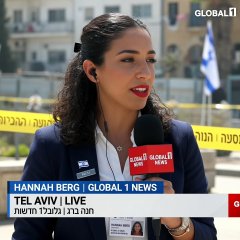
Israel Correspondent at Global1.News. Based in Tel Aviv, covering Israeli politics, security, technology, and society. Provides balanced, deeply-sourced reporting on one of the most closely-watched regions in the world.













Comments (0)