
How India’s Courts Became So Entangled With Religion
India’s constitutional promise of religious liberty is paradoxically paired with a legal framework that empowers the state to intervene in the very practices it purports to protect.
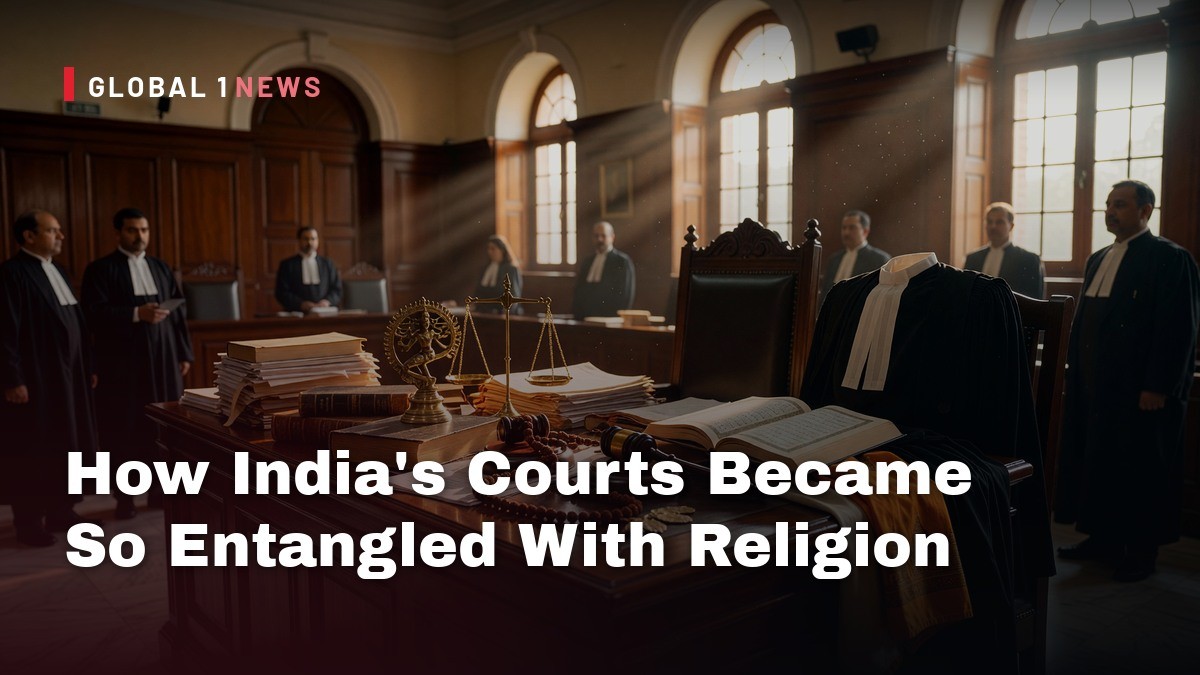
India’s constitutional promise of religious liberty is paradoxically paired with a legal framework that empowers the state to intervene in the very practices it purports to protect. Article 25 guarantees freedom of conscience, yet its second clause authorises regulation of “secular activities” of religion and permits “social welfare and reform” for Hindus. This duality, originally intended to advance the Temple Entry Movement that sought Dalit access to Hindu shrines, has evolved into a broader judicial habit of adjudicating theological matters. The result is an Indian judiciary deeply entangled with religious doctrine, a phenomenon that shapes affirmative‑action policy, temple management and personal law across the nation.
Constitutional Roots of Judicial Intervention
The framers of the Indian Constitution embedded the language of “social welfare and reform” to address historic caste discrimination within Hinduism. By linking state authority to the regulation of religious practice, they created a legal foothold that courts have repeatedly used to justify intervention beyond the original Dalit‑temple context. Judges, who are not trained theologians, nonetheless feel compelled to interpret religious tenets when adjudicating cases that touch on caste, gender or personal liberty.
This constitutional backdrop explains why Indian courts have developed an “interventionist concept of religion.” The judiciary’s mandate to protect equality often collides with the need to define what constitutes essential religious practice, leading judges to venture into theological analysis that would be foreign to courts in jurisdictions with a stricter separation of church and state.
The Secretary to Government v. Sameer Ahamed N. and the Theology of Equality
In October 2026, the bench in The Secretary to Government vs Sameer Ahamed N. addressed whether a person who converts from a Hindu social order to a non‑Hindu one can claim affirmative‑action benefits based on pre‑conversion caste status. The court concluded that conversion alone does not entitle a claimant to such benefits, emphasizing that “a person who converts … cannot claim affirmative action … merely on the basis of the social backwardness associated with his pre‑conversion status.”
To reach this conclusion, the judges devoted several paragraphs to the theology of Islam, citing the Quran’s egalitarian principle in Surah Al‑Hujurat (49:13) and noting that Islam “does not make birth, lineage or descent the measure of human worth.” By invoking Islamic doctrine, the court linked a secular policy question to a comparative religious analysis, illustrating how Indian jurisprudence routinely draws on doctrinal sources to resolve constitutional disputes.
Essential Religious Practices Doctrine: Origins and Evolution
The “essential religious practices” (ERP) doctrine emerged from mid‑century Supreme Court rulings. In 1954, the case The Commissioner, Hindu Religious Endowments, Madras v Sri Lakshmindra Thirtha Swamiar of Sri Shirur Mutt introduced the idea that constitutional protection should be confined to practices deemed “essential and integral” to a faith. This principle was refined in the 1961 decision Durgah Committee, Ajmer v Syed Hussain Ali, which applied the ERP test to a Muslim shrine, granting courts the authority to distinguish between core doctrines and peripheral customs.
The ERP doctrine thus gave the judiciary a tool to scrutinise religious customs, allowing judges to deem certain practices “superstitious” or “extraneous” and therefore subject to regulation. While intended to safeguard fundamental freedoms, the doctrine also positioned courts as arbiters of theological authenticity, a role that has sparked criticism from both secular constitutionalists and religious communities.
Case Studies: Courts Defining Doctrine
Indian courts have repeatedly ventured into doctrinal territory. In the Allahabad High Court case Vineet Vincent Pereira v State of UP, the bench ruled that a Catholic priest’s claim that Christianity is the sole true religion could invite criminal prosecution for insulting others’ beliefs. This decision treated a core Christian conviction as a potentially punishable statement, illustrating judicial willingness to police theological assertions.
Other high‑profile judgments have addressed personal law matters. Courts have examined whether the hijab is an essential Islamic practice, and they have debated the permissibility of barring menstruating women from the Sabarimala Temple—a practice rooted in Hindu tradition. In each instance, the judiciary moved beyond interpreting secular statutes to articulating its own understanding of religious doctrine, thereby shaping the lived experience of believers.
Backlash and Calls for Reform
Resistance to judicial overreach has emerged from multiple fronts. Secular constitutionalists argue that the ERP doctrine infringes on the principle of religious freedom by allowing courts to impose an elite interpretation of faith. Simultaneously, many Hindus object to what they perceive as disproportionate state control over temple administration—a control that does not extend to Christian churches or Muslim mosques. In April 2026, the Supreme Court stayed criminal proceedings against Vineet Vincent Pereira, reflecting judicial acknowledgment of the controversy surrounding its own interventions.
The Sabarimala Temple verdict of 2018, which permitted menstruating women to enter the shrine, intensified this tension. Traditionalists contended that the judiciary had overstepped, insisting that religious communities should retain autonomy over internal reforms. The Supreme Court’s current reconsideration of the ERP doctrine signals an awareness that its doctrinal determinations may be perceived as elitist and intrusive.
Comparative Perspective: The United States’ Hands‑Off Approach
India’s entanglement of courts with religious doctrine stands in stark contrast to the United States, where the Supreme Court has long adhered to a “hands‑off” principle. American jurisprudence repeatedly declares that judges are precluded from evaluating the substance of religious doctrine, thereby limiting judicial intrusion into theological matters. This comparative lens highlights how constitutional design and historical context shape the scope of judicial review in matters of faith.
While the U.S. model emphasises deference to religious institutions, India’s model reflects a constitutional commitment to social reform that inevitably draws the judiciary into theological discourse. The divergent paths underscore the challenge of balancing religious liberty with social equity in pluralistic societies.
Future Trajectories: Balancing Reform and Autonomy
India’s courts sit at a crossroads. The essential religious practices doctrine, though conceived to protect core beliefs, has become a conduit for state regulation of faith. Ongoing Supreme Court reviews of temple‑management laws and the ERP doctrine itself suggest a potential recalibration of judicial reach. Any shift will need to reconcile the constitutional aim of social welfare with the imperative to respect genuine religious autonomy.
For policymakers, the key may lie in crafting legislation that addresses social inequities—such as caste discrimination—without delegating theological interpretation to the bench. For the judiciary, restraint in doctrinal pronouncements could preserve legitimacy while still upholding constitutional guarantees. As India continues to navigate the complex interplay of religion, law and social justice, the evolution of its courts will remain a pivotal factor in shaping the nation’s pluralistic future.
This article was produced with AI-assisted research and editorial support. Reporting is based on the source material cited below. Sources: The Diplomat; thediplomat.com; Global1.News (11 November 2026).
By Kenji Tanaka, Staff Writer
What's Your Reaction?
 Like
0
 Dislike
0
 Love
0
 Funny
0
 Wow
0
 Sad
0
 Angry
0

Japan Correspondent at Global1.News. Tokyo-based voice covering Japanese politics, technology, economy, and culture. Tracks the intersection of tradition and innovation in one of the world's most dynamic societies.















Comments (0)