
Colombia Earthquake: Brothers Caught in a Second Disaster as a Nation Digs for Survivors
The first thing you notice in the rubble of Cali is not the dust, but the silence. It is a heavy, unnatural quiet that settles over streets where the concrete has folded in on itself, broken only by the rhythmic scrape of shovels and the occasional cry of a rescuer calling out for a...
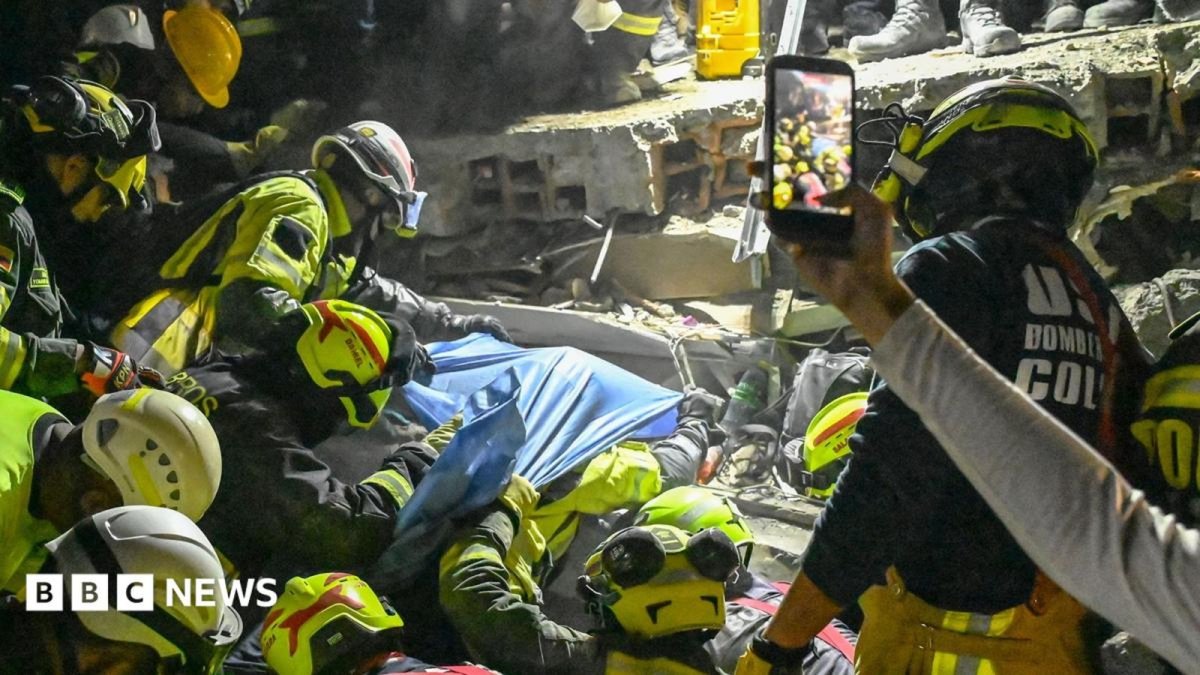
The first thing you notice in the rubble of Cali is not the dust, but the silence. It is a heavy, unnatural quiet that settles over streets where the concrete has folded in on itself, broken only by the rhythmic scrape of shovels and the occasional cry of a rescuer calling out for a response. In that silence, two brothers from Venezuela worked with a grim, practiced efficiency that belied their ages. Deivi Delfín, just 15, and his brother Winder, 17, had done this before. They had crawled through the wreckage of their own home in La Guaira, Venezuela, just weeks ago, pulling bodies and guiding rescuers through the debris. Now, on Tuesday in Colombia, they were doing it again, their hands raw and their eyes hollow, having survived one catastrophic earthquake only to be swallowed by another days after arriving in a new country.
Their story is a brutal testament to the fragility of life in Latin America, a region that sits on the edge of the world’s most volatile seismic faults. But so too is the story of Daniela Largo, a 32-year-old woman in Pereira who spent 36 hours entombed beneath a collapsed building, her life sustained by the hope of a 12-year-old son waiting at home and the relentless determination of firefighters who refused to give up. As Colombia reels from the strongest earthquake recorded this century—a magnitude-7.4 tremor that struck on Monday—the nation is caught between profound grief and extraordinary resilience.
A Nation Shaken to Its Core
The earthquake struck at 07:34 local time on Monday, a moment when most of Colombia was beginning its day. The epicentre was near the remote village of San José del Palmar in the Chocó department, a region of dense jungle and rugged terrain west of Bogotá. The force of the quake was staggering; seismometers nearest the epicentre registered shaking that lasted between 90 seconds and two minutes, a geological eternity that brought down buildings across the country. The tremor was felt in all 32 of Colombia’s departments, and its reach extended into neighbouring Ecuador and Venezuela, a stark reminder that borders are meaningless to tectonic plates.
According to President Abelardo de la Espriella, the death toll has reached at least 265 people, with 496 still missing. The numbers are fluid and likely to rise as rescue teams reach isolated communities in Chocó and the Coffee Axis. More than 1,500 buildings have been damaged, and 18 health centres in Valle del Cauca and the Coffee Axis have been severely compromised, hampering the medical response. In Cali, Colombia’s third most populous city and the capital of Valle del Cauca, the figures are stark: 95 confirmed dead, according to Asocapitales, with more than 200 people still trapped as of 16:00 local time on Tuesday. The city’s mayor has imposed a night-time curfew, and soldiers have been deployed to patrol the worst-hit neighbourhoods, a measure of both the scale of the disaster and the fear of looting. In Pereira, the heart of the coffee-growing region, 79 people have been confirmed dead, with at least 92 buildings collapsed and 37 residents reported missing.
President de la Espriella, who was sworn into office just days before the disaster, has declared three days of national mourning. It is a sombre start for a leader who campaigned on a platform of security and order, and the earthquake now presents an immediate, existential test of his government’s capacity to respond.
Daniela Largo: A 36-Hour Fight for Life
In Pereira, the rescue of Daniela Largo has become a symbol of hope amidst the devastation. The 32-year-old was trapped beneath a collapsed building for 36 hours, her survival a miracle of endurance and engineering. Firefighters located her using a small camera after a local resident heard her faint cries for help. What followed was a 10-hour rescue operation that required extraordinary precision. The team dug two tunnels: one from above to deliver oxygen to her, and one from below to create a path for her extraction. The operation was painstaking, fraught with the risk of secondary collapses, but the firefighters worked with a singular focus.
When Largo was finally pulled free, the scene was one of raw emotion. Her 12-year-old son, who had been waiting at home, was reunited with her, and the image of their embrace circulated widely on social media. President de la Espriella, in a televised address, called the rescue "news which fills us with hope," a rare moment of levity in a week defined by tragedy. For the rescuers, it was a validation of their exhausting work. For the nation, it was a reminder that amidst the statistics of death and disappearance, there are individual lives worth fighting for.
The Delfín Brothers: Twice Displaced, Twice Survivors
Few stories capture the cruel irony of this disaster better than that of Deivi and Winder Delfín. The brothers fled Venezuela after twin earthquakes—magnitude 7.2 and 7.5, striking 39 seconds apart—devastated the Caribbean coast on 24 June. According to the Venezuelan government, more than 6,300 people were killed in those quakes. The brothers’ home in La Guaira, one of the hardest-hit areas, collapsed, killing their mother Yusmani, their grandmother Carmen, and their 10-year-old brother Moissés. In the aftermath, the teenagers did not flee. They stayed, helping rescuers for weeks, crawling into unstable rubble to guide digs and locate survivors.
Seeking a new start, they moved to Cali on Friday 7 August to live with their father, Deivid. They had been in Colombia for barely 72 hours when the ground began to shake on Monday. "By that point, I didn't feel like a child anymore," Deivi told reporters, his words a chilling summary of a childhood stolen by geology and circumstance. The brothers immediately joined the rescue efforts in Cali, drawing on the grim expertise they had acquired in La Guaira. For three days, they had nowhere to sleep and nothing to eat, yet they continued to work, their presence a haunting reminder of the interconnectedness of Latin America’s crises. They are part of the roughly 2.8 million Venezuelans who have sought refuge in Colombia, according to UN estimates, and their experience underscores a painful reality: displacement does not guarantee safety.
A New President’s Trial by Fire
The earthquake has landed squarely on the desk of President Abelardo de la Espriella, a right-wing leader who was sworn in on Friday 7 August, just days before the disaster. His presidency began with a promise to crack down on illegal armed groups, a departure from his predecessor Gustavo Petro’s "total peace" strategy of negotiation. De la Espriella has already signalled his intent, stating that security forces had killed alleged Farc dissident leader Hernando Forero Mosquera, also known as "El ruso," and five others, sending "a clear and powerful message to all bandits that there is nowhere for them to hide."
Now, he must pivot to disaster management. The response has been swift, but the challenges are immense. The damage to health centres in Valle del Cauca and the Coffee Axis has crippled the medical response in the very regions that need it most. The US State Department has pledged $1bn in security assistance and has welcomed Colombia into the "Shield of the Americas" alliance, but military aid does not rebuild hospitals or unearth survivors. The president’s handling of this crisis will likely define his early tenure, and the nation is watching closely.
A Region on the Edge of the Ring of Fire
For those of us who call Latin America home, this earthquake is a sobering reminder of our shared vulnerability. Colombia, Chile, Peru, Ecuador, and Mexico all sit on the Pacific Ring of Fire, a horseshoe-shaped zone of intense seismic activity that encircles the Pacific Ocean. The region is no stranger to catastrophe, yet the level of preparedness varies wildly from country to country. Building codes in some urban centres are robust, but in rural areas like Chocó, where the epicentre was located, infrastructure is often fragile and response times are slow.
The human cost of this disparity is evident in the numbers. The 265 dead and 496 missing are not just statistics; they are the result of a systemic failure to protect the most vulnerable. The earthquake also highlights the broader pattern of displacement in the region. Venezuela’s June quakes displaced thousands, and Colombia now hosts one of the world’s largest Venezuelan migrant populations. The Delfín brothers are a microcosm of this crisis—people fleeing one disaster only to be caught in another. As a Brazilian, I look at this with a mix of sorrow and solidarity. We are all neighbours in this fragile geography, and when the earth moves in Colombia, we all feel the tremor.
In the days since Monday, the rescue efforts have continued, driven by firefighters, soldiers, and ordinary citizens who have volunteered their time and strength. The stories of survival—like Daniela Largo’s—are beacons of light in the darkness. But the road ahead is long. The missing must be found, the injured must be treated, and the displaced must be housed. For the Delfín brothers, the search for a safe home continues. For Colombia, the work of rebuilding has only just begun.
This article was produced with AI-assisted research and editorial support. Sources: BBC News, Agence France-Presse, Reuters.
By Elena Vasquez, Staff Writer
What's Your Reaction?
 Like
0
Like
0
 Dislike
0
Dislike
0
 Love
0
Love
0
 Funny
0
Funny
0
 Wow
0
Wow
0
 Sad
0
Sad
0
 Angry
0
Angry
0

Latin America Correspondent at Global1.News. Based in Mexico City, covering politics, economics, energy, and culture across the region. Brings an on-the-ground perspective to stories spanning from the Rio Grande to Patagonia.











Comments (0)