
China's Arctic 'Ice Silk Road' Opens as El Nino Squeezes the Panama Canal
The Arctic Ocean is no longer a frozen barrier at the top of the world — it is becoming a shipping highway, and China has just claimed the first scheduled lane on it. As Beijing's 'Ice Silk Road' cuts the voyage from Asia to Europe to as little as 18 days, Latin America is watching its own trade lifeline tighten: the Panama Canal, squeezed by a forecast historic El Niño, just cut draft limits again.
The Arctic Ocean is no longer a frozen barrier at the top of the world — it is becoming a shipping highway, and China has just claimed the first scheduled lane on it. As Beijing's 'Ice Silk Road' cuts the voyage from Asia to Europe to as little as 18 days, Latin America is watching its own trade lifeline tighten: the Panama Canal, squeezed by a forecast historic El Niño, just cut draft limits again. Two climate stories — one in the ice, one in the tropics — are converging to redraw the map of global commerce.
China's Arctic 'Ice Silk Road' Opens as El Niño Squeezes the Panama Canal
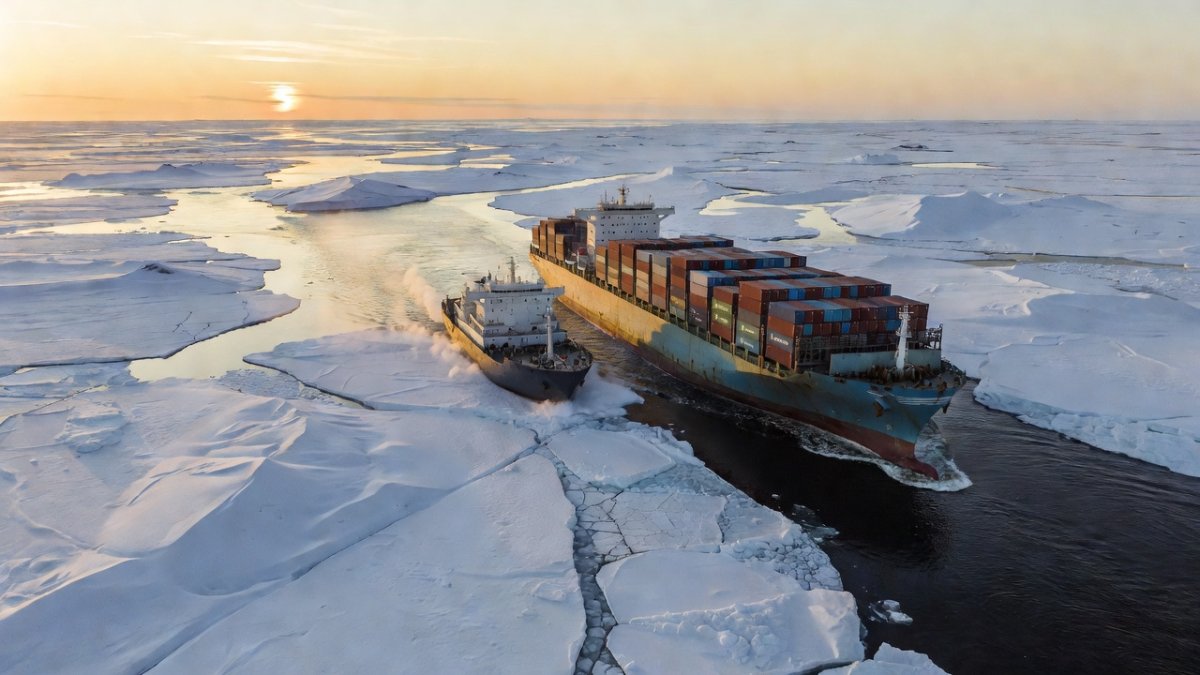
Beijing and Panama City, August 17, 2026 — The frozen geography of the top of the world is being redrawn by diesel engines and geopolitical ambition, even as the tropics close. Chinese carrier Sea Legend has launched the first scheduled container service through the Arctic's Northern Sea Route (NSR), connecting Ningbo-Zhoushan in eastern China to Felixstowe in the United Kingdom — a route branded the 'Ice Silk Road.' The voyage takes as little as 18 days, a staggering reduction from the 40-plus days required via the Suez Canal and the roughly 50 days needed to round the Cape of Good Hope, cutting sailing distance between Asia and Europe by 30 to 40 percent.
Eighteen Days to Europe: China Opens the Arctic's 'Ice Silk Road'
The frozen geography of the top of the world is being redrawn by diesel engines and geopolitical ambition. In a development that would have been unthinkable a generation ago, Chinese carrier Sea Legend has launched the first scheduled container service through the Arctic's Northern Sea Route (NSR), connecting the sprawling port complex of Ningbo-Zhoushan in eastern China to Felixstowe in the United Kingdom. This is the 'Ice Silk Road' made manifest—not as a speculative concept, but as a commercial timetable. The voyage takes as little as 18 days, a staggering reduction from the 40-plus days required via the Suez Canal and the roughly 50 days needed to round the Cape of Good Hope. For shippers, this cuts the sailing distance between Asia and Europe by 30 to 40 percent, a margin that can mean the difference between profit and loss in the hyper-competitive world of container logistics.
The proof of concept came in 2025, when a single pilot voyage by the vessel 'Istanbul Bridge' completed the transit in a record 20 days, crossing 3,500 nautical miles from the Bering Strait to the Barents Sea at close to 17 knots. The route proved navigable for an Ice1-class ship, a vessel not even designed for the heaviest polar ice. That success opened the floodgates. Rosatom, Russia's state nuclear company, issued permits for 7 Chinese vessels to sail to Europe via the NSR, a decision announced on August 7, 2026. Sea Legend now plans regular weekly sailings during the Arctic navigation window, with 8 voyages planned for the 2026 season, though some reports cite as many as 16. The momentum is undeniable: NSR transits rose from 15 in 2024 to a record 23 in the 2025 summer season. This is no longer a stunt; it is a scheduled artery, pulsing with cargo and consequence.
Climate's Double-Edged Gift: Melting Ice and the Perils of the Frozen Sea
We must be brutally honest about what makes this route possible. The NSR is a roughly 5,500-5,600 km lane along Russia's Arctic coast from the Barents Sea to the Bering Strait, navigable only in warmer months—a window that has widened as summer sea ice retreats. The National Snow and Ice Data Center (NSIDC) reports that about 13% of the Arctic Ocean's perennial ice cover has vanished per decade since 1979. That is the climate crisis delivering a logistical gift to China and Russia, a gift wrapped in the very emissions that caused the melt. Xi Jinping first publicly proposed a 'polar Silk Road' with Russia in 2017, and now the vision is being realized on a schedule. The cargo suited to this route is telling: temperature-sensitive goods—electric vehicles, lithium batteries, solar products—plus consumer goods, clothing, and components. These are high-value, time-sensitive items where the 18-day transit is a competitive weapon.
But the gift is double-edged. Sea Legend claims the Arctic route roughly halves emissions due to the shorter sailing time. Experts, however, warn that environmental risks could erase those savings entirely. The use of heavy fuel oil (HFO), banned from Arctic shipping in 2024, remains a persistent risk. Black carbon from HFO is 'one of the most potent absorbers of solar radiation,' reducing the region's reflectivity and trapping heat, worsening global warming. When a ship burns HFO in the Arctic, it deposits soot on ice, turning a white mirror into a dark sponge. The Bellona Environmental Foundation's 2025 report is stark: oil decomposes slowly in cold water, is almost impossible to remove once trapped in ice, and Russia is unprepared for a spill. Remote recovery teams could take weeks to reach a spill site, by which time the damage would be catastrophic and irreversible. This is the paradox of the Ice Silk Road: it exists because of climate change, and it accelerates the very warming that created it.
El Niño Tightens the Panama Canal: Latin America's Chokepoint Under Pressure
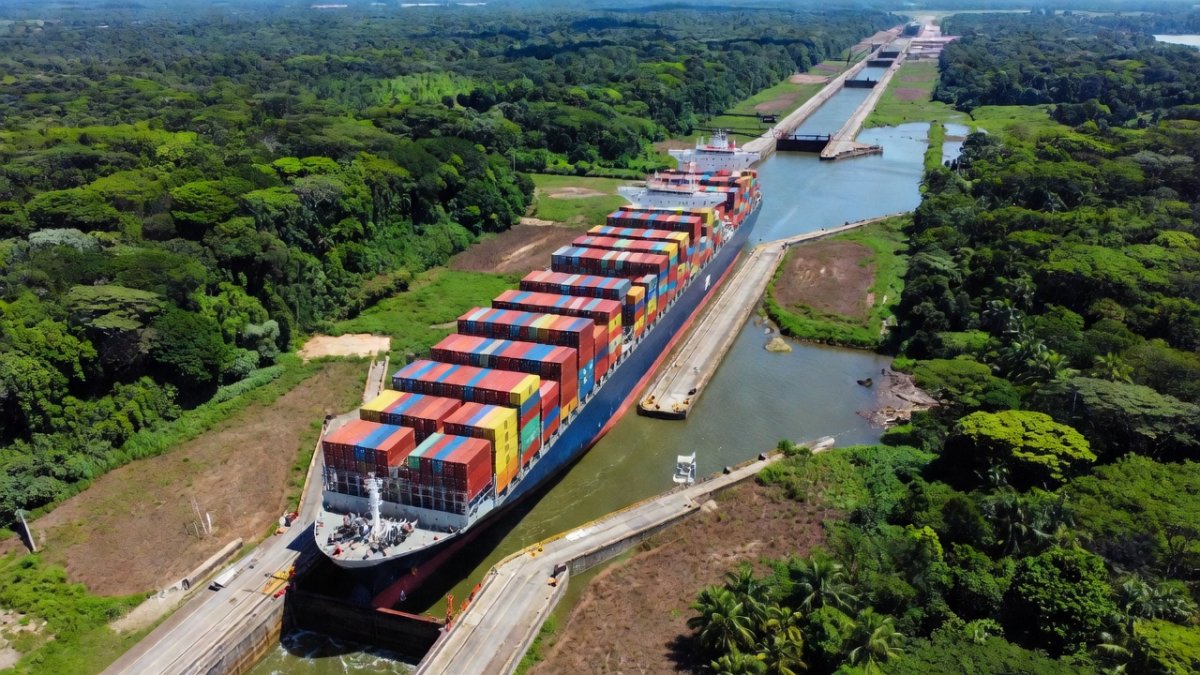
While the Arctic opens, the tropics are closing. The Panama Canal Authority (ACP) announced on August 17, 2026 that Neopanamax locks draft limits will be cut to 48 feet (14.63 m) on August 26 and 47.5 feet (14.48 m) on September 3—the fourth and fifth adjustments, part of water conservation measures in place since December 2025. This is not a drill. NOAA's August forecast puts a 69% chance of a historic El Niño in October-December 2026, exceeding events dating back to 1950, with a greater than 90% chance of a very strong event in the 2026-27 Northern Hemisphere fall/winter. For Latin America, this is existential. The canal is not just a waterway; it is the economic aorta of the region, carrying a significant portion of the trade that sustains economies from Chile to Colombia. Every foot of draft reduction means fewer containers, less cargo, and higher costs for exporters who have no alternative.
The numbers tell a story of volatility. Panama Canal FY2026 saw revenue hit $5.7 billion on 13,404 transits as drought eased earlier in the year, but average auction prices for transit slots ran $135,000-$140,000 before the Middle East conflict began. The canal learned hard lessons from the 2023-24 drought, when a severe water shortage forced drastic cuts and sent shockwaves through global supply chains. Now, with El Niño looming, the ACP is being proactive. The authority says draft adjustments will not change the number of daily transits, reflecting water conservation and resource management since December 2025. But that is cold comfort for a soybean farmer in Brazil or a copper miner in Peru who must get product to market. The canal is tightening, and the region is bracing for impact. The question is no longer if the canal will face another crisis, but how severe this one will be.
What This Means for Latin America: Trade, Drought, and the Search for Alternatives
For Latin America, the Arctic route is a distant abstraction; the Panama Canal is a daily reality. The region's exporters—from Chilean fruit growers to Colombian coffee producers to Brazilian meat packers—depend on the canal's reliability. When the canal tightens, their costs rise, their delivery times stretch, and their competitiveness erodes. The 2023-24 drought was a preview: ships queued for days, auction prices spiked, and some shippers were forced to reroute around Cape Horn, adding weeks to voyages. The forecast El Niño threatens to repeat that nightmare, and the ACP's draft cuts are a preemptive admission that the water is not there. The Arctic Institute analysis suggests that melting Arctic ice could eventually challenge the Panama Canal's niche in global shipping, but that is a long-term scenario. In the short term, the canal remains irreplaceable for Latin America, and its vulnerability is the region's vulnerability.
Panama's Maritime Authority (AMP) has participated in multinational exercises on the Polar Code, a sign that the region is not ignoring the Arctic's rise. But participation in exercises is not the same as having alternatives. The search for alternatives is real but limited. Overland routes across the Andes are impractical for bulk cargo. The Strait of Magellan is a dangerous and slow alternative. The Arctic route, even if it were viable for Latin American exporters, is controlled by Russia and China, not by the region. The stakes are human: farmers who cannot ship their harvest, workers in port cities who depend on canal traffic, and communities that face higher prices for imported goods. The canal is not just infrastructure; it is the lifeblood of the region's trade, and every draft reduction is a small wound. The region watches the El Niño forecasts with the same anxiety that a sailor watches a storm—knowing that the weather will decide their fate.
The Geopolitics of Frozen Water: Russia, China, and the Shadow Fleet
The Arctic is not a neutral ocean; it is a geopolitical chessboard. Russia controls the NSR through Rosatom, which issues permits and provides nuclear-powered icebreakers. Moscow has grown dependent on Beijing since its full-scale invasion of Ukraine, giving China greater leverage. This is a relationship of convenience, not trust. China's 'Polar Silk Road' has invested more than $90 billion in Arctic infrastructure, according to Global Views analysis, making it the dominant external player. Russia needs the revenue and the diplomatic cover; China needs the route and the resources. The result is a partnership that is reshaping the region's politics. The geopolitical context is even more volatile: the Strait of Hormuz crisis and attacks in the Red Sea/Bab el-Mandeb have pushed shipping lines to seek alternatives. US Secretary of State Marco Rubio has suggested new shipping lanes to bypass Hormuz, while Japan, South Korea, and India have expressed interest in NSR cargoes. The Arctic is becoming a strategic corridor, not just a shipping lane.
The shadow fleet is the dark underbelly of this new trade. In 2025, about 100 ships under international sanctions—nearly a third of cargo ships on the NSR—sailed the route as a 'shadow fleet.' In 2026, shadow fleet shipments are happening at an even faster rate. In the past week, ship-watchers spotted an unprecedented convoy of Russian tankers carrying about 8 million barrels of oil passing within 500 miles of the North Pole. A Russian LNG carrier made an early transit in May thanks to shrinking ice. These vessels operate outside the normal insurance and regulatory frameworks, posing a heightened risk of accidents and spills. Insurance premiums for Arctic voyages can run 5-10x higher than conventional routes, which is why only about 2% of global shipping currently uses Arctic routes. Coface analysis suggests only ~3.5% of East Asia-Northern Europe-North America trade is likely to shift to Arctic routes in the short term. But the shadow fleet does not care about insurance; it cares about evading sanctions and moving oil. The Arctic is becoming a lawless frontier, and the consequences could be catastrophic.
Voices from the Ice: Experts on Spills, Black Carbon, and a Fragile Ecosystem
The experts are unanimous in their warnings, even as the ships keep sailing. Allianz principal marine risk consultant Capt. Nitin Chopra puts it bluntly: 'Due to the remoteness of the region and lack of logistical support, the probability of a prolonged machinery breakdown and consequential grounding is much higher. This poses the risk of an environmental oil spill in a fragile ecosystem.' The Arctic is not like the Gulf of Mexico or the North Sea. There are no nearby ports, no rapid-response teams, no established cleanup infrastructure. A spill in the Arctic would be a disaster of a different magnitude, one that could persist for decades. The Bellona Environmental Foundation's 2025 report reinforces this: oil decomposes slowly in cold water, is almost impossible to remove once trapped in ice, and Russia is unprepared for a spill. Remote recovery teams could take weeks to reach a spill site, by which time the oil would have spread and sunk, becoming unrecoverable.
The environmental risks extend beyond spills. Black carbon from HFO is 'one of the most potent absorbers of solar radiation,' reducing the region's reflectivity and trapping heat, worsening global warming. Every ship that burns HFO in the Arctic is contributing to a feedback loop that accelerates ice melt, which in turn opens the route to more ships. It is a vicious cycle. RMIT professor Vinh Thai offers a sobering perspective: with climate change, the NSR may be open for more of the year, but 'can the northern sea route be used as a substitute for the strait of Hormuz and the Suez canal? The short answer is no, not for the moment.' The route is seasonal, risky, and environmentally fraught. It is not a solution; it is a symptom. The voices from the ice are clear: this is a fragile ecosystem, and we are gambling with its future for the sake of a few days of transit time. The question is whether the world is listening.
The Bottom Line: A Seasonal Corridor, Not a Substitute
Let us be clear about what the Ice Silk Road is and is not. It is a seasonal corridor, open only in the warmer months, dependent on the very ice melt that threatens the planet. It is not a substitute for the Suez Canal, the Strait of Hormuz, or the Panama Canal. The numbers prove it: only about 2% of global shipping currently uses Arctic routes, and Coface analysis suggests only ~3.5% of East Asia-Northern Europe-North America trade is likely to shift to Arctic routes in the short term. The route is a niche, a supplement, a hedge—not a replacement. For Latin America, the Panama Canal remains the critical chokepoint, and its vulnerability under a forecast El Niño is a direct threat to the region's trade and prosperity. The ACP's draft cuts are a warning, not a solution. The region must invest in resilience, in water management, in alternative infrastructure, and in adaptation to a changing climate.
The bottom line is that the Ice Silk Road is a symbol of a warming world, not a solution to its problems. It offers speed and savings for a select few, but it carries risks that could dwarf those benefits. The shadow fleet, the black carbon, the potential for catastrophic spills—these are the costs of this new route, and they are borne by the entire planet. For Latin America, the lesson is clear: the region cannot rely on the Arctic to save it from the Panama Canal's drought. It must look inward, to its own resilience, its own infrastructure, and its own capacity to adapt. The Arctic is opening, but the tropics are closing, and the world's trade routes are shifting in ways that demand attention and action. The Ice Silk Road is a fact, but it is not a future. The future lies in sustainable, resilient, and equitable trade—a future that Latin America must fight for, not just in the halls of power, but in the ports, farms, and communities that depend on the sea.
By Elena Vasquez, Staff Writer
This article was produced with AI-assisted research and editorial support. Reporting is based on sources cited in the article.
What's Your Reaction?
 Like
0
Like
0
 Dislike
0
Dislike
0
 Love
0
Love
0
 Funny
0
Funny
0
 Wow
0
Wow
0
 Sad
0
Sad
0
 Angry
0
Angry
0

Latin America Correspondent at Global1.News. Based in Mexico City, covering politics, economics, energy, and culture across the region. Brings an on-the-ground perspective to stories spanning from the Rio Grande to Patagonia.










Comments (0)