
Boks 43-0 Wales: 11-Match Streak, Kolisi Back for Argentina
Springboks 43-0 Wales: Boks Storm Into Argentina Clash on 11-Match Streak DURBAN — The Springboks delivered a masterclass at Hollywoodbets Kings Park on July 18, dismantling Wales 43-0 with seven tries from seven different scorers to extend their winning streak to 11 matches and maintain a perfect 3-0 record in the inaugural Nations Championship.
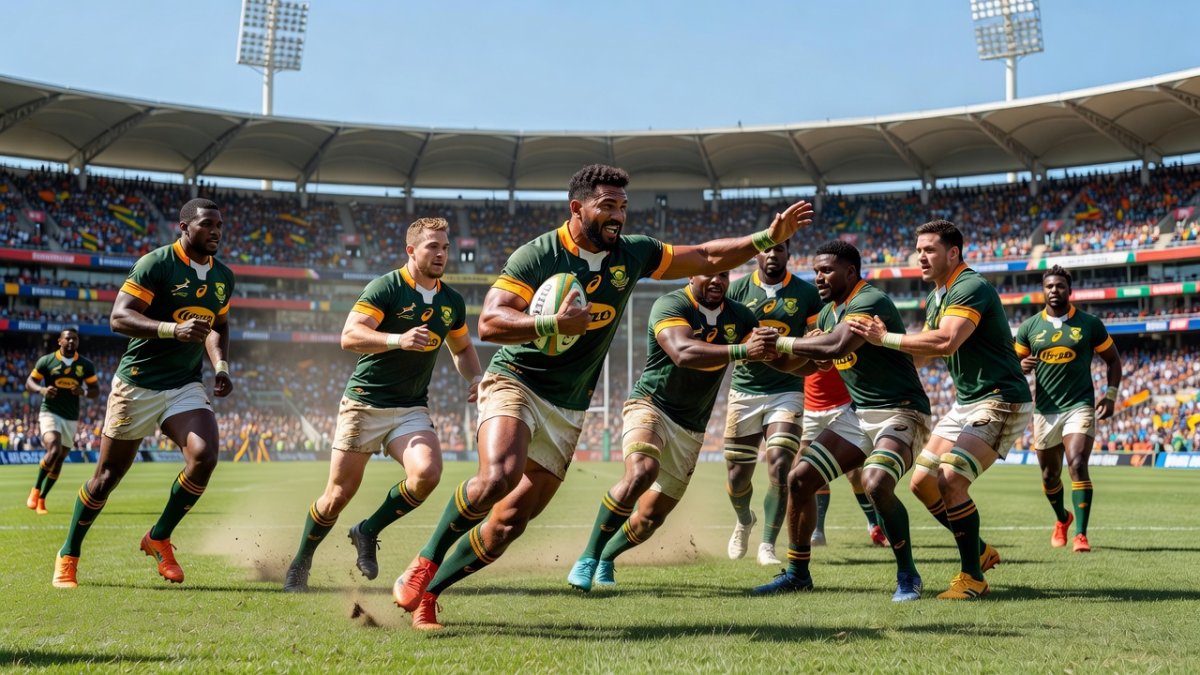
Springboks 43-0 Wales: Boks Storm Into Argentina Clash on 11-Match Streak
DURBAN — The Springboks delivered a masterclass at Hollywoodbets Kings Park on July 18, dismantling Wales 43-0 with seven tries from seven different scorers to extend their winning streak to 11 matches and maintain a perfect 3-0 record in the inaugural Nations Championship. And here's the thing that should send shivers down the spine of every opponent watching: they did it without Siya Kolisi, without Cheslin Kolbe, without Eben Etzebeth.
This was not a full-strength Springboks side. This was a team still finding its rhythm in a new competition, still rotating personnel, still building towards the big one. And they still put 43 unanswered points on a Test nation in front of a roaring Durban crowd. If that doesn't tell you where South African rugby stands right now, nothing will.
Tags: Springboks, South Africa rugby, Wales 43-0, Nations Championship, Siya Kolisi, Eben Etzebeth, Rassie Erasmus, Argentina Test, All Blacks series, Rugby's Greatest Rivalry, Durban, Kings Park, Sacha Feinberg-Mngomezulu, Tony Brown, seven tries, 11-match winning streak
Seven Tries, Seven Heroes — A Statement Performance
The scoreline tells a story of utter dominance, but the manner of the victory was what had the Kings Park faithful on their feet from the opening whistle. The Boks ran in seven converted tries — that's 49 points worth of attacking firepower before factoring in the missed conversions — through Jasper Wiese, Cobus Reinach, Jesse Kriel, Nizaam Williams, Jean-Luc Jantjies, Kurt-Lee Arendse, and a de Villiers effort that put the final nail in the Welsh coffin.
Mlungisi Moyo slotted three conversions while Manie Libbok added another, and the defensive effort was just as impressive — a second consecutive clean sheet against Wales, following the blueprint laid down in the corresponding fixture last year. Wales head coach Steve Tandy didn't mince words after the match, admitting his side was "no match for the power and precision of the Springboks." That's not sour grapes. That's a honest assessment from a coach who watched his team get systematically taken apart by a green-and-gold machine operating at a different level entirely.
The try-scoring spread is particularly noteworthy. Seven different players crossed the whitewash, highlighting the depth and variety in this Springboks attacking setup. This is not a team that relies on one superstar finisher. Under attack coach Tony Brown, the Boks have developed a multi-dimensional attacking structure that can hurt you from anywhere on the park — through the forwards' brute force, the backs' pace out wide, or the creative spark of players like Jantjies and Arendse in broken play.
11 and Counting — The Boks' Unbeaten Run
Eleven consecutive Test match victories. Let that settle for a moment. Since their last defeat, the Springboks have beaten Scotland, England, Argentina, New Zealand, Australia, and now Wales — a collection of northern and southern hemisphere heavyweights that reads like a world championship schedule. The 11-match streak is the longest active winning run in international rugby and puts the Boks in rarefied company alongside some of the great Springboks sides of the past.
What makes this streak particularly impressive is the context. Rassie Erasmus has been using a deliberate rotation policy, managing player workloads across a brutal schedule that includes the United Rugby Championship, the Nations Championship, and the looming four-Test series against New Zealand. The fact that the Boks can rest their captain, their star flyhalf, and their most destructive lock — and still beat Wales 43-0 — speaks volumes about the depth Erasmus and his coaching staff have built.
The Nations Championship table reflects this dominance. The Springboks sit atop the Southern Hemisphere standings with a perfect 3-0 record, having dispatched Scotland, England, and Wales in succession. France lead the Northern Hemisphere, setting up the tantalising possibility of a cross-hemisphere final between the two form teams in world rugby.
Welcome Back, Heavyweights — Kolisi, Etzebeth and Co. Return
On July 22, Erasmus named a 43-man squad that will assemble in Johannesburg on Sunday, July 26, to begin preparations for the next phase of the season. And the headline is unmistakable: the big names are back.
Siya Kolisi, the iconic Springboks captain who has led this team to back-to-back Rugby World Cup titles, is fit and ready to go after a period of rest and recovery. Sacha Feinberg-Mngomezulu, the dazzling Stormers flyhalf who has emerged as one of the most exciting talents in South African rugby, returns to the setup. And Eben Etzebeth — the 120-Test lock, the enforcer, the heartbeat of the Boks' forward pack — is back in the mix alongside Lood de Jager, giving Erasmus a selection headache that most coaches would envy.
Ten players return from injury in total, a significant injection of quality and experience into a squad that was already performing at an elite level. Erasmus has also released five players to their domestic franchises for match fitness, a tactical move designed to ensure sharpness across a squad that will need to be at its absolute best for what lies ahead.
"We've been strategic about managing the squad through this period," Erasmus said in comments reported by multiple South African outlets. "The depth we've built allows us to rotate without losing momentum, and now we're at the stage where we integrate our returning players into a system that's already firing."
Argentina in Buenos Aires — The Next Test
First stop on the return tour: Buenos Aires, where the Boks face Los Pumas on Saturday, August 8, in their fourth Nations Championship fixture. Argentina have proven themselves a formidable force in world rugby, pushing Scotland in the opening round and boasting a forward pack capable of matching up with anyone. The cauldron of Estadio Mario Alberto Kempes in Córdoba gave way to what will be another hostile reception for the Boks in the Argentine capital.
But this Springboks side has shown time and again that they thrive on hostility. The noise, the pressure, the expectation — it fuels them. With Kolisi likely to lead from the front and Etzebeth packing down in the second row, the Boks will have the leadership and physical presence to control the contest. The challenge for Erasmus will be managing the integration of the returning players into a backline and forward pack that has already developed strong combinations over the first three rounds.
The Argentina Test is more than just another fixture. It's a statement game. Win in Buenos Aires, and the Boks head into the All Blacks series with four from four, riding a 12-match winning streak, and carrying the momentum of an entire nation on their shoulders.
Rugby's Greatest Rivalry — Four Tests, One Epic Series
And then there's the one that every South African rugby fan has been circling on the calendar since the fixture list dropped. The Rugby's Greatest Rivalry series against New Zealand. Four Tests. Two countries. One trophy.
The schedule is a rugby fan's dream. August 22 at Ellis Park in Johannesburg — the cauldron, the fortress, the venue where Springboks history has been written for decades. August 29 at Cape Town Stadium, with Table Mountain as the backdrop and the Cape Town faithful in full voice. September 5 at FNB Stadium in Soweto, the largest stadium in Africa, where 94,000 green-and-gold faithful will create an atmosphere that no broadcast can fully capture. And the finale on September 12 in Baltimore, USA — a historic first, taking Springboks vs All Blacks to American soil as World Rugby continues its push into the North American market.
Four Tests against the All Blacks in the space of four weeks. This is the ultimate examination of squad depth, tactical adaptability, and mental fortitude. The Boks have won 11 on the bounce, but the All Blacks — stung by their Rugby World Cup quarterfinal exit and rebuilding under new leadership — will arrive in South Africa with something to prove and nothing to lose.
What Tony Brown Has Unlocked
One of the most significant developments in this Springboks campaign has been the influence of attack coach Tony Brown. The former All Blacks playmaker and Highlanders head coach has brought a new dimension to the Boks' attacking game, blending the traditional South African strengths — set-piece dominance, physicality, kicking strategy — with a faster, more expansive approach that has opposition defences scrambling.
The seven-try performance against Wales was a showcase of this evolution. The Boks attacked from deep. They shifted the point of contact. They used the full width of the field. And crucially, they trusted their skills to execute under pressure. This is not the conservative, kick-heavy Springboks of years past. This is a team that can beat you in the air, in the trenches, or out wide — and they're only getting better.
Brown's philosophy has clearly resonated with the players. The try-scoring spread across seven different players against Wales is not a coincidence — it's a deliberate attacking structure designed to create opportunities for everyone, not just the designated finishers. When your lock, your scrumhalf, your centre, your wingers, and your loose forwards are all genuine try-scoring threats, you become exponentially harder to defend against.
What This Means for South African Rugby
Let's step back and look at the bigger picture, because this matters beyond the scoreboard. The Springboks are not just winning — they're dominating in a way that reflects the health and depth of South African rugby as a whole. The United Rugby Championship has provided a platform for local talent to develop against top European opposition. The Currie Cup continues to produce young players hungry for Test honours. And the pipeline from schools rugby through to the professional game has never been stronger.
There are challenges, of course. Transformation remains a work in progress, and the debate around equity in South African sport is as active as ever. The financial pressures on domestic franchises continue, with player salaries and broadcast revenues under constant scrutiny. But what the Springboks are achieving on the international stage provides a beacon of hope and unity for a country that so often needs one. When the Boks play, South Africa stops. When they win — and especially when they win like this — the nation feels a little bit more whole.
What to Watch For
The next few weeks will define this Springboks season. The squad assembles in Johannesburg this weekend, and the returning stars will need to hit the ground running. Expect Erasmus to ease Kolisi and Etzebeth back into action against Argentina, with the captain likely to play 50-60 minutes as he regains match sharpness.
Keep an eye on the flyhalf battle. Sacha Feinberg-Mngomezulu's return adds another dimension to a position already stacked with talent — Manie Libbok, Handré Pollard, and Jordan Hendrikse are all vying for the No. 10 jersey. How Erasmus balances these options across the Argentina Test and the All Blacks series will be one of the most compelling narratives of the season.
And for the All Blacks series itself — four Tests in four weeks is unprecedented in the professional era. The squad depth that Erasmus has built will be tested like never before. If the Boks can emerge from that series with a winning record, they will have cemented their status as not just the best team in the world right now, but one of the greatest Springboks sides of all time.
Buckle up, South Africa. This ride is just getting started.
By Dante Williams, Staff Writer
This article was produced with AI-assisted research and editorial support. Reporting is based on sources cited in the article.
What's Your Reaction?
 Like
0
Like
0
 Dislike
0
Dislike
0
 Love
0
Love
0
 Funny
0
Funny
0
 Wow
0
Wow
0
 Sad
0
Sad
0
 Angry
0
Angry
0

Breaking News and Investigations Correspondent at Global1.News. Based in London, covering global breaking news, security, and investigative stories. Known for digging deeper and connecting the dots across continents.















Comments (0)