
Beijing Says US Is Turning Taiwan Into 'Cannon Fodder'
CCTV accused Washington of turning Taiwan into cannon fodder after AIT chief Raymond Greene said Taipei need not win a war outright, as a US$14 billion arms package sits unapproved and Taiwan's legislature strips domestic drone funding.
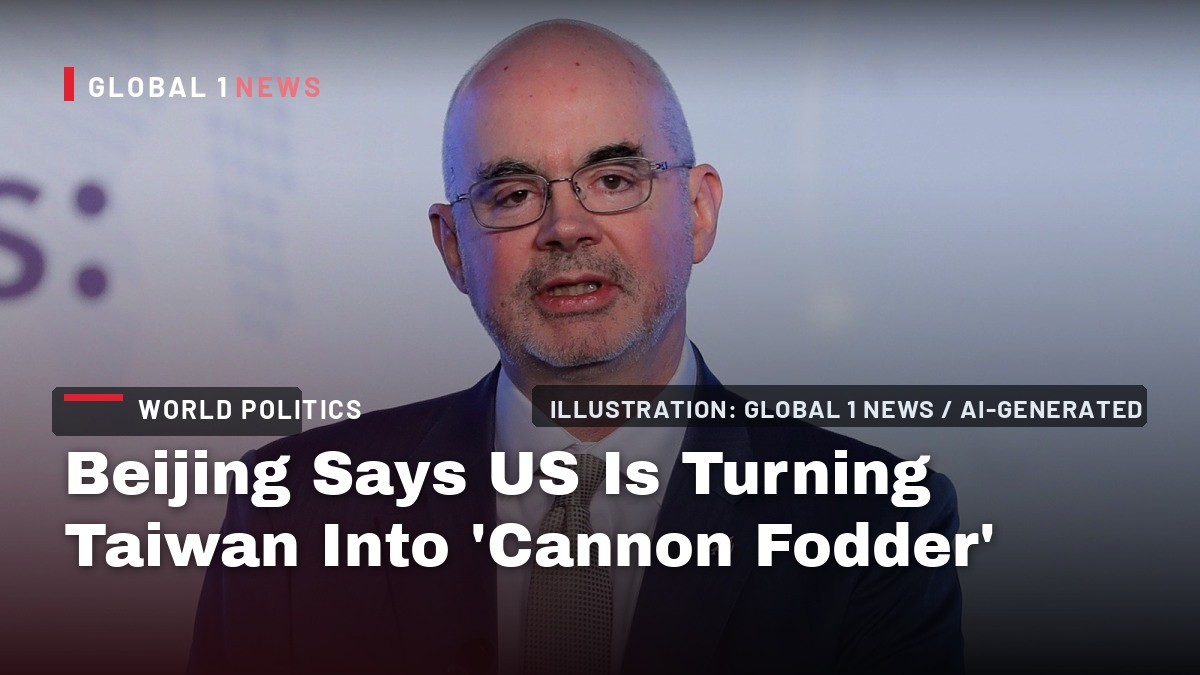
A Deterrence Speech in Taipei That Beijing Heard as a Confession
Raymond Greene chose his words carefully, and Beijing read them just as carefully. In a keynote at the Taipei Security Dialogue on September 9, the director of the American Institute in Taiwan told an audience of Taiwanese strategists that the island does not have to win a war in order to survive one.
"Taiwan doesn't need to demonstrate that it can win a war outright," Greene said, according to the South China Morning Post. What it must do instead, he argued, is convince an adversary that any landing "would struggle" in "heavily urbanised, mountainous terrain" and then have to be sustained "across 90 miles [145km] of open, turbulent waters". Such an operation, he said, would be "hard to imagine" for even a combat-experienced force.
His theme, set out in the title of the address, was asymmetric deterrence. Greene pointed to uncrewed systems, mission command and societal resilience as Taiwan's "unique strengths", and to joint work with American companies on drones and autonomous systems that have already been battle-tested.
Three days later, CCTV answered. In a commentary, China's state broadcaster seized on the formulation that Washington had spent decades avoiding: "The subtext of Greene's speech is clear as day: he said that Taiwan does not need to win, which means the US doesn't care whether it wins or loses."
The commentary went further. "It meant that Taiwan's mission is to serve as cannon fodder in confronting and containing the mainland. It's meant to turn Taiwan into a battlefield capable of wearing the mainland down over the long haul."
That is the frame Beijing now applies to US policy in the strait: not a guarantee of protection, but a hedge that treats the island as consumable.
What Washington Stopped Saying
The doctrine itself is not new. In a January speech in Taipei, Greene argued that America "can only help our friends as much as they help themselves", and that while the United States is "committed to maintaining the military capacity to deny aggression anywhere in the first island chain", Washington "should not bear this burden alone".
What has changed is the direction of the disclosure. For four decades, US policy on Taiwan rested on strategic ambiguity, the deliberate refusal to say whether American forces would fight. Officials like Greene have drifted toward something closer to strategic candour: telling Beijing what Washington is not prepared to do.
CCTV also cited Elbridge Colby, the Pentagon's undersecretary for policy, saying that Taiwan is "very important to the US ... but not an existential interest". President Donald Trump has said he was not "looking" to send the US military "9,500 miles to fight a war". A superpower that publishes its own ceilings hands its rival a map.
Taiwan's vice-president, Hsiao Bi-khim, responded to Greene by saying Taipei "must strive to achieve" a defence budget worth 5 per cent of GDP, a target Greene suggested would still not be enough.
A US$14 Billion Package Stuck Between Taipei and Tehran
The rhetorical shift is matched by a material one. Congress pre-approved a US$14 billion arms package for Taiwan in January, but Trump has yet to notify it formally, a step required before delivery. In December 2025 his administration cleared an earlier sale worth US$11.1 billion, one of the largest in the history of the relationship.
The US$14 billion tranche, which includes air-defence interceptors such as Lockheed Martin's PAC-3, has become a bargaining instrument rather than a procurement plan. Trump has called it "a very good negotiating chip" with Beijing and said he would "make a determination over the next fairly short period".
The acting navy secretary, Hung Cao, told a Senate subcommittee in May that some foreign military sales were being paused so that US forces could hold sufficient munitions for the war with Iran, where the operation code-named Epic Fury took priority. Taiwan's presidential office said it had received no notification of any change.
There has been a further oddity. Trump recently threatened to include Taiwan's de facto embassy in Washington in a US$5 billion lawsuit against a US think tank, and said he would speak directly with Taiwan's president, William Lai Ching-te, about the weapons package, a break with longstanding diplomatic practice.
Taipei's Rearmament Runs Into Its Own Legislature
Beijing is not the only obstacle to Taiwan's build-up. On May 8, the opposition-controlled Legislative Yuan passed the Special Act for Safeguarding National Security and Strengthening Asymmetric Capabilities, capping procurement at NT$780 billion, about US$25 billion, or 38 per cent below the NT$1.25 trillion that Lai had requested.
The legislation's title invokes asymmetric warfare. Its provisions did the opposite. Domestic drone procurement was stripped out, including plans for roughly 200,000 drones and 1,320 uncrewed surface vessels over 2026 to 2032, along with AI-enabled command and control, the T-Dome air-defence network and NT$64 billion for joint Taiwan-US research and development.
That is very close to the capability set Greene described as decisive. Taiwan's regular 2026 defence budget still lands at roughly 3.3 per cent of GDP under newly adopted NATO-style accounting, and Lai has pledged to reach 5 per cent by 2030. But the island has now interrupted the domestic industry its own deterrence concept depends on.
Why Tokyo Cannot Treat This as a Spectator Sport
For Japan, none of this is academic. In March 2025 the government published a plan to evacuate 120,000 residents and tourists from five municipalities in Okinawa's Sakishima island chain - Ishigaki, Miyako, Taketomi, Yonaguni and Tarama - within six days, roughly 20,000 people a day, using Self-Defence Force and coast guard vessels alongside private ferries and aircraft. Evacuees would be housed across Yamaguchi and seven Kyushu prefectures, with 32 municipal governments receiving about 110,000 residents for the first month. Officials said the plan did not assume a particular incident, then privately acknowledged that a Taiwan contingency shaped it. A full drill is scheduled for this fiscal year.
Tokyo has already paid a price for saying out loud what it thinks. On November 7, 2025, Prime Minister Sanae Takaichi told a parliamentary committee that a Chinese attack on Taiwan involving warships and the use of force could constitute a "survival-threatening situation" for Japan, the legal trigger for collective self-defence. Beijing responded with a seafood import ban, a travel advisory urging Chinese citizens to avoid Japan, and a diplomatic freeze that has lasted most of a year.
The cost is visible in Japan's own arrival data. Chinese arrivals fell 60.7 per cent year on year in January, 45.2 per cent in February and 55.9 per cent in March, even as Japan's overall inbound numbers held near record levels. Ties remain stalled, and Tokyo has lately been probing for a way back.
The deeper question is alliance credibility. Japan's planning, including the Sakishima blueprint and the build-up of missile units along the Nansei chain, assumes that American forces would fight. Greene's description of Taiwan's mission, and Colby's line about existential interests, invites Tokyo to ask what that assumption is worth.
Beijing's Two-Track Campaign: Protests and Pressure
Beijing's response runs on two channels. The first is diplomatic. On September 11, foreign ministry spokeswoman Mao Ning said China had lodged "serious representations" with Italy and the European Union over Hsiao's visit to the Italian island of Ventotene for a democracy conference, where she appeared alongside Taiwan's foreign minister, Lin Chia-lung. Taiwan's ruling party, Mao said, was attempting "to pursue independence under the guise of democracy and freedom", calling such efforts "truly despicable, and futile".
The second channel is military. CSIS tabulations record 3,764 incursions by PLA aircraft into Taiwan's de facto air defence identification zone in 2025, a 22.4 per cent increase on 2024. December 2025 brought the largest exercises around the island in years.
All of it now collides with a diplomatic calendar. Xi Jinping is due in Washington this month, and in May he told Trump that the Taiwan issue was the "most important" in the relationship and that mishandling it could lead to conflict. For Beijing, the arms package has become a test of whether Washington will trade the island's security for progress elsewhere.
What to Watch For
Four signals will show whether this is posturing or a genuine shift.
First, the US$14 billion notification. If Trump approves it before the summit, the cannon fodder argument loses force in Beijing. If he defers it again, CCTV's framing hardens into the consensus view of Chinese commentary.
Second, Taiwan's drone bill. A NT$210 billion package covering domestically produced uncrewed systems remains deadlocked in the Legislative Yuan. Its fate decides whether Taipei can build the asymmetric force it has been told to build.
Third, Japan. The Sakishima evacuation drill later this fiscal year will be the first full rehearsal of the plan. Watch whether Takaichi's government can steady relations with Beijing without retreating on Taiwan, and watch arrivals from China, the clearest measure of how far ties have frayed.
Fourth, the phrase itself. If the next US statement on Taiwan abandons "doesn't need to win", Beijing will read it as a walk-back. If it repeats, expect the same CCTV line, sharper.
By Kenji Tanaka, Staff Writer
This article was produced with AI-assisted research and editorial support. Sources: South China Morning Post; CCTV; American Institute in Taiwan; Associated Press; BBC; Reuters; Fox News; UPI; The Hill; Taipei Times; The Diplomat; Asahi Shimbun; Yomiuri Shimbun; Japan National Tourism Organization; Al Jazeera; CSIS.
What's Your Reaction?
 Like
0
Like
0
 Dislike
0
Dislike
0
 Love
0
Love
0
 Funny
0
Funny
0
 Wow
0
Wow
0
 Sad
0
Sad
0
 Angry
0
Angry
0
Japan Correspondent at Global1.News. Tokyo-based voice covering Japanese politics, technology, economy, and culture. Tracks the intersection of tradition and innovation in one of the world's most dynamic societies.












Comments (0)