
4 Fault Lines that Could Shape the Trump-Xi Summit
In the waning days of September 2026, the United States and China stand poised for a second high‑level summit between President Donald Trump and President Xi Jinping, scheduled for September 24 at the White House.
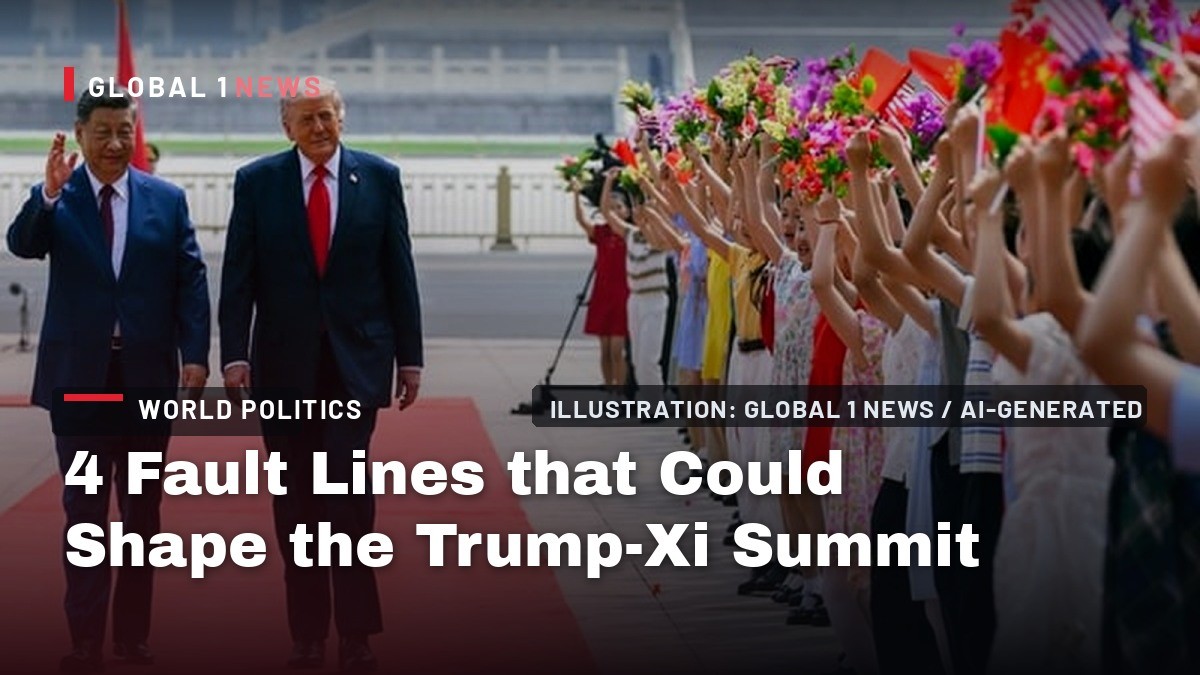
In the waning days of September 2026, the United States and China stand poised for a second high‑level summit between President Donald Trump and President Xi Jinping, scheduled for September 24 at the White House. This encounter follows an earlier meeting in May 2026 in Beijing and a bilateral dialogue on the sidelines of the APEC summit in Busan on 30 October 2025, where the two leaders agreed to a one‑year truce in their trade war. The forthcoming summit, however, unfolds against a complex matrix of domestic political calculations, regional security tensions, and strategic economic negotiations that will test the durability of the modest gains achieved in Busan.
Domestic and International Context of the Summit
The timing of the summit is striking. U.S. midterm elections are slated for roughly 40 days after the meeting, a proximity that traditionally compels incumbents to avoid diplomatic risks that could jeopardize voter sentiment. Yet, Pew Research data cited in recent coverage indicates that while American views of President Xi remain largely unfavorable, there has been a six‑percentage‑point rise in his favorability since the previous year, suggesting a nuanced shift in public perception that could influence campaign narratives.
Internationally, the summit occurs under the lingering shadow of the Iran‑U.S. confrontation, which has driven Brent crude to hover near the $100‑per‑barrel mark. Simultaneously, the deepening strategic partnership between Beijing and Moscow—formalized in a joint statement shortly after the May 2026 summit—places the United States in a delicate position as it prepares to welcome Xi while confronting a Russia‑backed war in Ukraine. Pew Research also notes that Beijing enjoys a relatively more favorable image than Washington in a broader set of countries, adding an additional diplomatic dimension to the proceedings.
Trade Truce and the Fragility of Rare‑Earth Arrangements
The Busan agreement of October 2025 established a limited trade truce: the United States lowered its fentanyl‑related tariff on Chinese goods to 10 percent, suspended a reciprocal 10 percent tariff, secured a pledge for China to purchase 25 million tons of U.S. soybeans annually through 2028, and deferred export controls on rare‑earth elements. That truce is set to expire in November 2026, making the September summit a critical juncture for extending—or reshaping—these arrangements.
Recent reports indicate that the rare‑earth component of the deal is already under strain. Exports of yttrium, a key element for aerospace and defense applications, have declined sharply since April 2025 despite China’s earlier commitment to waive export controls. U.S. officials are reportedly contemplating new tariffs or charges on specific Chinese commodities as leverage in forthcoming negotiations. The outcome will have direct implications for supply‑chain security in sectors ranging from electric‑vehicle batteries to advanced weaponry.
Iranian Contention and the “Operation Economic Outcast” Initiative
Iran remains a flashpoint that both presidents must address. A recent Iranian retaliation against U.S. strikes on the Islamic Revolutionary Guard Corps—targeting Jordan, Bahrain, Kuwait, and Iraq—has intensified the regional volatility. China, as Iran’s largest trading partner and primary oil buyer, occupies a pivotal role in any diplomatic calculus concerning Tehran.
Washington’s Treasury Department has launched “Operation Economic Outcast,” a campaign aimed at pressuring entities that enable Iran’s actions, even as both superpowers reaffirmed in May 2026 their shared opposition to a nuclear‑armed Iran. President Trump has indicated an intention to speak directly with President Xi about discouraging Beijing’s involvement in Iran’s regional maneuvers, underscoring the delicate balance between strategic partnership and divergent security priorities.
Taiwan as a Bargaining Chip and Regional Alliance Implications
Taiwan continues to dominate the bilateral agenda. After the May 2026 summit, President Trump described U.S. arms sales to Taiwan as a “very good negotiating chip,” a characterization that alarmed allied nations. Taiwanese President Lai Ching‑te swiftly rebuked any notion of sacrificing the island’s sovereignty, emphasizing that Taiwan will not be “sacrificed or traded away.”
The prospect that Beijing might cancel the September summit if Washington proceeds with a $14 billion arms sale to Taiwan adds a layer of coercive diplomacy. Moreover, the perception that U.S. security commitments could be contingent on negotiations with Beijing reverberates across the alliance network. Manila’s dispute with Beijing over Scarborough Shoal and Tokyo’s broader concerns about the reliability of U.S. guarantees illustrate how a perceived willingness to “trade” security could erode confidence among U.S. partners in East and Southeast Asia.
Artificial Intelligence and Export Control Reversals
AI technology sits at the heart of the strategic competition between Washington and Beijing. Under the previous administration, export controls effectively barred advanced AI chips from reaching China. President Trump tightened these restrictions in April 2025 but subsequently reversed the policy between December 2025 and January 2026, shifting from a blanket “presumption of denial” to a case‑by‑case approval regime for Nvidia’s H200 chips. Chinese firms have since placed orders for millions of these chips, reflecting a rapid recalibration of the U.S. approach to AI export controls.
The September summit will likely probe the future trajectory of this policy. While the United States may seek to re‑impose stricter controls to safeguard its technological edge, Beijing will undoubtedly press for broader market access, citing the importance of AI for its national development strategy. The balance struck here will influence not only bilateral trade but also the broader architecture of technology governance in the Indo‑Pacific.
Potential Outcomes and the Limits of Diplomatic Leverage
Analysts converge on a modest expectation for tangible outcomes from the September 24 meeting. The consensus is that any agreements will likely extend the Busan‑era trade truce rather than introduce groundbreaking new provisions. Nevertheless, the summit’s significance lies in its signaling function: a successful meeting could reinforce a fragile détente, while a cancellation—potentially triggered by a U.S. decision on Taiwan arms sales—would underscore the volatility of the bilateral relationship.
Four fault lines—trade and rare‑earth stability, Iranian regional influence, Taiwan’s security calculus, and AI export controls—will shape the diplomatic calculus. Each represents a lever that either side can use to extract concessions, yet each also carries the risk of escalation. The interplay among these issues will determine whether the summit consolidates a tentative equilibrium or precipitates a renewed period of strategic competition.
Forward‑Looking Assessment for Korean Stakeholders
For South Korea, the Trump‑Xi summit holds particular relevance. The October 2025 Busan meeting, held on Korean soil, demonstrated Seoul’s capacity to serve as a neutral venue for U.S.–China dialogue. As the summit approaches, Korean ministries—particularly the Ministry of Foreign Affairs and the Ministry of Trade, Industry and Energy—must monitor the rare‑earth component closely, given Korea’s own reliance on imported rare‑earths for its semiconductor and battery industries.
Think tanks such as the Asan Institute for Policy Studies and the Korea Development Institute (KDI) are likely to assess the ripple effects on regional security alliances, especially in light of Taiwan‑related bargaining dynamics that could affect the U.S. security umbrella over the Korean Peninsula. Moreover, the AI export‑control debate may intersect with Korea’s burgeoning AI sector, prompting policy coordination with the Ministry of Science and ICT to safeguard domestic innovation while navigating U.S. export regimes.
In sum, the September 2026 summit, while modest in its expected concrete deliverables, will serve as a barometer of the broader U.S.–China relationship. Its outcomes will reverberate through trade, security, and technology domains that are central to Korean national interests. Continued scholarly monitoring of the summit’s four fault lines will be essential for anticipating shifts in the regional order and for informing Korea’s diplomatic posture in the evolving great‑power landscape.
This article was produced with AI-assisted research and editorial support. Reporting is based on the source material cited below. Sources: The Diplomat; thediplomat.com; Global1.News (19 September 2026).
By Prof. David Park, Staff Writer
What's Your Reaction?
 Like
0
Like
0
 Dislike
0
Dislike
0
 Love
0
Love
0
 Funny
0
Funny
0
 Wow
0
Wow
0
 Sad
0
Sad
0
 Angry
0
Angry
0

East Asia/Technology Correspondent at Global1.News. Seoul-based voice covering Korean politics, technology, business, and culture. Analyzes how technology and geopolitics intersect across East Asia.














Comments (0)