
Y-20B Tanker Conversion Extends PLA Western Pacific Reach
China confirmed its Y-20B heavy transport can convert into an aerial refuelling tanker, extending PLA Air Force reach beyond the first island chain. The modular design, unveiled in an August 5 CCTV documentary, lets commanders draw on dozens of tanker-capable aircraft.
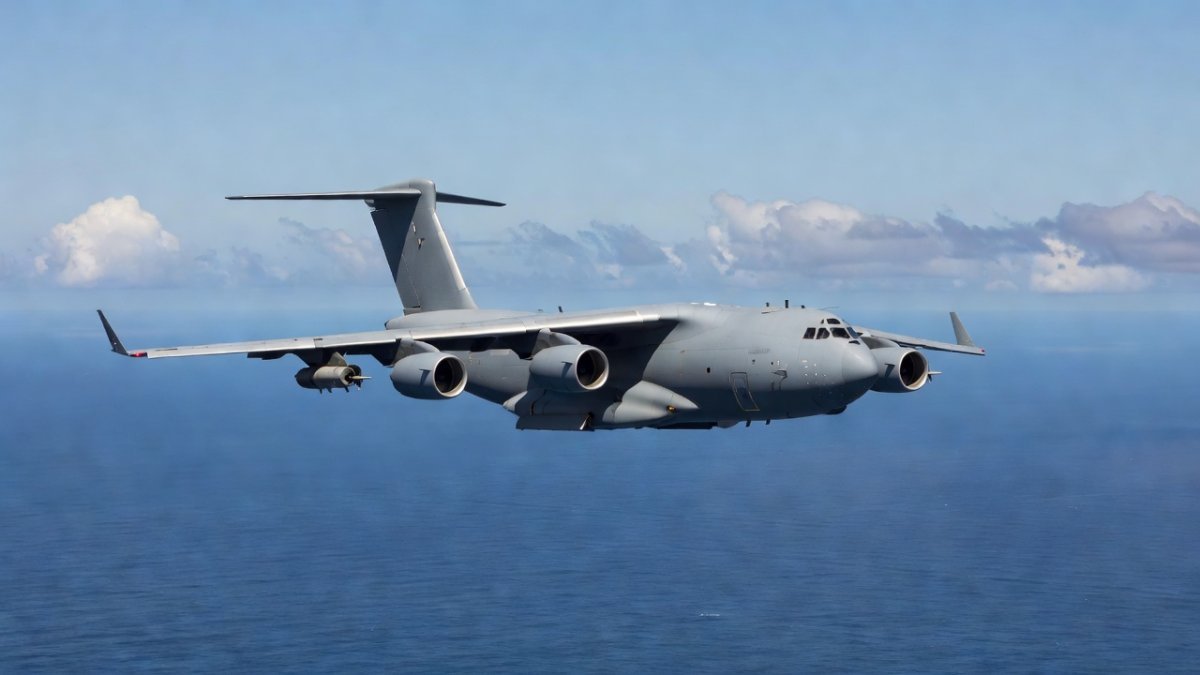
Beijing Confirms Convertible Tanker Role for Its Newest Heavy Transport
China has confirmed that its new Y-20B heavy transport aircraft can be converted into an aerial refuelling tanker, a capability that could extend People's Liberation Army Air Force operations deeper into the western Pacific. The confirmation, aired by state broadcaster CCTV in a documentary on August 5, marks the first official acknowledgment of a mission profile that open-source analysts had tracked for more than four years.
Tags: Y-20B, aerial refuelling, PLA Air Force, WS-20 engine, first island chain, western Pacific, YY-20A tanker, China military, Japan defense, KC-767J, power projection
What CCTV Revealed About the Convertible Transport
The CCTV programme said the Y-20B, an improved variant of China's Y-20 strategic transport powered by domestically developed WS-20 turbofan engines, could switch between transport and aerial refuelling missions using pallet-ready fuel tanks and removable refuelling equipment. The modular design means individual aircraft can be assigned to either role depending on mission demand, rather than requiring a separate, dedicated tanker fleet.
Andreas Rupprecht, an aviation analyst who specialises in the Chinese military, described the convertible design as offering "a tremendous boost" in capacity and flexibility. A common configuration could also simplify maintenance compared with operating separate Y-20A transports and YY-20A tankers, he noted. The YY-20A is the dedicated aerial-refuelling variant of the Y-20, known internationally as the Y-20U.
The concept itself is not unique to China. Europe's A400M military transport aircraft can also be reconfigured for aerial refuelling by fitting underwing refuelling pods while retaining its airlift role. What makes the Chinese case significant is the scale of the fleet behind it.
From Prototype Sighting to Official Status
The official confirmation aligns with a trail of open-source evidence stretching back to January 2022, when the third Y-20B prototype was spotted with in-flight refuelling pods. Further evidence emerged in April 2023, when the first Y-20B in standard military grey appeared at Kaifeng airbase bearing characteristic refuelling alignment markings.
Rupprecht said the Y-20B development showed how seriously the PLA Air Force was taking aerial refuelling after years of relatively limited capacity. Before the Y-20-derived tanker, the force relied primarily on a small fleet of H-6-based tankers and three imported Il-78s, which limited the scale of long-range operations it could support.
The CCTV programme highlighted the greater thrust and fuel efficiency of the Y-20B's WS-20 high-bypass turbofan engines. That could reduce the aircraft's own fuel consumption, potentially leaving more fuel available for transfer or allowing it to operate farther from base, although actual fuel-offload performance has not been made public.
Numbers Tell the Story of a Fleet in Expansion
The Pentagon's 2024 China Military Power Report estimated that the PLA operated 16 Y-20U tankers as of March that year, and said the tanker variant "significantly expands" China's ability to conduct long-range offensive air operations. The fleet has grown substantially since that assessment.
Rupprecht said open-source tracking had identified at least 35 individual YY-20A tankers, alongside more than 24 Y-20Bs capable of serving as multi-role tanker transports. He estimated that China now operates "a good 150 Y-20s of all versions", compared with a transport fleet that for years relied on little more than 30 Il-76s and three Il-78 tankers.
The same Pentagon report said PLA aviation missions were evolving from territorial defence towards offensive operations beyond the first island chain, while air force leaders had repeatedly called for a "strategic" air force capable of projecting power over long distances.
Operational Meaning Beyond the First Island Chain
By allowing commanders to draw on part of its expanding heavy-transport fleet during a contingency, the Y-20B could help sustain fighter sorties and other air operations beyond the first island chain and deeper into the western Pacific, as well as across the vast area covered by the PLA Western Theatre Command and over the South China Sea.
China fields large numbers of J-10, J-16 and J-20 fighters capable of receiving fuel in flight. Rupprecht said greater tanker availability would allow refuelling to be practised "more frequently and intensively than before", while supporting longer and more persistent operations. Another military expert, speaking on condition of anonymity, said additional tankers could be particularly useful closer to China for maintaining combat air patrols, allowing fighters to remain on station longer.
The implications extend to China's long-range strike forces. Recent official footage showed an H-6N strategic bomber carrying the JL-1 air-launched nuclear-capable ballistic missile, while separate footage released in June showed an H-6N receiving fuel from a Y-20-family tanker. Rand research has found PLA Air Force aircraft practising aerial refuelling during "distant sea" training beyond the first island chain, and a December 2025 report by the US Air Force's China Aerospace Studies Institute found refuelling being incorporated into flight-academy transition and combat-training programmes.
Japan's Calculus: A Small Dedicated Tanker Force
The contrast with Japan's own tanker posture sharpens the strategic significance. The Japan Air Self-Defense Force fields a comparatively small dedicated tanker force — four Boeing KC-767J aircraft operated by the 404th Tactical Airlift Tanker Squadron at Komaki Air Base in Aichi Prefecture. Japan's fleet has prioritised a limited number of multi-role platforms, while China is now building tanker capacity measured in dozens of aircraft drawn from a single common airframe.
For Japanese defence planners, the Y-20B development feeds directly into assessments of PLA power projection towards the Nansei island chain and the sea lanes of the western Pacific. Tokyo's 2026 defence white paper, released in early August, framed China as "an unprecedented and the greatest strategic challenge", citing expanding PLA air and naval activity around Japan. A tanker force able to sustain fighter and bomber operations farther from mainland bases underpins exactly the kind of long-range mission profile the white paper warns about.
Japan is responding through its own capability investments, including the introduction of KC-46A Pegasus tankers to modernise and gradually expand its refuelling capacity, and deeper trilateral air cooperation with the United States and Australia. But the structural gap in fleet scale remains: Japan is modernising a tanker force measured in single digits, while China is standardising on an airframe it already produces in volume.
What to Watch For
Several open questions will determine how quickly the convertible Y-20B changes the regional balance. Analysts noted that conversion time, how frequently aircraft switch between transport and tanker roles, and how much fuel a converted Y-20B can transfer have not been publicly disclosed. The anonymous expert said fuel-offload capacity would determine how many and what types of aircraft each tanker could support — whether, for example, it could refuel one bomber or several fighters.
CCTV also presented the tanker capability as part of a broader effort to use the Y-20 airframe for multiple missions. Pang Rongqi, an officer with a PLA Air Force unit, said the boundaries between transports, bombers, early-warning and electronic-warfare aircraft were "becoming increasingly blurred". Both experts cautioned that this more likely referred to using the Y-20B airframe as the basis for specialised variants, such as China's new airborne early-warning and control aircraft, rather than individual aircraft switching between all roles.
For Asia-Pacific readers, the practical question is no longer whether China can project air power beyond the first island chain, but at what scale and with what persistence. The Y-20B confirmation suggests Beijing intends to answer that question with a tanker fleet built on the economics of a mass-produced transport — a development Japan and its allies will be watching closely in the months ahead.
By Kenji Tanaka, Staff Writer
This article was produced with AI-assisted research and editorial support. Sources: South China Morning Post, Janes, Global Times, Pentagon China Military Power Report, Rand Corporation, US Air Force China Aerospace Studies Institute.
What's Your Reaction?
 Like
0
Like
0
 Dislike
0
Dislike
0
 Love
0
Love
0
 Funny
0
Funny
0
 Wow
0
Wow
0
 Sad
0
Sad
0
 Angry
0
Angry
0

Japan Correspondent at Global1.News. Tokyo-based voice covering Japanese politics, technology, economy, and culture. Tracks the intersection of tradition and innovation in one of the world's most dynamic societies.












Comments (0)