
Xokleng People Plant Sacred Brazilian Pines to Save a Critically Endangered Forest
The first time Carl Gakran watched his father speak to a pine cone, he didn't fully grasp the weight of the moment. It was just a seed, a tree, a forest that had always been there. But in the years since, that quiet conversation between a Xokleng elder and the sacred zág has grown into a movement of more than 140,000 seedlings, a reclamation of identity, and a defiant answer to centuries of violence.
The first time Carl Gakran watched his father speak to a pine cone, he didn't fully grasp the weight of the moment. It was just a seed, a tree, a forest that had always been there. But in the years since, that quiet conversation between a Xokleng elder and the sacred zág has grown into a movement of more than 140,000 seedlings, a reclamation of identity, and a defiant answer to centuries of violence. In the shadow of a critically endangered species, a people are planting their own survival.
In Brazil's Atlantic Forest, the Xokleng People Are Planting Their Future One Sacred Pine at a Time
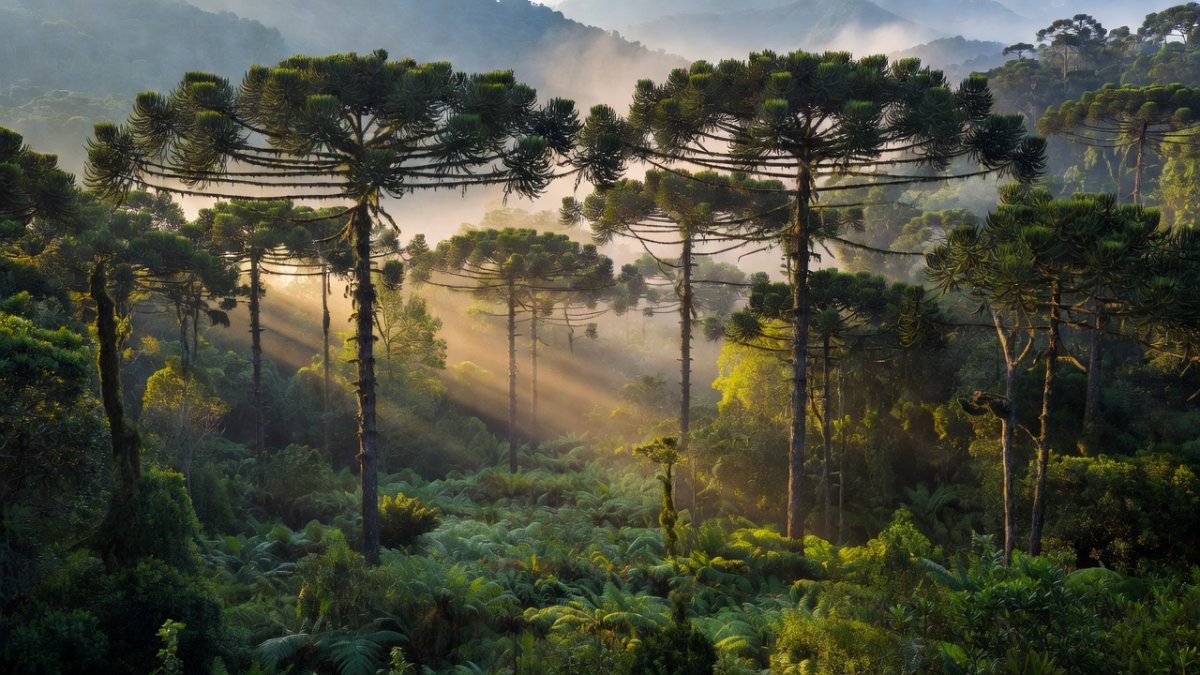
Ibirama-La Klãnõ Indigenous Territory, Santa Catarina, Brazil — August 2026 — The morning mist clings to the steep slopes of the Itajaí Valley, where the last great stands of the Brazilian pine once touched the sky. Here, in the 37,000-hectare Ibirama-La Klãnõ Indigenous Territory, the air smells of damp earth and the promise of rain. Carl Gakran, executive director of the Zág Institute, walks among rows of young araucaria trees, their distinctive umbrella-shaped canopies reaching just five meters into the air. To the untrained eye, they are simply saplings. To the Xokleng people, they are the physical manifestation of a creation story, a legal battle, and a legacy that will outlive them all.
"Brazilian pines are sacred to us," Gakran says, his hand resting on the rough bark of a ten-year-old tree. "You can't tell the story of our people without speaking of them. Our creation myth says the protective animal was made from that tree, so it appears in the very first story." That story, passed down through generations, is now being rewritten in the soil of Santa Catarina state, where the Xokleng (also known as the Laklãnõ) are leading one of the most culturally significant reforestation efforts in South America. It is a fight not just for a tree, but for the very soul of a people who have been pushed to the brink of extinction alongside the forest they call home.
A Sacred Tree on the Brink
The Araucaria angustifolia, known as zág in the Xokleng language and pinhão for its prized nut, is a living fossil. The species has been evolving for approximately 200 million years, predating the breakup of the supercontinent Gondwana. It is a towering giant that can exceed 50 meters (164 feet) in height, with a lifespan that can stretch for centuries. But its ancient resilience has been no match for the chainsaws of the modern era. The tree's seed, the pinhão, is a nutritional powerhouse, eaten by at least 22 animal species and by humans who rely on it for both sustenance and income. For the Xokleng, however, the tree is more than a food source; it is the axis around which their cosmology spins.
Gakran’s journey began in 2016, not with a grand plan, but with a quiet realization. He had learned that the Brazilian pine was critically endangered, decimated by deforestation, urban expansion, and relentless logging. The forests that once stretched in a green blanket across Paraná, Santa Catarina, and Rio Grande do Sul, with isolated patches in São Paulo, Minas Gerais, and Espírito Santo, had been reduced to a shadow of their former glory. "Just as our pine is endangered, my people are also endangered, and consequently our language and culture are endangered," Gakran says. The connection was undeniable. The tree and the people were bound in a shared fate, a symbiotic relationship that had been severed by colonization and greed. His initial goal was humble: plant ten trees on his home plot. It was an act of personal defiance, a seed of an idea that would soon take root.
Less Than 3 Percent of a Once-Mighty Forest
The numbers are stark, a testament to a century of ecological devastation. Brazilian pine forests now cover less than 3% of their original range. This is not a slow decline; it is a catastrophic collapse. The Atlantic Forest, one of the most biodiverse ecosystems on the planet, has been systematically dismantled since European colonization. The 1850 Land Law, as explained by Georgia Fontoura, head of the Regional University of Blumenau's Indigenous Studies Center, formalized the encroachment on Indigenous lands, leading to "violent persecution, massacres and forced displacement." The Itajaí Valley, where the Ibirama-La Klãnõ territory now sits, became one of the last refuges for the Laklãnõ people, a final stand against a tide of settlers and loggers.
The so-called "peaceful contact" by Brazil's Indian Protection Service in 1914 marked the end of the Laklãnõ's "forest era." It was a euphemism for a brutal transition. The people were displaced from their ancestral lands and concentrated into posts—first Posto Platê, then the Duque de Caxias Reserve, and finally the Ibirama-La Klãnõ territory that straddles the municipalities of José Boiteux, Doutor Pedrinho, Vitor Meireles, and Itaiópolis. The damage was compounded by the construction of the North Dam between the 1970s and 1990s, a state government project for flood control that was built without properly considering Indigenous impacts. The dam drastically altered the landscape, flooding ancestral lands and creating a new source of conflict over flood-gate decisions. Today, about 2,000 people live in 10 villages within the territory, representing the Laklãnõ/Xokleng, Guarani, and Kaingang peoples. They are surrounded by a landscape that has been fundamentally changed, but they are fighting to restore it.
The Zág Institute: From 10 Seedlings to 140,000
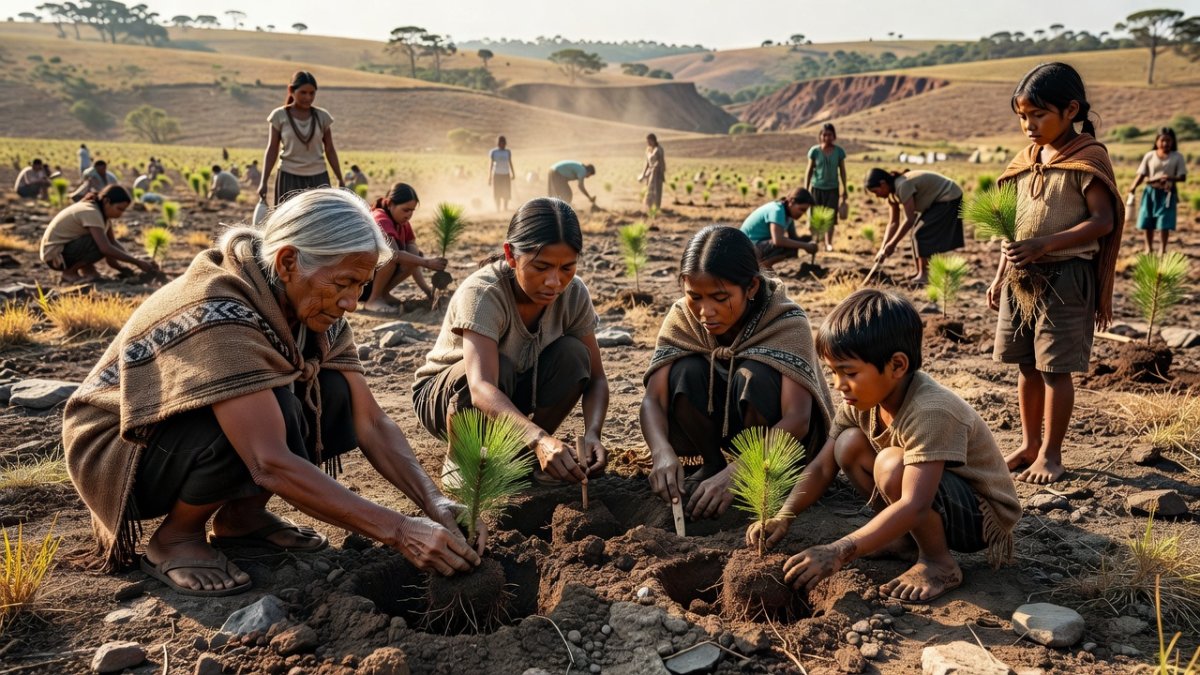
What began as a personal goal of ten trees quickly outgrew Gakran's home plot. He started holding workshops with friends, teaching them how to collect seeds and nurture seedlings. In that first year, they produced a little over 1,000 seedlings. Following his father's advice, they recorded the initiative, giving it a name and a structure. The next year, the Zág Institute was born, with Gakran's wife, Isabel, serving as vice president and environmental director. The growth since then has been exponential. The institute has now planted more than 140,000 seedlings across some 1,000 hectares (2,500 acres) of the territory, with survival rates of 70-80%—a remarkable achievement in the challenging conditions of the Atlantic Forest.
"From the start, our strategy was to involve the community, especially schools," Gakran explains. "As the tree is sacred, people adopt these seedlings, and the children who receive one will care for it as if it were a pet." This approach has transformed reforestation from a technical exercise into a cultural revival. The institute relies on a core group of 30-40 volunteers from several villages, a number that swells to 60 during the harvest and distribution season. The work is not just about planting trees; it is about reconnecting a people with their heritage. The seedlings are nurtured in a wooden structure under a thatched roof, protected by shade cloth. Each one is placed in a biodegradable bag made from sugarcane fiber, a sustainable alternative to plastic. The soil is enriched with organic fertilizers produced on the territory, closing a loop that honors the elders' knowledge of the land.
Planting as Resistance: Territory, Memory and the Law
The act of planting a tree in the Ibirama-La Klãnõ territory is never just about ecology; it is a political statement. The Xokleng have faced a long legal battle over their land rights, including a Supreme Federal Court case concerning a law that barred Indigenous groups from claiming land occupied after an October 5, 1988 cutoff date. The ruling has created a climate of uncertainty, but the Zág Institute has refused to be paralyzed by it. "As a way of demarcating our territory, we also plant trees in those areas," Gakran says. Each seedling is a marker, a living claim to a land that was stolen and must be returned.
Fontoura frames this reforestation as "a strategy of territorial, cultural and spiritual resistance in the face of the historic violence suffered throughout colonization, territorial confinement and environmental degradation." The trees are not just restoring the landscape; they are healing the wounds of history. The reforestation contributes to the recovery of water sources, protects the soil from erosion, and encourages the return of native species. It strengthens food sovereignty and provides a source of income for the community. But more than that, it is a way of reclaiming memory. The elders who remember the great forests are passing on their knowledge to a new generation. The children who plant a seedling today are learning that they are part of a story that did not begin with their birth and will not end with their death. The trees are a bridge between the past and the future, a physical manifestation of the community's determination to endure.
The Women Who Plant Zág
At the heart of this movement are the women. Isabel Gakran, Carl's wife and the institute's environmental director, notes that half of the active participants are women. They are known, affectionately, as "the women who plant zág." Their role extends beyond the physical act of planting. They are involved in every stage, from harvesting the cones to nurturing the seedlings in the nursery. But their participation is also about empowerment. The institute runs workshops in photography and technology, giving women new tools to document their work and share their stories with the world. These workshops are a form of resistance in themselves, challenging traditional gender roles and creating space for women's voices to be heard.
The women's connection to the zág is deeply personal. They speak to the seeds as they plant them, following the elders' knowledge that the trees respond to human intention. They perform harvest rituals, explaining to the seeds what is happening and why they are being taken. This is not superstition; it is a sophisticated understanding of the relationship between people and the natural world. The harvest is conducted with restraint—they take no more than 60% of the cones, leaving the rest for the animals and for the forest's own regeneration. This sustainable practice ensures that the trees are not depleted, and that the ecosystem remains healthy. The women are not just planting trees; they are cultivating a future for their children and their grandchildren, a future where the forest is abundant and the culture is strong.
Science, Elders' Knowledge and a Long-Term Legacy
The Zág Institute's success lies in its ability to blend traditional knowledge with modern science. The collection of seeds is a case in point. The cones mature between April and July, and the team uses tree-climbing techniques to access them, though they now prefer to collect cones that have fallen to the ground. In the past, they used climbing spikes, but these damaged the trees and encouraged fungal growth. The seeds are mixed from different trees to ensure genetic diversity, then buried to germinate. After a month, each seedling is transferred to its biodegradable bag. This meticulous process, guided by the elders' understanding of the forest, has resulted in the impressive survival rates that the institute has achieved.
The first trees planted by the institute are now ten years old, standing about five meters tall. They are still young, and Gakran is realistic about the long road ahead. "The results are satisfactory, but there is still a lot to come because the trees are young. It's a long-term thing, a legacy we inherited and will pass on to future generations." A mature Brazilian pine can live for centuries, so the work being done today will not be fully realized for generations. This is a project that requires patience and faith, a belief that the seeds planted today will grow into a forest that will shelter the Xokleng people for centuries to come. The institute is funded by grants and awards from organizations like the Rockefeller Foundation in the US and the Mohamed bin Zayed Species Conservation Fund in the UAE, as well as donations via social media. This external support is crucial, but the drive and the vision come from within the community.
The Bottom Line — What Comes Next
The Zág Institute is not resting on its laurels. The next steps are ambitious and multifaceted. They plan to improve their monitoring efforts using drones, computers, smartphones, and AI software to track the health of the planted areas and protect the territory from loggers and miners. They are also working to weed out exotic species, such as slash pines and eucalyptus, which have invaded the landscape, replacing them with native trees. In 2025, they began producing juçara palm seedlings, and they have short-term plans to cultivate sassafras, imbuia, and xaxim, a fern used to make traditional beer. The long-term vision includes ethnotourism, agroforestry, honey production from native bee species, and flour made from pine seeds. These initiatives are designed to create a sustainable economy that is rooted in the forest and the culture.
"Reforesting with araucarias is a whole movement that is now part of our people's identity," Gakran says. It is a movement that has transformed a people on the brink of losing everything into a beacon of hope for the world. The Xokleng are not just saving a tree; they are saving themselves. They are proving that the fight against climate change and biodiversity loss is inseparable from the fight for Indigenous rights and cultural survival. The Brazilian pine, once a symbol of loss, has become a symbol of resilience. As the young trees grow, they carry with them the stories, the prayers, and the determination of a people who refuse to disappear. The forest is returning, and with it, the soul of the Xokleng.
By Elena Vasquez, Staff Writer
This article was produced with AI-assisted research and editorial support. Reporting is based on sources cited in the article.
What's Your Reaction?
 Like
0
Like
0
 Dislike
0
Dislike
0
 Love
0
Love
0
 Funny
0
Funny
0
 Wow
0
Wow
0
 Sad
0
Sad
0
 Angry
0
Angry
0

Latin America Correspondent at Global1.News. Based in Mexico City, covering politics, economics, energy, and culture across the region. Brings an on-the-ground perspective to stories spanning from the Rio Grande to Patagonia.












Comments (0)