
MIT Finds First Black Hole Star in the Early Universe
Astronomers have discovered a brand-new class of cosmic object — a "black hole star" — that could finally explain the mysterious little red dots crowding NASA's deepest views of the early universe.
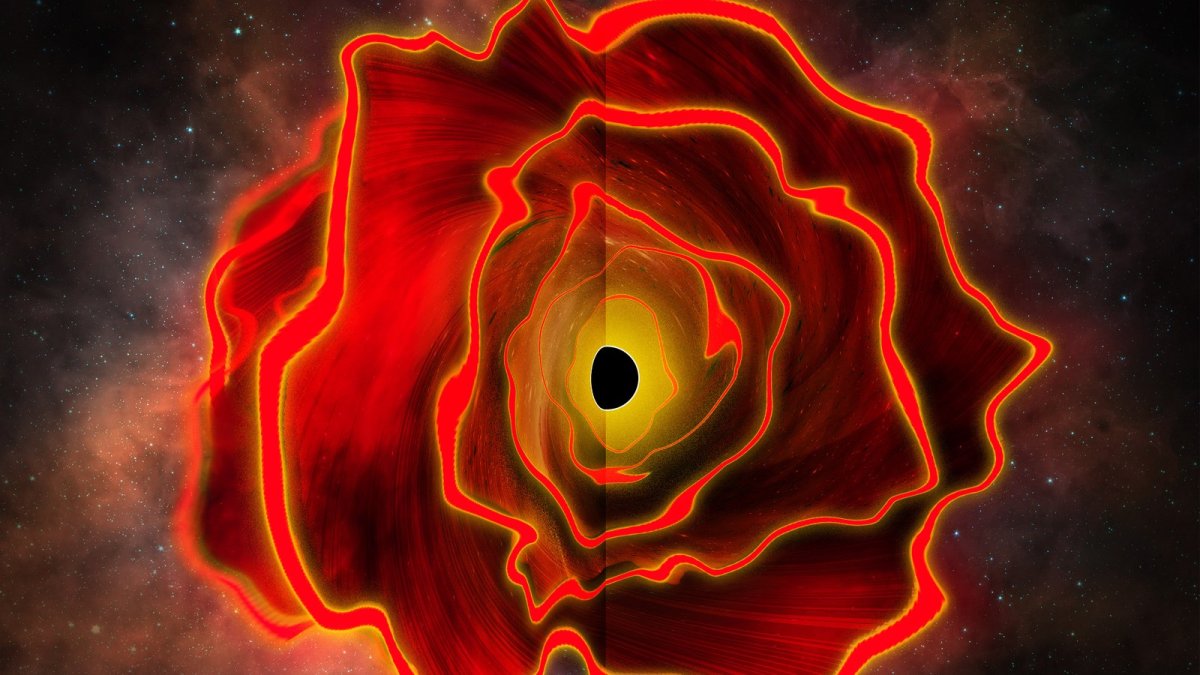
Astronomers have discovered a brand-new class of cosmic object — a "black hole star" — that could finally explain the mysterious little red dots crowding NASA's deepest views of the early universe. The object, designated MoM-BH*-1, shines 100 billion times brighter than an ordinary star and appears to be powered by a central black hole roughly 100,000 times the mass of the Sun.
MIT Finds First "Black Hole Star" in the Early Universe
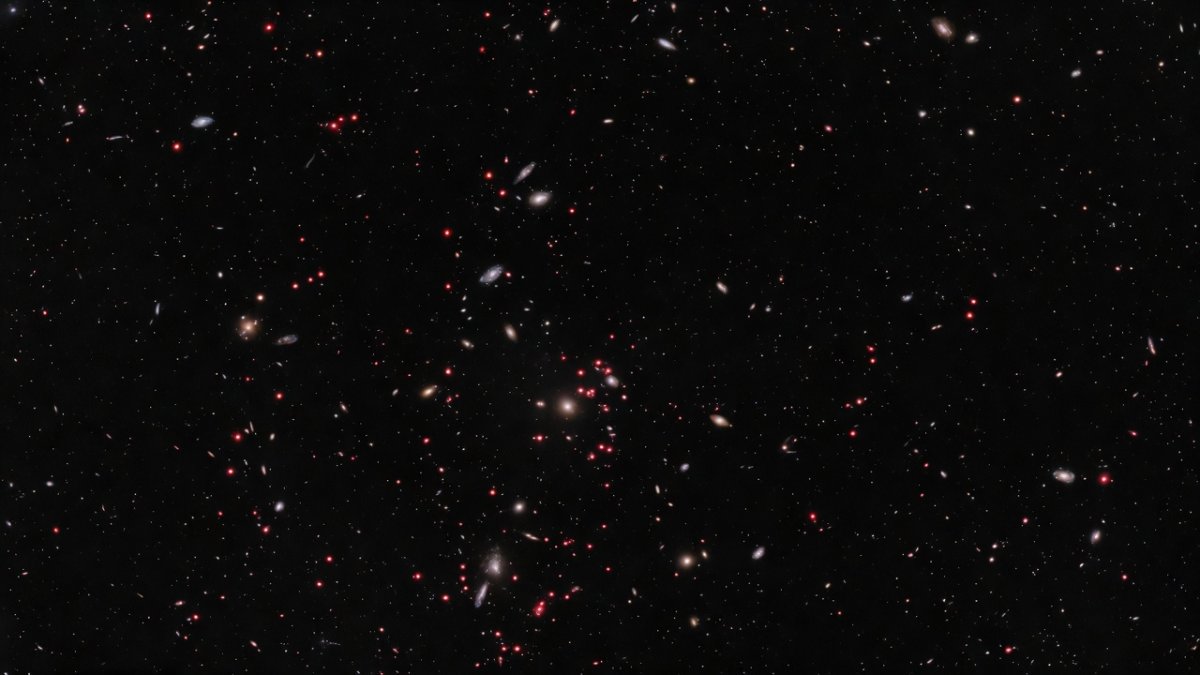
New Delhi – 14 August 2026 — In a discovery that could rewrite the earliest chapters of cosmic history, MIT astronomers using NASA’s James Webb Space Telescope (JWST) have identified a possible new class of celestial object: a "black hole star" — a colossal hydrogen cloud powered not by nuclear fusion but by a central black hole. The object, designated MoM-BH*-1, is a bright red dot seen just a few hundred million years after the Big Bang, and its existence may finally explain the mysterious "little red dots" that litter nearly every deep-space image JWST has captured.
The findings, published in the journal Nature on August 12, 2026, under the title "A Gas Enshrouded and Gas Reddened Black Hole at Cosmic Dawn," represent the first observational evidence of a hybrid object that theorists have long speculated about but never seen. For Indian astrophysicists and students tracking the frontiers of black-hole physics, the discovery is a landmark — one that connects directly to the legacy of Meghnad Saha and the future of Indian space observatories.
A Red Dot That Defied Explanation
The team, led by Rohan Naidu, a NASA Hubble Fellow and Pappalardo Fellow at MIT’s Kavli Institute for Astrophysics and Space Research (MKI), did not set out to find a black hole star. They were conducting a survey named "Mirage or Miracle" (MoM), designed to hunt for the most distant, earliest galaxies in the universe. The goal was to distinguish genuine primordial galaxies from objects that merely appear to be early galaxies due to dust reddening or other effects.
But as they scanned JWST’s deep-field images, one source stood out: a dot that was exceptionally red and exceptionally bright. "When we see something very red in the universe, we often assume that it is surrounded by dust, like soot or ash," explained Robert Simcoe, MKI Director and the Bruno B. Rossi Professor of Experimental Physics at MIT, a co-author of the study. "The same way that the wildfire smoke from Canada recently made the sky in Boston look bright red, astronomical objects can also appear redder than their intrinsic color when you see them through a veil of dust."
Yet the spectral signatures did not match a dust-reddened galaxy. The object’s light was extraordinarily bright — roughly 100 billion times brighter than an ordinary star — but it dropped off sharply below certain wavelengths, a feature known as a "Balmer break." This break, traditionally associated with dense gas absorbing photons in stellar atmospheres, was the deepest ever observed in any astronomical object. "The break we observed in this object is the deepest break we have ever observed in any object, ruling out 'ordinary' stars as the source," Naidu said.
The Physics of Hydrogen: A Nod to Meghnad Saha
For Indian physicists, the Balmer break carries a familiar resonance. The physics of why hydrogen absorbs light at specific wavelengths — and why dense hydrogen screens out certain photons — is rooted in the ionization equation developed by Meghnad Saha at Allahabad in 1920. The Saha equation, which describes the ionization state of a gas in thermal equilibrium, underpins the entire field of stellar atmospheres. It is the reason astronomers can read the composition and temperature of stars from their spectra, and it is the same physics that allowed Naidu’s team to conclude that MoM-BH*-1’s spectrum contained almost no elements other than hydrogen and helium.
"It was truly singular in so many ways," Naidu said. The absence of metals — elements heavier than helium — ruled out a dusty, evolved galaxy. The extreme brightness ruled out nuclear fusion as the energy source. The only scenario that fit all the data was a black hole star: a central black hole roughly 100,000 times as massive as the Sun, surrounded by a dense, star-like cocoon of hydrogen about the size of the solar system.
The team ran extensive simulations, varying the black hole’s mass and the density of the hydrogen envelope, and compared the resulting brightness with JWST’s observations. The closest match was a black hole star. "You have something that looks a bit like a star but is 100 billion times brighter," Naidu said. "That means you can’t be powering this by nuclear fusion, which is the energy source that sits at the heart of all the stars we have."
Solving the Mystery of the Little Red Dots
The discovery has implications far beyond a single object. Since JWST began operations, its deep-field images have been dominated by "little red dots" — compact, red sources that appear everywhere in the early universe but essentially vanish by the present day. Their identity has been one of the most debated topics of the JWST era. Naidu and his colleagues now argue that many of these dots could be black hole stars, embedded in ordinary early galaxies but outshining their hosts.
"Every little red dot is consistent with being a black hole star, embedded in a generic early galaxy," Naidu said. "But what is special about MoM-BH*-1 is, the black hole star is essentially completely outshining its surrounding host galaxy, such that we’re seeing pure black hole star light."
The team has named the object MoM-BH*-1, after the survey that detected it, with the asterisk signalling "black hole star — one," implying it is the first of a new class. The researchers suspect that black hole stars could explain many of the other little red dots, which are not as bright as MoM-BH*-1 but share similar spectral features.
What This Means for Galaxy Formation and Life Itself
The implications extend to the very architecture of the cosmos. Black hole stars may have governed when stars were able to form and when they ceased forming in the early universe. "They may govern when stars are able to form and when they cease forming, setting the course for everything that follows from star formation: the birth of planets, the rise of life, the emergence of species that may one day piece together this entire history," Naidu told The Guardian.
If every massive black hole — including the one at the centre of the Milky Way — passed through a black-hole-star phase, then this channel of black hole formation must be extremely common. "We argue that Black Hole Stars may be powering all of JWST's Little Red Dots that are found almost everywhere in the early Universe," Naidu told Mashable. "Which is to say, this channel of making massive black holes must be very common, to the point where every massive black hole (like the Milky Way's) may have gone through this phase."
That would rewrite the standard model of black hole seed formation, which has struggled to explain how supermassive black holes grew so quickly in the early universe. A black hole star, with its dense hydrogen cocoon funneling matter into a central black hole, could provide the rapid accretion needed to build a billion-solar-mass black hole within a few hundred million years of the Big Bang.
India’s Role in the Next Generation of Cosmic Discovery
For India, the discovery underscores the growing importance of space-based observatories and the need for homegrown capabilities. ISRO’s AstroSat, launched in 2015, has made significant contributions to ultraviolet and X-ray astronomy, but it lacks the infrared sensitivity of JWST. The upcoming XPoSat mission, dedicated to X-ray polarimetry, will study black hole accretion disks and neutron stars, but it cannot probe the earliest epochs of the universe.
Indian institutions are already deeply engaged in the physics of black holes and the early universe. The Inter-University Centre for Astronomy and Astrophysics (IUCAA) in Pune, the Tata Institute of Fundamental Research (TIFR) in Mumbai, the National Centre for Radio Astrophysics (NCRA-TIFR) in Pune, the Indian Institute of Astrophysics in Bengaluru, and the Aryabhatta Research Institute of Observational Sciences (ARIES) in Nainital all have active research groups in these areas. The planned LIGO-India gravitational-wave observatory in Hingoli, Maharashtra, will add a new dimension, allowing Indian scientists to detect the mergers of black holes that may have originated as black hole stars.
But the discovery of MoM-BH*-1 also highlights a gap. India does not yet have a space telescope capable of deep infrared observations comparable to JWST. The next generation of space telescopes — including the proposed Indian Space Observatory and potential collaborations on future NASA and ESA missions — will be critical if Indian researchers are to participate directly in discoveries like this one. For Indian students, the message is clear: the physics of the early universe is being written now, and the tools to read it are within reach.
The Bottom Line
The discovery of MoM-BH*-1 is a watershed moment in astrophysics. It provides the first observational evidence for a black hole star — a central black hole 100,000 times the Sun’s mass, wrapped in a hydrogen cocoon the size of the solar system, shining 100 billion times brighter than an ordinary star. The object’s spectrum, with the deepest Balmer break ever observed and a composition of pure hydrogen and helium, rules out all conventional explanations. The paper in Nature is not just a new data point; it is a new category of cosmic object.
For India, the discovery is a reminder of the power of fundamental physics — the same physics that Meghnad Saha illuminated a century ago — and a call to invest in the next generation of space observatories. As Naidu put it, the picture of this object is evolving very rapidly. The first black hole star has been found. The question now is how many more are waiting in the red dots of the early universe.
This article was produced with AI-assisted research and editorial support. Sources: MIT News (August 12, 2026), NDTV (August 14, 2026), Nature.
— By Dr. Raj Patel, Staff Writer
What's Your Reaction?
 Like
0
Like
0
 Dislike
0
Dislike
0
 Love
0
Love
0
 Funny
0
Funny
0
 Wow
0
Wow
0
 Sad
0
Sad
0
 Angry
0
Angry
0

India/South Asia Correspondent at Global1.News. Analytical voice with a background in science and health journalism. Based in New Delhi, covering Indian politics, education, healthcare, technology, and policy. Breaks down complex data into clear, actionable reporting.















Comments (0)