
Vibra-Signe: How Burkina Faso's Deaf Dancers Turn Vibrations Into Art
In Bobo-Dioulasso, Burkina Faso, a stage comes alive to the beat of drums and djembe — yet many of the dancers cannot hear a single note. Compagnie Fientan, a troupe made up entirely of deaf and hard-of-hearing artists, has become one of West Africa's most striking examples of inclusive contemporary dance, feeling the music through the ground beneath their bare feet, through touch, and through the language of sign.
In Bobo-Dioulasso, Burkina Faso, a stage comes alive to the beat of drums and djembe — yet many of the dancers cannot hear a single note. Compagnie Fientan, a troupe made up entirely of deaf and hard-of-hearing artists, has become one of West Africa's most striking examples of inclusive contemporary dance, feeling the music through the ground beneath their bare feet, through touch, and through the language of sign.
Vibra-Signe: How Burkina Faso's Deaf Dancers Turn Vibrations Into Art
Bobo-Dioulasso, Burkina Faso — What began as one choreographer's private question — how could the deaf young people of his neighbourhood join the dance traditions at the heart of Burkinabè culture? — has grown into Vibra-Signe, an award-winning method that has carried this company from a courtyard in Bobo-Dioulasso to a gold medal on an international stage.
Dancing Beyond Sound: How Vibra-Signe Works
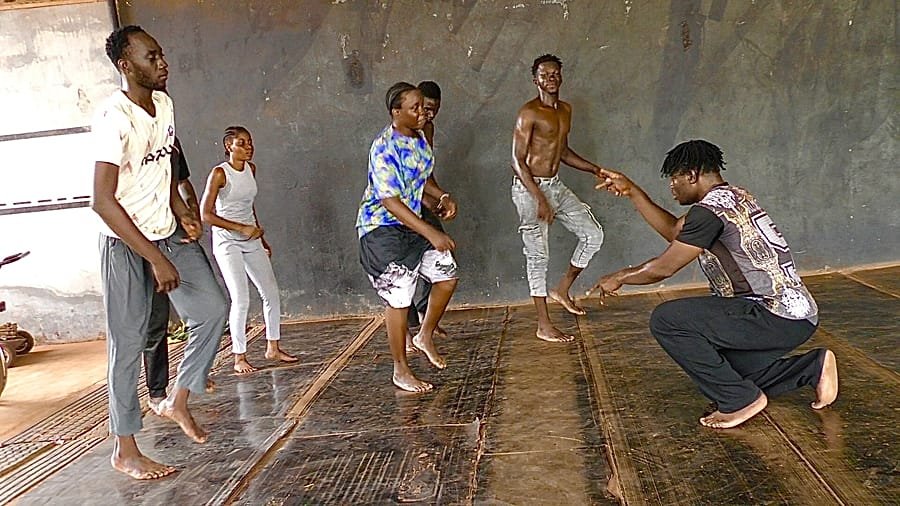
When Compagnie Fientan performs, the stage floor becomes a living instrument. The drummers strike their djembe with force, and the dancers — all of them deaf or hard of hearing — move in perfect synchrony, their bare feet pressed firmly against the wooden surface. They are not guessing the rhythm; they are reading it through their soles, feeling every pulse as it travels through the ground and up into their bodies.
The technique at the heart of this magic is called Vibra-Signe, developed by choreographer Yaya Sanou. It is a three-part method that combines sign language, vibrations from the floor, and physical touch. Each element plays a distinct role: sign language shapes the visual vocabulary of the choreography, the floor delivers the musical pulse, and touch allows Sanou to transmit tempo corrections in real time during rehearsals and even during performances.
Sanou explains the method with the precision of a master craftsman. "Sign language allows us to sign the dance. To work with the music, I work with the touch of the body and the relationship to the ground. When bare feet are placed on the ground, you feel the vibrations," he told africanews correspondents Ali Bamba and Steven Midjola, who produced a report on the company. This is not a simplified version of hearing dance — it is a complete reimagining of how musicality can be accessed.
During rehearsals in Bobo-Dioulasso, Burkina Faso's second-largest city, Sanou moves among his dancers like a conductor without a baton. He taps their shoulders, their arms, their backs — each touch carrying information about tempo, accent, and phrasing. The dancers respond instantly, their bodies translating these tactile signals into sweeping movements that fill the stage with energy and intention.
What makes Vibra-Signe genuinely revolutionary is that it does not ask deaf dancers to imitate hearing dancers. Instead, it builds a new physical language from the ground up, one where silence is not an obstacle but a canvas. The result is a style of contemporary dance that could only exist because of the unique perspective of its creators — a point of pride for the company and a lesson for the wider dance world.
A Technique Born From a Neighbourhood Question
Yaya Sanou did not set out to invent a new dance method. He is a Burkinabè choreographer from Bobo-Dioulasso, a city known for its vibrant cultural life and deep musical traditions. Growing up, he was surrounded by the rhythms that define West African identity — the drums at celebrations, the dance at weddings, the music that marks every milestone of life. But as he looked around his own neighbourhood, he noticed something that troubled him.
The deaf young people in his quarter were being left out of these traditions. They could see the dancing, but they could not access the music that drove it. They were spectators at a celebration that should have been theirs. Sanou felt this exclusion personally, and it sparked a question that would change his life and theirs.
"In my culture, we have always grown up with music and dance. I asked myself how to allow them to dance with the music," Sanou recalls. That question, simple and profound, set him on a path of experimentation. He began working with deaf youth in Bobo-Dioulasso, trying different approaches, failing, adjusting, and trying again. Each small breakthrough — a dancer feeling a vibration, a movement aligning with a beat — built toward something larger.
In 2018, Sanou founded Compagnie Fientan in Bobo-Dioulasso, bringing together a group of deaf and hard-of-hearing dancers who shared his vision. The company's name and reputation grew as the method took shape, eventually earning the name Vibra-Signe. What started as a neighbourhood initiative became a structured technique, refined through years of practice and performance.
The philosophy behind Vibra-Signe is that silence is not a lack to be compensated for but a creative starting point. Where a hearing choreographer might begin with a melody, Sanou begins with a question: how can this movement be felt? The answers have produced a body of work that stands on its own artistic merit, not as a charitable exercise but as a genuine contribution to contemporary dance in Africa and beyond.
Dance as Freedom: The Company's Voice
For the dancers of Compagnie Fientan, dance is far more than entertainment. It is communication, emancipation, and self-affirmation rolled into one. Through their art, they speak to audiences who might otherwise never encounter a deaf person's perspective, and they do so with a confidence that commands respect.
Dancer Sanou Waramata, speaking through a sign-language interpreter, put it plainly: dance helps her blossom, communicate, and tell her story. She said she feels truly free when she performs — a statement that carries weight in a world where disabled artists are often marginalised or pitied rather than celebrated. On stage, Waramata is not a subject of sympathy; she is a powerful presence who controls the space around her.
The company's shows are not abstract exercises in movement. They tell stories — stories of the dancers' relationship to the world, their struggles, their joys, and their dreams. Each performance is a narrative built from the body, a language that transcends the barriers that deaf people face in everyday life. The stage becomes a place where those barriers simply do not exist.
Learning and rehearsing with Compagnie Fientan requires a different kind of discipline. The dancers must develop an acute sensitivity to vibration and touch, skills that hearing dancers rarely cultivate. They must trust their choreographer completely, reading his signals through their skin. This intimacy creates a bond within the company that is visible in every performance.
For Sanou, dance is a complete language — artistic, social, and political. It challenges assumptions about what deaf people can do, and it does so through beauty rather than argument. The company's existence is a statement that culture is not decorative but a tool of autonomy, a way for marginalised communities to claim their place in society.
Gold in Kinshasa: A Recognition That Echoes
In the summer of 2023, Compagnie Fientan travelled to the Democratic Republic of Congo for the IXes Jeux de la Francophonie, held in Kinshasa from 28 July to 6 August. The Francophonie Games bring together artists and athletes from across the French-speaking world, and the competition in choreographic creation was fierce. When the results were announced, the gold medal went to Burkina Faso — to Compagnie Fientan.
The winning piece was "Adepte de mon être," a work that draws on the journey and challenges of deaf and hard-of-hearing dancers. It is a deeply personal piece, rooted in the lived experience of the company members, and it resonated with audiences and judges alike. The gold medal was not a consolation prize or a diversity award; it was recognition of artistic excellence at the highest level.
The significance of this victory extends far beyond the medal itself. It proved that disabled artists can compete and win on international stages, not just participate. It sent a signal across francophone Africa that cultural accessibility is not a niche concern but a source of strength and innovation. And it positioned Burkina Faso as a country of production and experimentation, not just a place defined by crisis.
For the dancers, the gold medal was a validation of everything they had worked for. They returned to Bobo-Dioulasso as champions, their achievement celebrated not just within the deaf community but across the nation. The recognition echoed through the corridors of cultural institutions and government offices, forcing a conversation about what inclusive art can achieve.
The victory in Kinshasa also raised the company's international profile. Compagnie Fientan is now a reference for inclusive contemporary dance in Burkina Faso and beyond, and invitations to perform and teach have followed. The gold medal opened doors that might otherwise have remained closed, and the company is determined to walk through them.
Inclusion and Culture: What Burkina Faso Teaches the Continent
Burkina Faso has long been a cultural powerhouse in West Africa, home to FESPACO, the Pan-African Film and Television Festival of Ouagadougou, one of the continent's most important cultural institutions. The country's commitment to artistic expression runs deep, and Compagnie Fientan is building on that foundation in new and exciting ways.
The company does not work in a vacuum. Burkina Faso has associative and educational structures working on sign language and access to culture, and these networks have supported Fientan's growth. The relationship between the company and these institutions is symbiotic: the structures provide a framework, and the company demonstrates what is possible when that framework is used creatively.
Across West Africa, dance and music traditions are passed down through generations, forming the cultural DNA of the region. Senegal's own heritage — the pulsing rhythms of Mbalax, the global voice of Youssou N'Dour, the annual Saint-Louis Jazz Festival — shares this same rhythm-centred foundation. What Vibra-Signe shows is that these traditions can be made accessible to everyone, including those who cannot hear the music.
The pan-African question is how to make accessibility durable. It is not enough for one company to succeed; the methods and lessons need to spread. Art schools across the continent should be teaching inclusive techniques. Festivals should be programming deaf and disabled artists as a matter of course. Public policy should support these efforts with funding and institutional backing.
The ECOWAS dimension is also important. Artists and audiences circulate across West African borders, and the success of Compagnie Fientan in Kinshasa shows that inclusive creativity resonates from Dakar to Lagos and beyond. The company's work is part of a larger movement toward a more inclusive African cultural landscape, one where every citizen can participate in the artistic life of the continent.
What to Watch For
Compagnie Fientan shows no signs of slowing down. The company has touring ambitions that extend well beyond Burkina Faso, and the gold medal in Kinshasa has given them momentum. They are eager to share Vibra-Signe with other troupes and communities, spreading the method across the continent and the diaspora.
The conversation about inclusive arts across Africa is growing, and Fientan is at the centre of it. Other troupes are beginning to ask how they might adopt similar methods, and Sanou is generous with his knowledge. The technique is not a secret to be guarded but a gift to be shared, and the company's willingness to teach is expanding the impact of their work.
Funding and institutional support remain challenges. Inclusive companies like Fientan show that accessibility in the arts can produce works that are celebrated and exportable, but they still struggle to secure the resources they need. Governments and cultural organisations across Africa have an opportunity to invest in this potential, and the returns would be measured not just in awards but in social transformation.
Audiences across the continent and the diaspora can support inclusive companies by attending their performances, inviting them to festivals, and demanding that cultural institutions prioritise accessibility. Every ticket sold, every invitation extended, every conversation started is a step toward a more inclusive cultural landscape.
As the sun sets over Bobo-Dioulasso, the drums still beat, and the dancers of Compagnie Fientan still move to rhythms they cannot hear but feel deeply. Their art is a celebration of what is possible when creativity meets determination, and it is a reminder that African culture has always found ways to include everyone. From the courtyards of Burkina Faso to the grand stages of the Francophonie, Vibra-Signe is dancing a new future into being — one vibration at a time.
By Amara Diop, Staff Writer
This article was produced with AI-assisted research and editorial support. Reporting is based on sources cited in the article.
What's Your Reaction?
 Like
0
Like
0
 Dislike
0
Dislike
0
 Love
0
Love
0
 Funny
0
Funny
0
 Wow
0
Wow
0
 Sad
0
Sad
0
 Angry
0
Angry
0
West Africa/Sahel Correspondent at Global1.News. Dakar-based journalist covering politics, security, climate, and development across Francophone and Anglophone West Africa. Tells the stories of a region undergoing profound transformation.











Comments (0)