
Guinea's President Doumbouya Dismisses 173 Soldiers, Including Key Coup Ally, in Bid to Cement Power
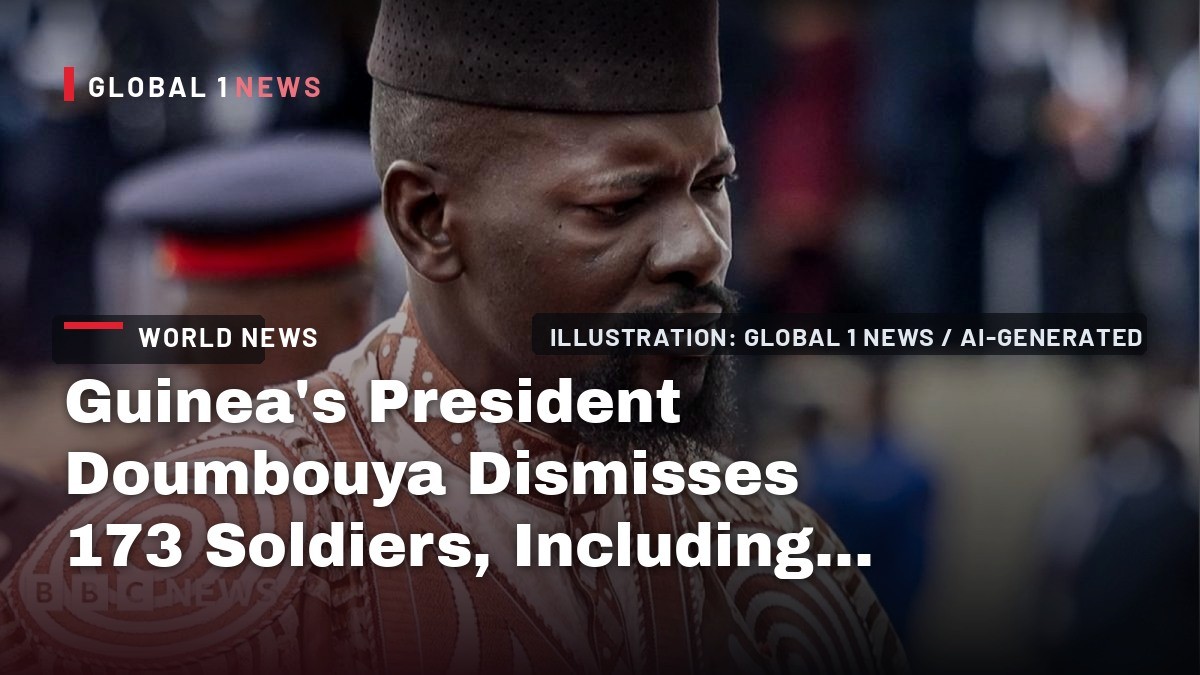
Guinea's President Doumbouya Dismisses 173 Soldiers, Including Key Coup Ally, in Bid to Cement Power CONAKRY — Guinea's President Mamadi Doumbouya has dismissed more than 170 soldiers for "desertion," a sweeping purge that has reached into the inner circle of the very unit that helped him seize power in a 2021 coup.
Guinea's President Doumbouya Dismisses 173 Soldiers, Including Key Coup Ally, in Bid to Cement Power
CONAKRY — Guinea's President Mamadi Doumbouya has dismissed more than 170 soldiers for "desertion," a sweeping purge that has reached into the inner circle of the very unit that helped him seize power in a 2021 coup. The dismissals, announced in a decree read on state television on Monday, mark the latest and most significant step in the former junta leader's efforts to consolidate control ahead of a promised return to civilian rule that has yet to materialize.
The decree, read by the president's spokesman, Gen Amara Camara, removes 173 military personnel from various branches of the armed forces. Among those dismissed is Col Michel Lamah, a member of the elite Special Forces Group (GFS) — the unit Doumbouya once commanded — who gained international attention during the September 2021 coup when he was photographed in a vehicle carrying deposed President Alpha Conde. No details were provided regarding the circumstances of the alleged desertions, leaving analysts to interpret the move as a calculated political maneuver rather than a routine disciplinary action.
Who Is Mamadi Doumbouya?
Mamadi Doumbouya, now 41, is a former French Foreign Legion officer who returned to Guinea and rose through the ranks of the country's military. He commanded the Special Forces Group, an elite unit trained for counter-terrorism and rapid response operations. On 5 September 2021, Doumbouya led a group of soldiers in storming the presidential palace in Conakry, arresting President Alpha Conde and announcing the dissolution of the government and constitution.
In his first public address after the coup, Doumbouya appeared on state television draped in the Guinean flag, surrounded by soldiers, and declared that the military had seized power to end the country's "endemic corruption" and political instability. He promised a swift transition back to civilian rule, stating that he would not seek election and would hand over power to a democratically elected government within a reasonable timeframe.
That promise has since been broken. In December 2025, Doumbouya stood as a candidate in the presidential election — a vote that he won with a landslide, securing 87% of the ballot. The election was boycotted by several opposition parties and marred by allegations of irregularities, with two of Guinea's largest opposition parties — the RPG Arc en Ciel and the UFDG — excluded from participating.
The Significance of Dismissing Col Michel Lamah
The dismissal of Col Michel Lamah carries particular weight. Lamah was not merely a soldier in the GFS; he was a visible symbol of the 2021 coup. The photograph of Lamah in a vehicle with the deposed President Conde, taken in the immediate aftermath of the palace storming, became one of the defining images of the takeover. It signaled to the world that the old order had fallen and that a new military hierarchy was in charge.
Lamah's removal from the military suggests that Doumbouya is now willing to turn on even those who were instrumental in his rise to power. Analysts view this as a clear signal that the president is prioritizing loyalty to his person over loyalty to the coup's original objectives. The GFS, which Doumbouya once led, has been a key pillar of his support base; purging a prominent member of that unit sends a message that no one is untouchable.
The dismissals also come at a time when Doumbouya is seeking to transform Guinea's political landscape. By removing potential rivals within the military, he reduces the risk of a counter-coup or internal challenges to his leadership. The lack of detail about the alleged desertions — no dates, locations, or specific circumstances were given — further suggests that the decree is less about military discipline and more about political consolidation.
The Broken Promise of Civilian Rule
Doumbouya's path from coup leader to elected president has been marked by a series of broken promises and shifting timelines. In the months following the 2021 coup, he faced intense pressure from the Economic Community of West African States (ECOWAS) and the African Union to restore civilian rule quickly. Initially, he set a transition timeline of 24 months, which was later extended under the guise of needing more time to implement reforms.
By 2024, it had become clear that Doumbouya intended to remain in power. He announced that he would run in the December 2025 election, a direct reversal of his earlier pledge. The election itself was deeply contested. The RPG Arc en Ciel, the party of former President Conde, and the UFDG, led by opposition figure Cellou Dalein Diallo, were both barred from fielding candidates. International observers noted significant irregularities, including voter intimidation and a lack of transparency in the vote count.
Doumbouya's landslide victory, with 87% of the vote, was met with skepticism both domestically and internationally. While his supporters hailed it as a mandate for change, critics argued that the exclusion of major opposition parties rendered the result meaningless. The United Nations and several Western governments expressed concern, but stopped short of imposing sanctions, reflecting a broader reluctance to isolate a country with significant mineral wealth.
The Broader Crackdown on Civil Liberties
Since the 2021 coup, Guinea has witnessed a steady erosion of civil liberties. The military government has shut down multiple media outlets, banned protests, and suspended several political parties. Journalists who have attempted to report critically on the government have faced harassment, detention, and exile. The crackdown has extended to civil society organizations, with activists and opposition figures either arrested or forced to flee the country.
The December 2025 election was held in this climate of repression. The exclusion of the RPG Arc en Ciel and the UFDG effectively removed any credible opposition from the ballot, leaving Doumbouya to face a field of largely unknown or marginal candidates. The government defended the exclusions on technical grounds, citing alleged irregularities in party registration, but critics saw it as a transparent attempt to rig the electoral process.
The dismissals of the 173 soldiers must be viewed within this broader context. By purging the military of potential dissidents, Doumbouya is not only securing his own position but also sending a message to any remaining opposition — civilian or military — that dissent will not be tolerated.
Guinea's Mineral Wealth and Doumbouya's Industrial Ambitions
Guinea is one of the world's most resource-rich countries, holding the largest reserves of bauxite — the primary ore used to produce aluminum — on the planet. The country also possesses significant deposits of iron ore, gold, and diamonds. For decades, Guinea has functioned primarily as a supplier of raw materials, exporting unprocessed minerals to international markets, particularly China and other Asian economies.
Doumbouya has made it a central goal of his presidency to change this dynamic. Over the last five years, he has pushed for the development of domestic processing facilities, aiming to transform Guinea from a raw material exporter into an industrial processing hub. This strategy is designed to capture more value from the country's mineral wealth, create jobs, and reduce dependence on foreign buyers.
The plan has had mixed results. While some international companies have expressed interest in building alumina refineries and other processing plants in Guinea, progress has been slow. The country's infrastructure remains underdeveloped, and the political instability since the coup has deterred some investors. Nevertheless, Doumbouya has continued to court foreign investment, particularly from Chinese and Middle Eastern firms, offering favorable terms in exchange for commitments to build local processing capacity.
The military dismissals could have implications for this economic agenda. A stable, loyal military is seen by many investors as a prerequisite for long-term investment. By consolidating his control over the armed forces, Doumbouya may be seeking to project an image of stability and decisiveness to attract the capital needed to realize his industrial ambitions.
Implications for West African Democracy
The situation in Guinea is being closely watched across West Africa, a region that has seen a wave of military takeovers in recent years. Coups in Mali, Burkina Faso, and Niger have raised fears of a democratic backslide, and Guinea's trajectory under Doumbouya has done little to allay those concerns. The pattern is familiar: a military leader seizes power, promises a swift return to civilian rule, then clings to power through manipulated elections and repression.
For Senegal, Guinea's neighbor to the north, the developments are particularly significant. Senegal has long been considered a stable democracy in a volatile region, but the pressures that have driven military takeovers elsewhere — corruption, youth unemployment, and political polarization — are not absent there. The Guinean example serves as a cautionary tale about the fragility of democratic institutions when leaders are willing to discard constitutional norms.
The international community's response to Doumbouya's consolidation of power has been muted. ECOWAS, which has taken a hard line against coups in other member states, has been notably less forceful in its response to Guinea. This inconsistency undermines the bloc's credibility and sends a signal that military takeovers can succeed if the leader is willing to hold a sham election.
What Comes Next for Guinea?
The dismissal of 173 soldiers, including a key coup ally, suggests that Doumbouya is entering a new phase of his rule. Having secured the presidency through the December election, he is now focused on eliminating any potential threats to his authority. The military, which was once his power base, is now being reshaped to ensure absolute loyalty.
There are no indications that Doumbouya intends to step down or share power. His industrial ambitions, while potentially transformative for Guinea's economy, are likely to be pursued within a framework of authoritarian control. The crackdown on civil liberties is expected to continue, and opposition figures remain in exile or under threat of arrest.
For the people of Guinea, the promise of the 2021 coup — an end to corruption and a transition to democratic governance — remains unfulfilled. Instead, the country has seen a consolidation of power that mirrors the very abuses the coup was supposed to address. The dismissals of the 173 soldiers are a reminder that in Guinea, as in much of West Africa, the path to power is often paved with broken promises and the silencing of dissent.
By Amara Diop, Staff Writer
This article was produced with AI-assisted research and editorial support. Sources: BBC News.
What's Your Reaction?
 Like
0
Like
0
 Dislike
0
Dislike
0
 Love
0
Love
0
 Funny
0
Funny
0
 Wow
0
Wow
0
 Sad
0
Sad
0
 Angry
0
Angry
0
West Africa/Sahel Correspondent at Global1.News. Dakar-based journalist covering politics, security, climate, and development across Francophone and Anglophone West Africa. Tells the stories of a region undergoing profound transformation.











Comments (0)