
US Air Force Awards $1.84 Billion Contract for Rafael Litening Targeting Pods
The United States is extending its reliance on Israeli defense technology. The US Defense Department has awarded Northrop Grumman a $1.84 billion framework contract to supply, sustain, and modernize Rafael Advanced Defense Systems' Litening targeting pods for the US Air Force, locking in a partnership betw.
The United States is extending its reliance on Israeli defense technology. The US Defense Department has awarded Northrop Grumman a $1.84 billion framework contract to supply, sustain, and modernize Rafael Advanced Defense Systems' Litening targeting pods for the US Air Force, locking in a partnership between the Israeli state-owned defense pioneer and the American aerospace giant through 2035.
Contract Framework and Initial Funding
The United States Defense Department has awarded Northrop Grumman a $1.84 billion contract to supply Litening targeting pods to the US Air Force along with sustainment, production and modification services.
The framework agreement will remain in effect until 2035, allowing the US Air Force to place individual orders under its terms.
Northrop Grumman has initially received a $43 million contract as the first expenditure under the broader agreement, with related work performed at its facility in Rolling Meadows, Illinois, and expected completion by December 2035.
The framework agreement between Rafael Advanced Defense Systems and Northrop Grumman establishes a structured pathway for ongoing Litening pod acquisitions, reducing administrative delays for both companies. Israeli industry observers note that this model supports long-term planning at Rafael while allowing Northrop Grumman to coordinate production schedules efficiently across multiple potential orders.
The $43 million initial award represents the first tranche drawn from the $1.84 billion ceiling, demonstrating the US Air Force's commitment to begin integration work immediately. Activity centered at Rolling Meadows, Illinois, ensures that Israeli sensor technology undergoes final assembly and testing under established American industrial protocols before fleet deployment.
Northrop Grumman and Rafael Partnership
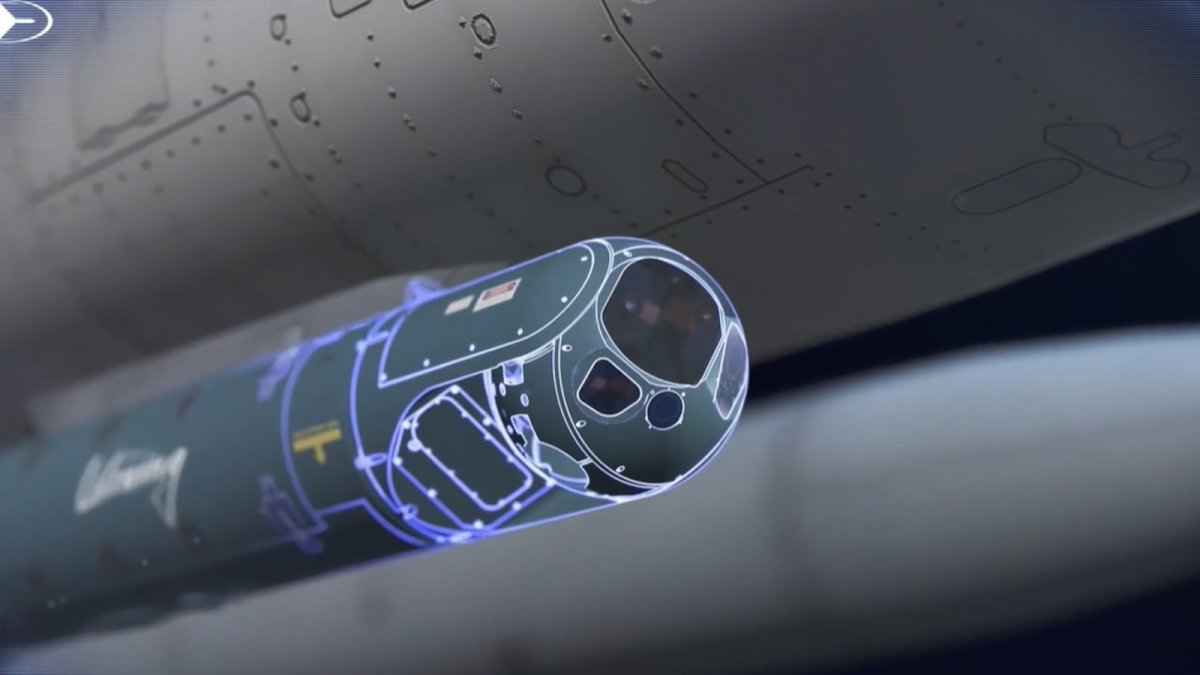
Litening is a targeting pod developed by Rafael Advanced Defense Systems. Northrop Grumman manufactures it in the US in partnership with the Israeli company for branches of the US military and foreign customers.
This long-standing collaboration highlights how Israeli defense technology integrates into American production lines while supporting export customers worldwide.
Technical Role of Targeting Pods
A targeting pod resembles a missile and is mounted on a dedicated hardpoint beneath an aircraft. It is equipped with a camera, additional sensors, and a laser for guiding weapons, allowing pilots and navigators to locate distant ground targets during the day or at night and in all weather conditions.
In recent years, it has also become increasingly important for identifying unmanned aerial vehicles and drones, small aircraft that onboard radars sometimes struggle to detect.
Rafael's Four-Decade Development Path
In an ironic twist, Rafael developed Litening 40 years ago with funding from the Defense Ministry after the US refused to sell the Israeli Air Force its equivalent American system, LANTIRN, long before the era of efforts to achieve greater weapons independence.
Rafael has since developed five generations of the pod, offering improved range and resolution, as well as the option of integrating radar manufactured by Israel Aerospace Industries, in a collaboration between the two competing Israeli defense companies.
After the United States declined to supply LANTIRN systems, Israel's Defense Ministry funded independent development of the Litening pod, creating a domestic alternative that later achieved widespread export success. This history underscores how early Israeli investment in precision targeting technology evolved into a globally competitive product line spanning five distinct generations.
Collaboration between Rafael Advanced Defense Systems and Israel Aerospace Industries on successive Litening versions illustrates rare cooperation between two competing state-linked defense firms. Israeli analysts highlight that joint engineering efforts combined Rafael's electro-optical expertise with Israel Aerospace Industries' platform integration knowledge, strengthening overall pod performance for international customers.
US Military Adoption Since 1996
Since 1996, the Pentagon has purchased 900 Litening pods, which proved cheaper and more effective than LANTIRN. In the US, the system is used by Air Force F-15E, F-16, and A-10 aircraft, Navy F/A-18 fighter jets, Marine Corps Harrier aircraft, and even B-52 bombers and Hercules transport aircraft.
Northrop Grumman reported that the system has an operational availability rate of 95 percent, indicating a high level of reliability across these platforms.
Since 1996 the US military has acquired approximately 900 Litening pods, selecting the system because it delivered lower costs and higher reliability compared with the earlier LANTIRN design. This sustained procurement reflects consistent preference for the Israeli-developed targeting solution across multiple service branches and aircraft types.
The pods equip a broad range of platforms including the F-15E, F-16, A-10, F/A-18, Harrier, B-52, and Hercules, achieving a reported 95 percent operational availability rate. US adoption at this scale validates the technology's versatility and supports continued production lines that benefit both American operators and Israeli manufacturers.
F-35 Integration and Continued Relevance
The F-35 aircraft being purchased by the Air Force, Navy, and Marine Corps are equipped with an integrated weapons guidance system, eliminating the need for external systems such as Litening. The F-35's entry into service raised concerns that Litening would lose an important customer, but the US military will continue using the system on its other aircraft.
Recent International Sales and Upgrades
The contract does not specify how many pods the Pentagon will purchase, which models it will acquire, or whether it will upgrade to the fifth generation of Litening. That version was purchased last year by the German government for Luftwaffe Typhoon aircraft in a deal worth €350 million.
Implications for Israeli Defense Exports
This major US framework contract underscores the strength of Israel's defense technology sector and its ability to compete successfully in the American market through established partnerships like the one between Rafael Advanced Defense Systems and Northrop Grumman.
Israeli companies such as Rafael and Israel Aerospace Industries continue to benefit from sustained demand that supports domestic innovation and employment in the defense industry.
Sustained US demand for Litening pods reinforces Israel's defense export base by generating steady revenue streams that fund further research at Rafael Advanced Defense Systems. Israeli economic observers point out that such contracts sustain skilled employment in high-technology sectors and contribute to the country's overall balance of trade in defense goods.
As a state-owned pioneer, Rafael channels export earnings into domestic innovation cycles while supporting ancillary industries across Israel. Continued American purchases therefore strengthen the broader ecosystem of suppliers and engineers that underpins Israel's strategic defense autonomy and global market position.
Regional Security Context in the Middle East
Israeli defense exports like the Litening pod contribute to broader security cooperation with the United States, reinforcing technological edges that matter amid ongoing regional tensions and the need for precise aerial capabilities.
Such deals also demonstrate how Israeli systems address evolving threats including drone proliferation that affect daily security considerations across the region.
Precision targeting capabilities provided by Litening pods enhance Israeli and US forces' ability to address evolving aerial threats, including drone incursions that have increased across the Middle East in recent years. This technology supports rapid identification and engagement decisions critical to maintaining air superiority in contested environments.
US-Israel defense cooperation through joint Litening programs aligns with wider regional security arrangements that emphasize interoperability among allied air forces. Israeli strategic analysts observe that such collaboration helps deter potential adversaries by demonstrating combined technological and operational readiness across multiple theaters.
Outlook for Sustained Collaboration
The agreement through 2035 provides a stable platform for ongoing production, upgrades, and maintenance that will keep Litening pods operational on multiple US aircraft fleets for years to come.
Israeli industry observers note that continued success in the US market helps sustain the innovation cycle that began with Rafael's early development efforts decades ago.
By Hannah Berg, Staff WriterThis article was produced with AI-assisted research and editorial support. Reporting is based on sources cited in the article.
What's Your Reaction?
 Like
0
Like
0
 Dislike
0
Dislike
0
 Love
0
Love
0
 Funny
0
Funny
0
 Wow
0
Wow
0
 Sad
0
Sad
0
 Angry
0
Angry
0

Israel Correspondent at Global1.News. Based in Tel Aviv, covering Israeli politics, security, technology, and society. Provides balanced, deeply-sourced reporting on one of the most closely-watched regions in the world.














Comments (0)